

Why Your Fireplace Smokes Back Into the Room: Draft Explained
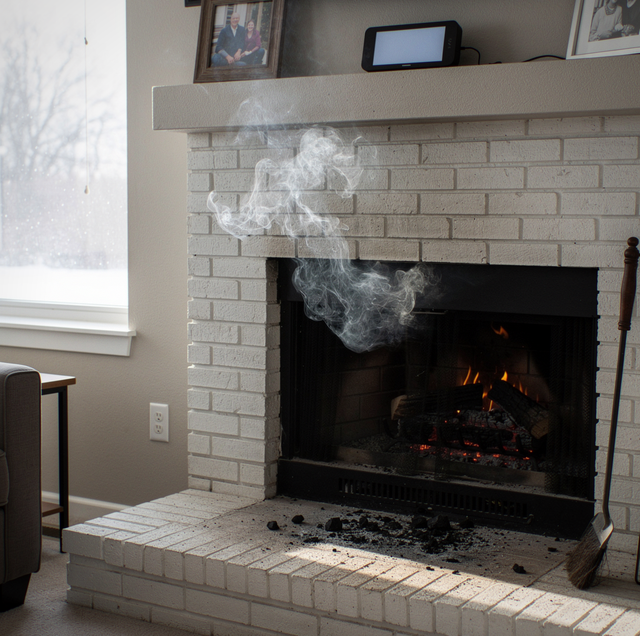
A chimney does not suck smoke out of a fireplace. Nothing inside it pulls. The only force moving smoke upward is a difference in weight: the warm gas standing inside the flue is lighter than the cold outdoor air beside it, and the heavier outdoor air presses that lighter column up and out. That difference is draft, and it is the whole mechanism.
Every smoky fireplace is a failure of that difference. Anything that cools the flue, narrows it, shortens it, or hands the house an easier place to pull replacement air from will weaken it or reverse it. Once it reverses, the flue stops being an exit and becomes an intake.
That matters more than the mess on the mantel. Smoke in a room is combustion gases, and carbon monoxide travels with them. Carbon monoxide is colorless and odorless, so a smoke smell says nothing about how much of it is present, and a room that no longer smells smoky has not been proven safe by that alone. A fireplace pushing smoke inward is a venting fault to diagnose, not a habit to work around.
If a carbon monoxide alarm sounds, or anyone in the home has a headache, dizziness, nausea, or confusion that eases outdoors, get everyone outside first and call emergency services. Do not open a window while keeping it burning.
A Cold Flue Has Not Established Draft Yet
Before a fire is lit, the flue holds air at whatever temperature the surrounding masonry has settled to. In cold weather that column is colder and denser than the room air, so the pressure difference already runs the wrong way. Cold air slides down the flue, over the smoke shelf, through the smoke chamber and the throat, into the firebox, and the first smoke meets a downward current.
This is why the first few minutes decide the rest of the fire. Draft builds only as hot gas warms the liner and the masonry mass around it, and until that column is warmer than the outdoor air, the flue cannot carry gas away reliably. A chimney left cold through a long cold stretch starts from the worst position, and an oversized flue takes longer still. A chimney that downdrafts at every startup is not asking for a better lighting technique.
How the Fire Itself Can Weaken the Draft
Draft depends on the temperature of the gas leaving the fire, so fuel is part of the mechanism. Wood that has not dried carries much of its weight as water, and the fire spends its early energy boiling that water off rather than raising the gas temperature. Flue gases leave cooler, the density difference shrinks, and draft is weakest exactly when the fire makes the most smoke.
Cooler gas leaves deposits: low flue temperature also lets unburned particulate condense on the liner as creosote, so a season of wet wood or slow, air-starved fires narrows the very passage the smoke depends on.
Dry fuel is one contributor to flue gas temperature, not the lever that fixes a draft problem, and it is no reason to keep burning while smoke or odor is unresolved.
When the House Wins the Pressure Contest
Two openings into the same house are always competing, and air coming in takes whichever one costs it the least. Run a range hood, a bathroom fan, and a clothes dryer at once in a tightly built house, and a large volume of air leaves the building every minute. That air has to be replaced. With the windows shut and the shell sealed, the largest and least restricted opening left is often the chimney, so the house draws down the flue and brings whatever sits in it along.
This is the cause most often mistaken for a chimney defect, because the chimney can be in fine condition and still lose. A dryer vents outdoors the whole time it runs, and another combustion appliance drawing on the same indoor air adds to the total. An airtight house has no deliberate opening for make up air.
Stack effect ties this to season. In cold weather, warm indoor air rises and escapes through upper leaks, drawing in replacement air from below. The height at which indoor and outdoor pressure are equal is the neutral pressure plane, and anything opening into the house below it tends to flow inward. A firebox on a lower level often sits below that plane, which is why backdrafting appears in cold weather even when nothing about the chimney has changed.
If the fireplace has smoked into the room, get everyone out of that space first. Once people are clear, open a window or door and switch off range hoods, bath fans, and the dryer. Nothing gets relit before an inspection.
How Flue Size and Shape Match the Firebox Opening
A fire sized to the fireplace opening produces gas at a certain rate, and the flue has to carry that volume away at least as fast. The relationship between the flue's cross section and the area of the firebox opening is a design relationship, not a preference. Where the opening is too large for the flue behind it, surplus gas spills over the top of the opening into the room, on every fire, in any weather.
Geometry counts as much as area. The smoke shelf and smoke chamber gather turbulent gas from the firebox and funnel it into the flue, and a chamber built with rough corbelled brick or an off-center transition creates drag; a correctly formed one does not. An oversized flue causes the opposite trouble, warming slowly and never building a strong column. None of this is something to eyeball; the dimensions and ratios are established by measurement during an inspection, compared with rated specifications and the inspector's on-site records.
Obstruction and Buildup in the Flue
Draft is a function of the available cross-section, so anything that narrows the flue reduces the draft. Creosote and soot accumulate on the liner over seasons of burning and can constrict a flue well before the fire behaves differently. Animals treat an open flue as a sheltered cavity and nest in it, usually in spring, which is why a fireplace that drew perfectly last winter can smoke on the first fire of the next. A chimney cap is the component meant to keep them out.
Structural obstruction is the other kind: shards of cracked flue tile, a displaced liner section, or fallen material lodged in the passage. This is where guessing turns dangerous. A cracked flue or a damaged liner cannot be diagnosed from how smoke behaves in a room, and the firebox should stay cold until a professional has looked.
Chimney Height, Termination, and Nearby Obstructions
Draft scales with the height of the warm column, so a short flue is a weak flue no matter how clean it is. Where the termination ends relative to the roof ridge, and whatever stands nearby, matter just as much.
Wind crossing a roof separates and reattaches in predictable ways, creating zones of higher pressure. A termination finishing too low relative to the ridge, or tucked into the wind shadow of a taller wall, a dormer, or mature trees, can sit inside one of those zones. Wind then pushes down the flue instead of drawing across it, producing a wind-induced downdraft. The tell is intermittency: a fireplace that floods the room only on windy days, or with wind from one direction, is usually reporting a termination problem.
This one often appears years after a chimney worked fine, because trees grow and rooflines change. Height above the roof and clearance from what stands nearby is measured during an inspection and compared against rated specifications, not judged from the ground.
An Unused Flue That Smells with No Fire at All
The odor complaint runs on the same mechanism as the smoke complaint, in the opposite season. Masonry is porous and holds moisture, and a flue lined with years of creosote and soot becomes a strong odor source when that material is damp and warm. Rain and humidity are what set that off, which is why the complaint tracks the weather rather than anything the fireplace is doing.
For that odor to reach a room, the chimney has to be flowing inward. In warm humid weather with the cooling system running, indoor air is cooler and denser than outdoor air, so the stack effect runs the reverse of its winter direction and the flue tends to flow downward all season. Add an exhaust fan, and that flow becomes steady. The result is a sharp, ashy, sour smell, worst on humid days and while the air conditioning runs.
So the two problems bracket the year. An odor with no fire lit is not evidence about carbon monoxide in either direction, since carbon monoxide has no smell at all. What it proves is direction of flow, and inward flow matters if any combustion appliance vents into that structure.
What an Inspection Settles That Guessing Cannot
Reading the pattern narrows the field. It does not close it. Several of these causes produce identical symptoms, and in older chimneys more than one is usually in play. What separates them is measurement, part by part, along the path the gas has to travel.
| Part of the Path | What an Inspection Measures There |
|---|---|
| The firebox opening and the flue behind it | Opening dimensions against the flue's cross section |
| The liner, end to end | Cracked or displaced tile, and how far buildup has narrowed it |
| The termination | Height above the roof, and what stands close enough to throw a wind shadow |
| The house around the fireplace | Room pressure with hoods, bath fans, and the dryer running |
| Every appliance on the structure | Whether each still vents into a flue sized for what it produces |
Until you have those answers, the safe position is a cold firebox. Get people clear of a room that has taken smoke before anything else, keep competing exhaust appliances off, stop lighting fires, and let someone measure what the smoke only hints at.
Frequently Asked Questions
Not necessarily. A home needs an alarm on each level and near the sleeping areas, and an alarm two rooms away can respond later than one in the room itself. Alarms also carry an end-of-life date printed on the housing, past which the sensor is no longer reliable even if the test button sounds.
Because those appliances share the same air budget, and sometimes the same chimney. When a high-efficiency furnace is vented through a sidewall, the water heater that shared the old chimney is left alone on a flue sized for two appliances. That orphaned water heater warms an oversized flue poorly, can spill its own combustion gases, and competes for the same indoor air.
Yes, and it is a common finding in older fireplaces and in fireboxes that were enlarged at some point. Where an inspection finds the opening out of proportion to the flue, one recognized remedy is a smoke guard: a fitted metal band across the top of the opening, lowering its effective height so the flue can carry the smoke it produces.
It can. Where two flues share a stack, the masonry division wall between them keeps them separate. If that wall is cracked, incomplete, or missing, or if the flues finish at unequal heights, gas leaving one can enter the other and travel down into the room the second one serves. The symptom is smoke or odor in a room whose own fireplace sits unused.
Only partly. A throat damper is a cast plate resting in a frame above the firebox, and soot, rust, and warping can cause it to leak even when fully closed, so it slows air movement rather than stopping it. A top sealing damper, installed by a professional at the upper end of the flue, closes against a gasket instead.
Position within the building explains much of it. A chimney running up through the interior is surrounded by heated space, so between fires its flue stays near indoor temperature. A chimney built against an outside wall is exposed to outdoor air on three sides, forms a colder, denser column, and begins every fire fighting a downdraft. That tendency is known as cold hearth syndrome.
Book a fireplace draft evaluation — find out why smoke or odor is entering the room before the next fire. Golden Stones Masonry serves St. Paul and the Twin Cities. Call (612) 509-0718.