
Concrete vs. Block vs. Boulder Retaining Walls: What Fails First
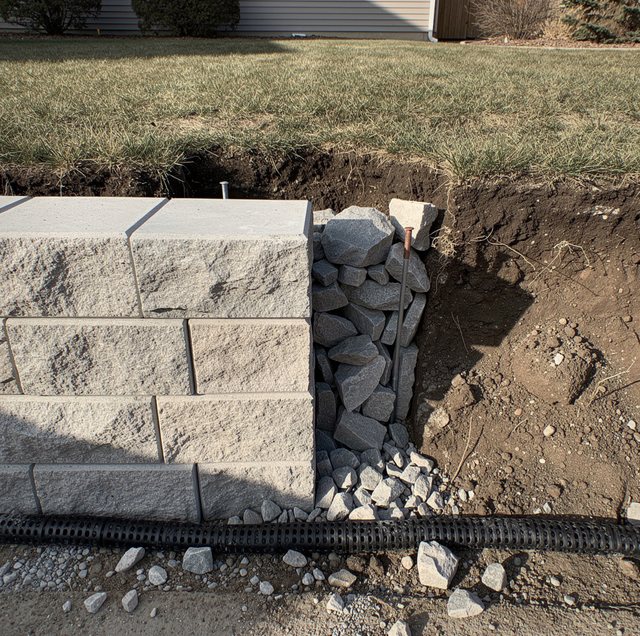
Four feet of drained granular backfill pushes against the back of a retaining wall with roughly 320 pounds of force per foot of wall length. Saturate that backfill and the figure passes 650, because water weighs 62.4 pounds per cubic foot and contributes all of it sideways, without the internal friction that lets soil grains carry part of their own load. That push is the same whatever your wall is made of. Poured concrete, segmental block and stacked boulders answer it three different ways, and they run in that order here because the order is real: each gives up a way of carrying force the one before it had. Poured concrete has continuity and steel; block works on weight, joint friction and a designed grip on the fill; boulders have weight and friction alone. How much water each passes, and what you can put back after one moves, follow from it.
Resisting a Load That Grows With Depth
Soil pressure increases with depth, from zero at the backfill surface to its maximum at the base. Rankine's active earth pressure equation puts the coefficient for clean, well-drained sand at about one third, so backfill weighing 120 pounds per cubic foot adds roughly 40 pounds per square foot for every foot you go down.
A poured concrete wall takes it as one piece. The stem bends about its base as a cantilever while the footing spreads the load onto the soil below, and the footing's heel, the part running back under the retained soil, carries a column of soil whose weight resists tipping.
Segmental block has no footing or bending strength at its joints, so weight and geometry do the work. Each course sets back from the one under it, tilting the mass into the hill and pulling the line of force back over the base. Where the block's own weight is insufficient, geogrid layers between courses extend into the fill, so the face and a wedge of backfill act as a single heavier body.
A boulder wall gives up the grid too, and resists on mass and on friction between irregular faces, so the size of stone you set carries the whole design. Granite runs about 165 pounds per cubic foot, so a two-foot stone weighs on the order of 1,300 pounds and a one-foot stone an eighth of that.
What Each Face Does With the Water
Whatever the face is made of, water behind it is the load that takes walls down.
What prevents it is identical in all three: a column of clean angular stone behind the wall, a perforated pipe at the bottom of it, and an outlet where that pipe reaches daylight or a drain. The outlet is the piece that gets left out, and a drain with nowhere to discharge is a trench holding water against your wall.
Where they separate is in how much the face itself compensates for what the drain misses, and that runs in the same order, since continuity and permeability are one property seen twice. Poured concrete is watertight, which makes it a dam unless weeps are cast through the stem, and a weep drains nothing without stone behind it to feed it. A dry-stacked block wall allows water to pass through every joint on its face, so pressure has a route both forward and downward.
A boulder wall passes more than either, its gaps being open voids rather than tight joints, and that changes what you watch for: water leaving through them carries fine soil, so the concern shifts from pressure behind the face to loss of the soil your wall holds.
What the Base Has to Be
Bearing capacity under a wall runs from dense native ground to fill nobody compacted, and uneven settlement rotates whatever sits on it.
A poured wall spreads its load over a footing whose width is set against the wall height and the bearing capacity underneath, and it sits below the depth at which the ground freezes, which is set locally rather than by any number you can copy.
Damp sand and gravel weigh about 120 pounds per cubic foot, so the cubic yard standing in an open cut behind a wall is roughly 3,200 pounds, and a vertical face shears without warning. Stay out of an unshored cut.
A segmental block wall gets no footing, only a leveling pad of compacted crushed stone in a trench, and the first course set into it is the whole wall. Every block above copies what that course does in both directions: a quarter inch out of level front to back leans every course above by that same quarter inch, and out of level along its length puts a wave in the top of your wall. Boulder walls behave the same way, heaviest stones set lowest and keyed into the ground rather than sitting on it.
Height Changes What the Wall Is
The total push grows with the square of a wall's height, and because that force acts about a third of the way up from the base, the overturning moment grows with the cube. Double the height of your wall, and you have roughly eight times the tendency to tip.
The three reach that point at successively lower heights, in the order already set, because each has one fewer way to answer the growth. A poured wall goes the highest, up to where steel and footing dimensions have to be calculated rather than copied, since concrete's tensile strength is about a tenth of its compressive strength and the bars carry the bending. A segmental wall stops lower where its own mass is no longer sufficient, and a geogrid has to be designed in, each layer extending past the wedge of soil that would otherwise slide. A boulder wall stops lowest, since the one variable you have is stone weight, and weight grows only with the cube of diameter.
Past a certain height, a wall is an engineered structure rather than a yard feature. Where that line falls, and what approval it carries, is set by your local building authority, so ask before your design is settled.
How Each Wall Takes Movement, and What You Can Put Back
Ground under a wall does not hold still. Water in soil expands about 9 percent when it freezes, and the larger movement comes from ice lenses drawing more water to the freezing front and lifting whatever sits above them. Clay does the same without freezing, swelling in a wet stretch and shrinking in a dry one. Every wall gets that input; what changes is how much of it a wall absorbs and how much of it you can undo, which sorts them the same way again. Reading movement in a particular wall is a diagnosis in itself.
A poured wall has no joint to give at. Movement it cannot follow is resolved by cracking, and the crack opens where the section is weakest, which on a cantilever stem is the line just above the footing. Concrete does not knit back together, so that crack is a permanent loss of the continuity the wall held by. Putting a load path back means bonding it, reinforcing the face, or building structure behind it, each a fabrication job on something you cannot take apart.
A segmental wall spends the same movement across its joints. Every course line lets two blocks shift against each other by a fraction of an inch, so a season of heave becomes dozens of small adjustments and your wall can come out of a hard freeze slightly out of line and still be sound. What gives first is the top, where the least weight and the least grid sit. It also comes apart the way it went together, so a leaning section is taken down course by course, backfill and drainage stone rebuilt, geogrid added where none was laid, and the block reset undamaged.
A boulder wall takes movement without cracking and keeps all of it, since nothing is bonded and stones settle and rotate freely. Movement shows first at a base stone, where a point contact carries more than its share, and the stone itself survives, so that boulder lifts out and resets. What makes that harder than a block is that every stone is unique, so it goes back into a socket that has already changed shape, with the stones above it coming off first.
Frequently Asked Questions
Yes, for a different reason. Water leaves through the gaps freely, so pressure has little chance to build, but they let fine soil travel out with it. That movement is called piping, and its voids appear as surface settlement. The control is a geotextile filter between the retained soil and the stone, its opening size matched to that soil's grain size.
Geogrid belongs to systems with continuous horizontal joints, meaning segmental block. It works only in tension, so a layer that is folded, slack, or laid backward carries nothing until it pulls taut, and the roll has a machine direction that must run perpendicular to your wall face. A boulder wall has no continuous joint to clamp a layer into.
That backward lean is called batter, and you do not choose it on site. The setback per course is fixed by the unit itself, by the lip cast into the block's bottom, or by the pin holes it uses, so a near-vertical unit and a heavily battered one are different products. Batter shifts the wall's center of mass back over its base.
The ends are loaded from two directions at once, so each has to be keyed back into the slope rather than stopped flat, or that end panel rotates out before anything in the middle moves. Your poured wall carries a second version: a long pour will crack somewhere as the concrete cures and shrinks, so control joints are cast in and the crack forms in them.
Sometimes, and the spacing between the two settles it. Two terraces behave as independent walls only when the upper one sits far enough back that its load falls outside the soil wedge the lower wall is already holding. Set it closer, and your upper wall becomes a surcharge on the lower one, which then holds its own retained soil plus a wall standing on that soil.
Only past the drainage zone. The column of clean angular stone against the wall, and the pipe in it, stay stone. Farther back, a clay fill takes on water and swells, loading your wall closer to full water pressure than to the drained-sand case it was sized for. Granular fill matters for a second reason: geogrid grips by friction, and clay gives it little to grip.
If your wall has already moved, the question worth answering is what lies behind and beneath it — an on-site read of the base, the drain line, and the retained soil determines whether the wall can be reset or has to come down. Golden Stones Masonry serves St. Paul and the Twin Cities. Call (612) 509-0718.
