

Masonry Contractor in North Branch
10 Years
Workmanship warranty, in writing

Start with the honest part. North Branch sits right at the edge of the radius we work in. Our rule across the whole site is that, beyond about 45 miles from St. Paul, we ask for photographs before scheduling a visit, and this city is on that line. We do go; there is no travel charge, and photographs first is how nobody wastes a morning.
The city itself is an odd shape for masonry. Roughly 209 homes here predate 1940, while the whole of the 1940s produced nothing and the 1950s and 1960s effectively together barely reach 290. Then the 1990s alone added 1,427. Two real building eras with a very thin middle.

What North Branch Homeowners Call Us About
Repointing on the pre-war housing
Roughly 209 pre-war properties, which for a city this size is a real group rather than a handful of survivors. They were laid in a lime mix meant to give way before the brick did, and putting modern mortar into those joints reverses that arrangement.
Chimney crowns on the 1990s and 2000s housing
Roughly 1,427 homes here went up in the 1990s and 1,273 in the 2000s, so the crowns on them are all roughly the same age. At that age, most of them are still worth sealing, which costs a fraction of a recast.
An entry that has shifted
In sand, the question is what spreads the weight and how far down it reaches. Bedded shallow, an entry will settle to a level of its own choosing.
Walls and patios on soft ground
Worth checking in a city with mapped peat in it. Peat compresses under load and keeps compressing, and it is a garden masonry problem rather than a house problem.
Fieldstone and older stonework on the farm properties
A lot of this city was farmland, and some of the older properties have stone worth keeping.
What We Do In North Branch
Split the city into the old village and everything built since about 1990.
Tuckpointing and mortar repair on the pre-war properties
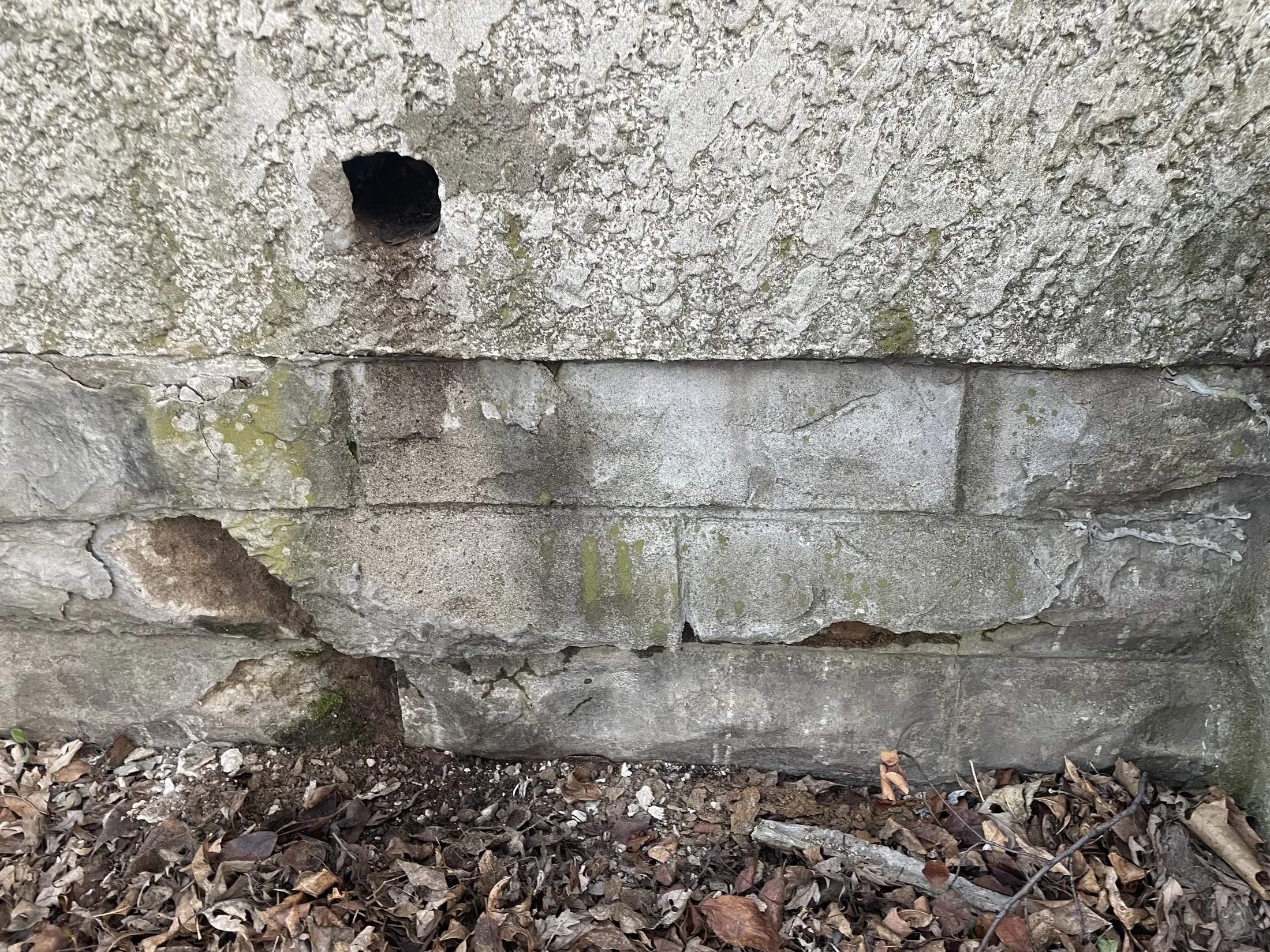
Cutting out the failed joints and refilling them with a mix matched to the wall's age. On nineteenth-century work, getting that decision wrong causes more damage than doing nothing at all.
Stone foundation repair
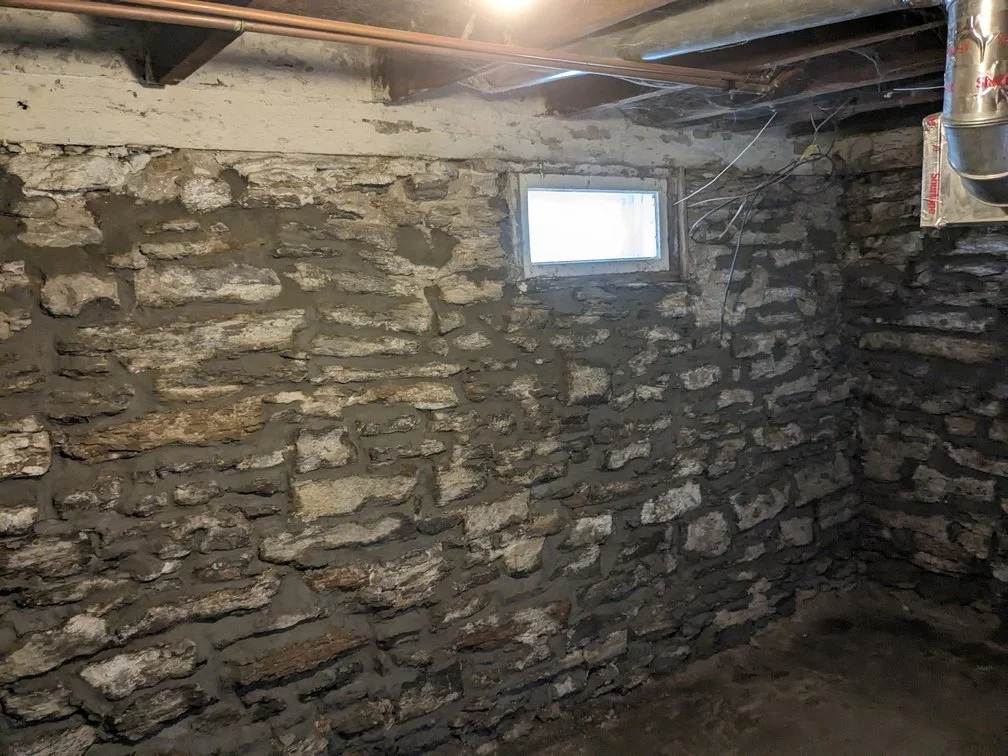
For the village-era properties. Where stones have actually moved, that section comes apart and goes back. Where they have only lost their pointing, it does not.
Chimney crowns and raincaps
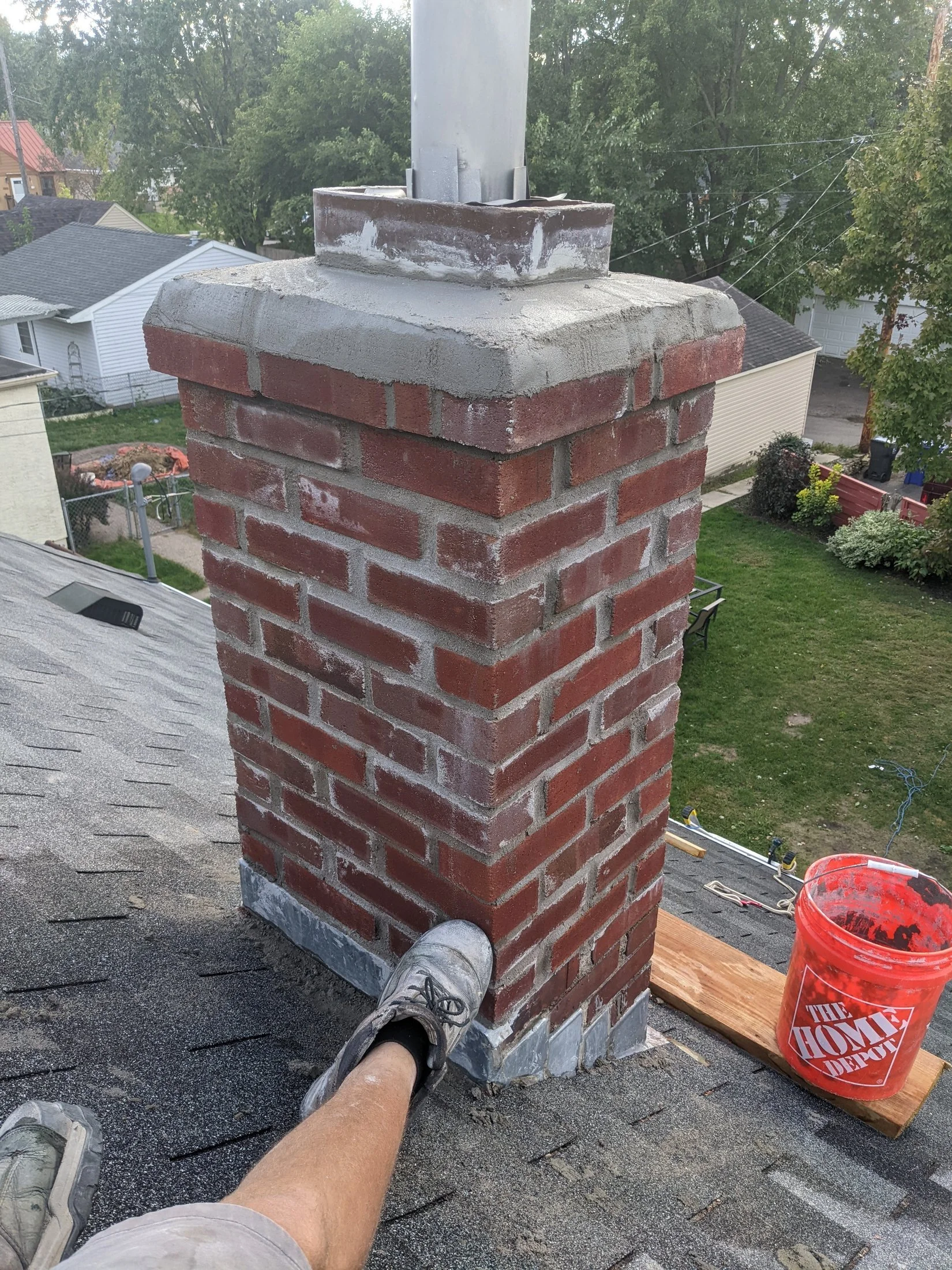
For the recent housing. Hairline crazing with no structural cracking seals for a fraction of a recast, and a cap that has come apart does not.
Chimney repair and rebuild
Two entirely different jobs in one city. On a village-era stack it is soft brick and a soft mix. On a 1990s stack it is almost always the cap and nothing below it.
Steps, stoops and entryways
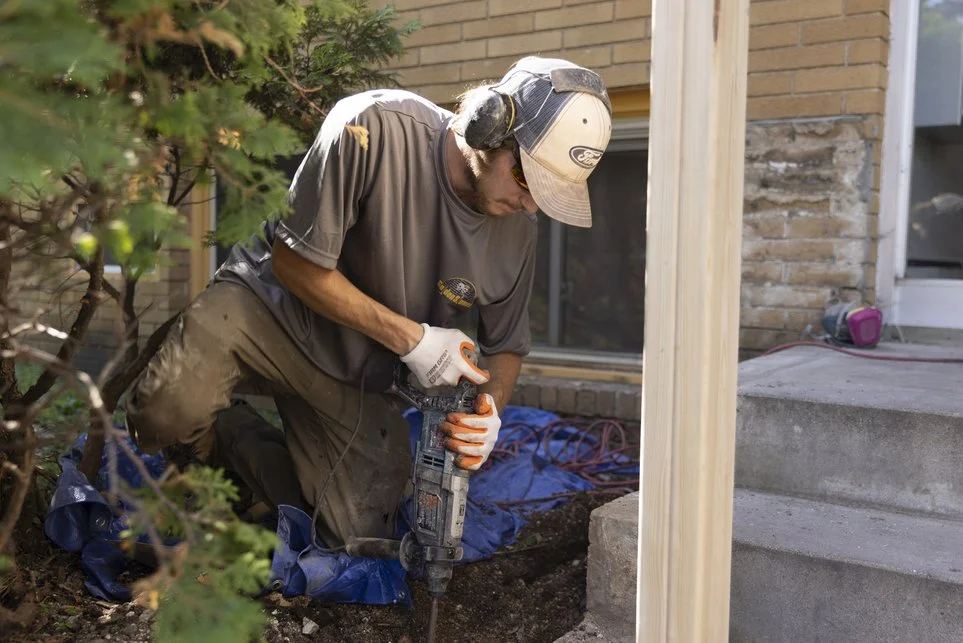
Rebuilt over a footing carried beneath the freezing depth, sitting on a base wide enough to spread the load across sand.
Retaining walls and garden walls in natural stone
Dismantled, foundation and drainage sorted, then rebuilt from what has survived. Interlocking block is not something we handle.
Fieldstone work on the farm properties
Field-gathered stone, rebuilt in what is already on the land. Out here, that usually means a wall or a foundation somebody put up out of what came off the ground when it was cleared.
Brick repair on the older walls
Spalled units and failed lintels, matched as closely as the age of the wall allows.
A One Square Mile Village Inside A City Of Forty
The incorporation record explains the housing curve almost exactly. North Branch was first incorporated as a township of thirty-six square miles in 1861. In 1901 the built-up center separated itself out as the Village of North Branch, one square mile, leaving the surrounding thirty-five as Branch Township. The two ran separately for most of a century. Voters approved consolidation in 1994.
Underneath, this is lake sand, and there is a great deal of it. County mapping and state well logs disagree by a factor of three on how deep the rock sits, with estimates ranging from roughly 120 to 360 feet. What that argument settles is that nobody digging here will ever meet it.
The thing that does matter sits nearer the surface. Peat and muck are mapped across the northwest quarter of the city, and peat is soft, compressible, and does not stop compressing under load. It is no threat at all to a house on designed footings. It is very much a threat to a garden wall or a patio if somebody sets on whatever happens to be there.

What It Costs
No travel charge, even at this distance, and no minimum job size.
Published starting points, which is all they are. Chimney repair on a single-story house, $3,500. A recast crown, $5,500. Tuckpointing a small area, $2,800. Minor brick replacement, $1,500. A rebuilt section of stone foundation, $3,200. Steps, $7,500 to $11,500.
At this range, pictures before anything else serve us both. If what arrives makes clear the work is not ours, you get told that on the phone, along with somewhere better to call, instead of losing a morning to hearing it in person.
Every one of those figures depends on square footage and on what we find when we look. They are rough guides to help you decide whether to call, not quotes. The exact number comes after the visit, and the visit is free.

What Customers Say
No review anybody has left us names North Branch. What appears below is the live Google feed, not a testimonial we picked out, so it shows whatever is genuinely on it.
Google review, September 2025Tell us what is going on with your masonry
Tell us what you are seeing and attach photos if you have them. Sam comes out himself, and you get the options priced in writing. No charge either way, and no service call fee.
Common Questions In North Branch
Yes. Forty-five miles from St. Paul is roughly the edge of where we work, and North Branch sits on that line. The drive is not billed, and neither is the estimate. What we do ask for is a photograph or two beforehand, because a fruitless trip out here costs you a morning as well as costing us one.
If it predates 1940, it very likely came out of the village rather than the township, because the village was one square mile until 1994 and everything around it was farmland. There are about 209 houses in the city that old. Tell us the build year and the address, and we can usually work it out between us.
Because the village was small and it was not growing. It stayed roughly one square mile from 1901 until the consolidation in 1994, and the modern city arrived afterwards. That is why the median build year for North Branch, 1995, describes almost none of its actual housing.
Somewhere between roughly 120 and 360 feet, and we will not narrow it further because the sources genuinely disagree. County mapping puts it near 280 feet at the city center, while individual well logs within a mile record 116 to 201 feet. Either way, it is nowhere near anything anybody would dig for masonry, which is the only part of it that affects you.
No, and it is worth saying because people assume otherwise. A footing up here is taken to exactly the depth it would be in St. Paul. Latitude does not move the frost line.
It stops the exterior mortar work, here and everywhere else. Interior foundation and fireplace work carries on. What the winter really changes at this distance is that we are less willing to make the drive on a maybe, so photographs matter more between December and March than they do in June.
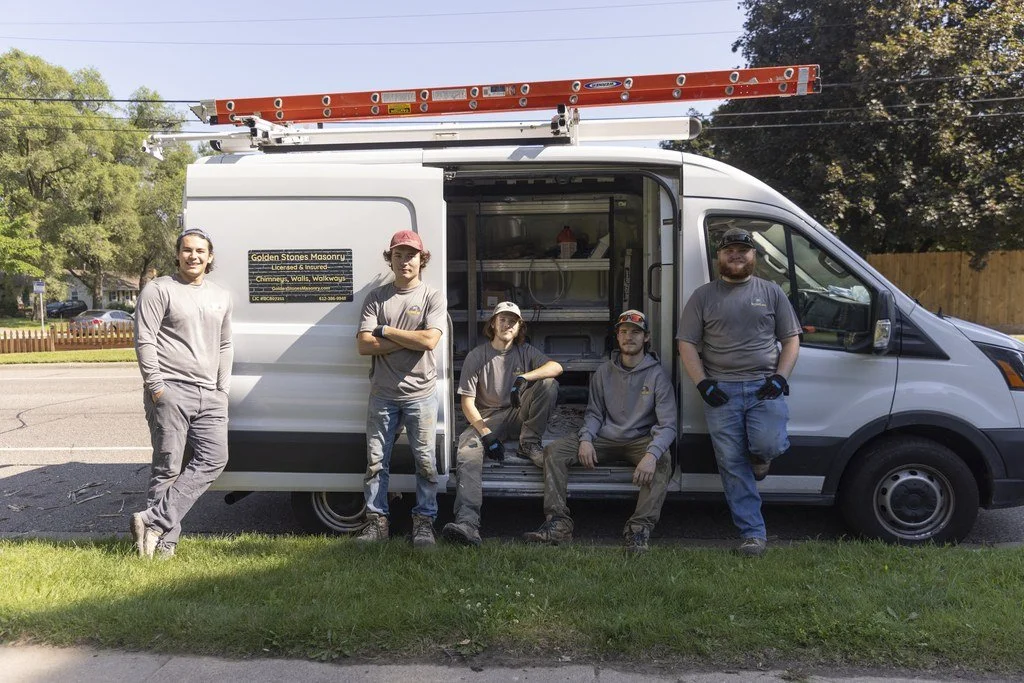
Photographs and the build year, by phone. Sam is the one who looks at them and drives out, so the answer you get comes from the man who would do the work.
Get A Free Estimate In North Branch
Two or three photographs and an approximate build year. At this range, that is not us being awkward. It is how we avoid billing you for a drive-by, wasting your morning instead.
For a pre-war building, get one shot close enough that the mortar joints are readable. On a wall that age, the joints tell us the era, the mix, and roughly how much of it has gone, none of which a photograph of a 1990s wall would show.
(612) 509-0718 · No travel charge, no minimum job size · In-person estimate at no charge