

Masonry Contractor in Wayzata
10 Years
Workmanship warranty, in writing

Wayzata was platted in 1854, and it still has 111 houses older than 1940. It also built 786 housing units between 2010 and 2019, which is a third of all the housing standing in the city.
Not many places hold both of those at once, and it means the masonry question here is answered almost entirely by the year. There is a small quantity of genuinely old work, a modest post-war layer, and then a very large amount that is barely out of its warranty. What all of it shares is the ground underneath, which in the middle of town is not natural ground at all.
Downtown Is Built On Filled Ground
The city's own environmental assessment for the Lake Effect project says it plainly. The majority of the area it studied is postglacial organic deposits, largely drained and filled over the past hundred years. The soil survey classes most of it as Udorthents, which is the term for ground that people put there.
The water is the other half of it. The same document places groundwater at zero feet along the lakeshore, at seven to ten feet below grade in the highest parts of the site, and at around five feet at the highest point of the Bushaway Road parcel. A well drilled in 2012 found water two feet below grade. Lake Minnetonka's normal high water level is 929.4 feet above sea level, and downtown sits about 10 feet above that.
Filled organic ground with water a couple of feet down is not a reason to worry about a house, which goes on designed footings and gets inspected. It is a reason not to assume anything at all about what a garden wall, a patio or a set of steps is bearing on, because in this part of town the honest answer is that somebody put it there and the record of what they used is thin.
Away from the middle it changes twice more. The state atlas maps Villard till, a loam, on the north-central upland, and Twin Cities outwash, gravelly sand, on the west side, which is the only ground in the city the state rates as worth quarrying. So a small city holds three genuinely different foundations. Bedrock is St. Peter Sandstone well over a hundred feet down, and there is no outcrop mapped anywhere near here.

What Wayzata Homeowners Call Us About
A patio or terrace that has dropped unevenly
The most likely thing to go on filled ground with water close beneath it. What is under the stone decides this, and on made ground nobody knows what that is until it is opened.
Repointing on the pre-war buildings
About 111 properties here predate 1940, and they are outnumbered by houses built since 2010 by close to seven to one. That gap is the story of most of the masonry in this city. The older buildings were bedded in a soft lime, designed so the joint is the part that fails first and gets replaced. Put a hard modern mortar into those joints and the design inverts. Now the brick takes the movement, and brick does not recover.
Steps and entries that have moved
Ground that was filled settles for a long time afterward, and anything bedded shallow rides it.
A retaining wall on a lakeward slope
Wayzata falls toward the water, and a good deal of what holds those grades back is masonry. The drainage behind a wall matters more here than the stone in front of it.
Chimney work on the recent housing
With 786 units built in the 2010s, most of this city's chimney tops are barely into their second decade. A failed crown at that age is unusual enough that we would want to know why before quoting a replacement.
What We Do In Wayzata
Genuinely split three ways, because the city is. The old buildings, the post-war layer, and the recent construction want different things.

Tuckpointing and repointing on the pre-war buildings
Matched to the brick of the period, which means a mix softer than anything a modern spec sheet would suggest. It is the decision most often mishandled on old walls, and mishandling it causes damage nobody can take back.
Stone foundation repair
For the pre-war buildings. Where individual stones have shifted out of line, that section is taken apart and reset. Where the wall has only lost its pointing, it has not.
Brick veneer repair and wall tie replacement
For the post-war layer, about 380 houses from the 1950s and 1960s. Corroded fixings behind a veneer let the wall lean away from the house, and no amount of repointing brings it back.
Patios, terraces and walkways in natural stone
Lifted, a base built underneath that will carry the load and move water away from it, then relaid. On filled ground, the base is the entire job.
Retaining walls and garden walls in natural stone
Taken down, the footing and the water path corrected, rebuilt from the stone worth keeping. Interlocking block is a separate trade, and we can point you at one.
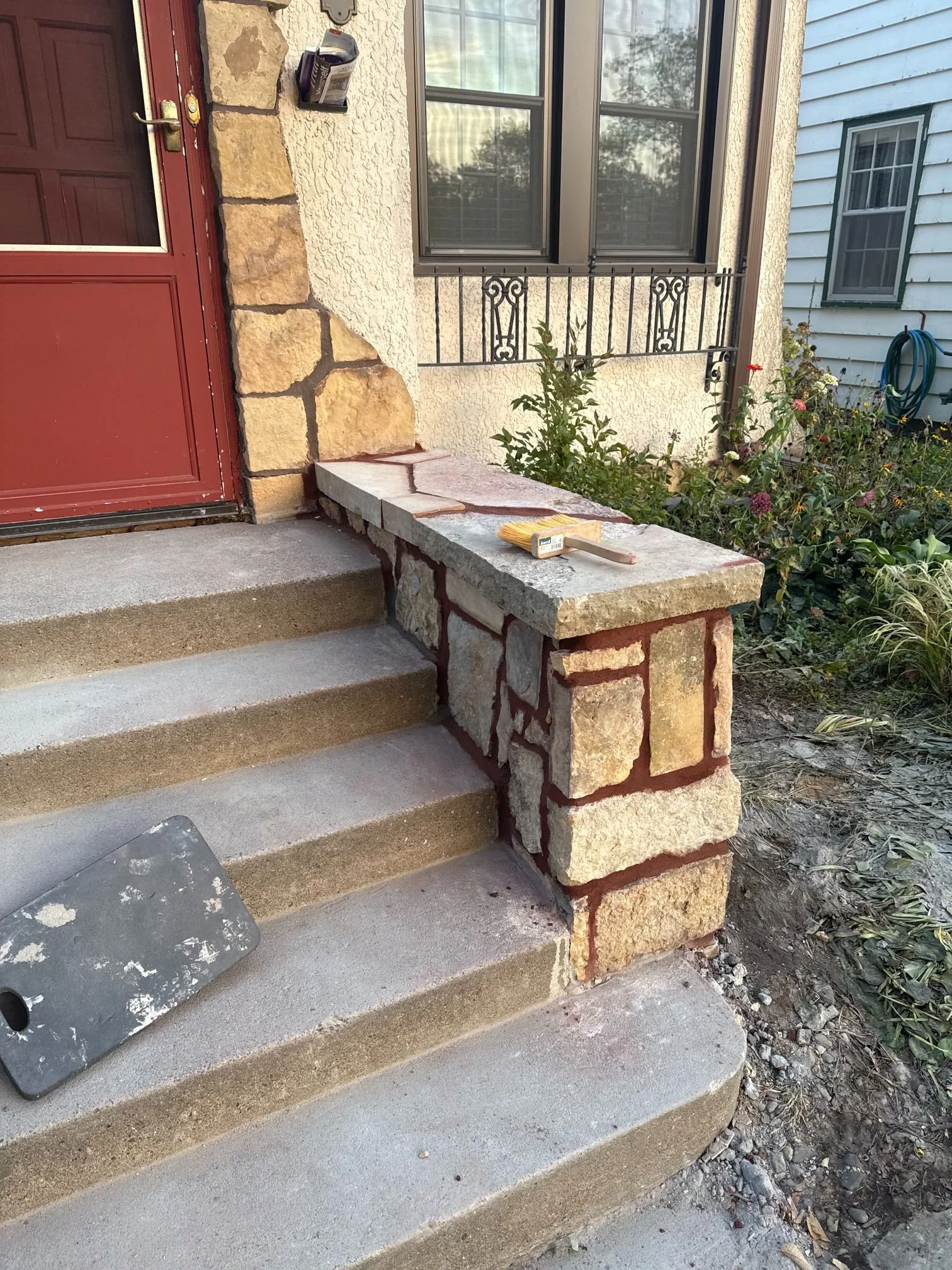
Steps, stoops and entryways
Rebuilt on a footing carried past frost onto something that will actually bear. On made ground, finding that takes longer than the building does.
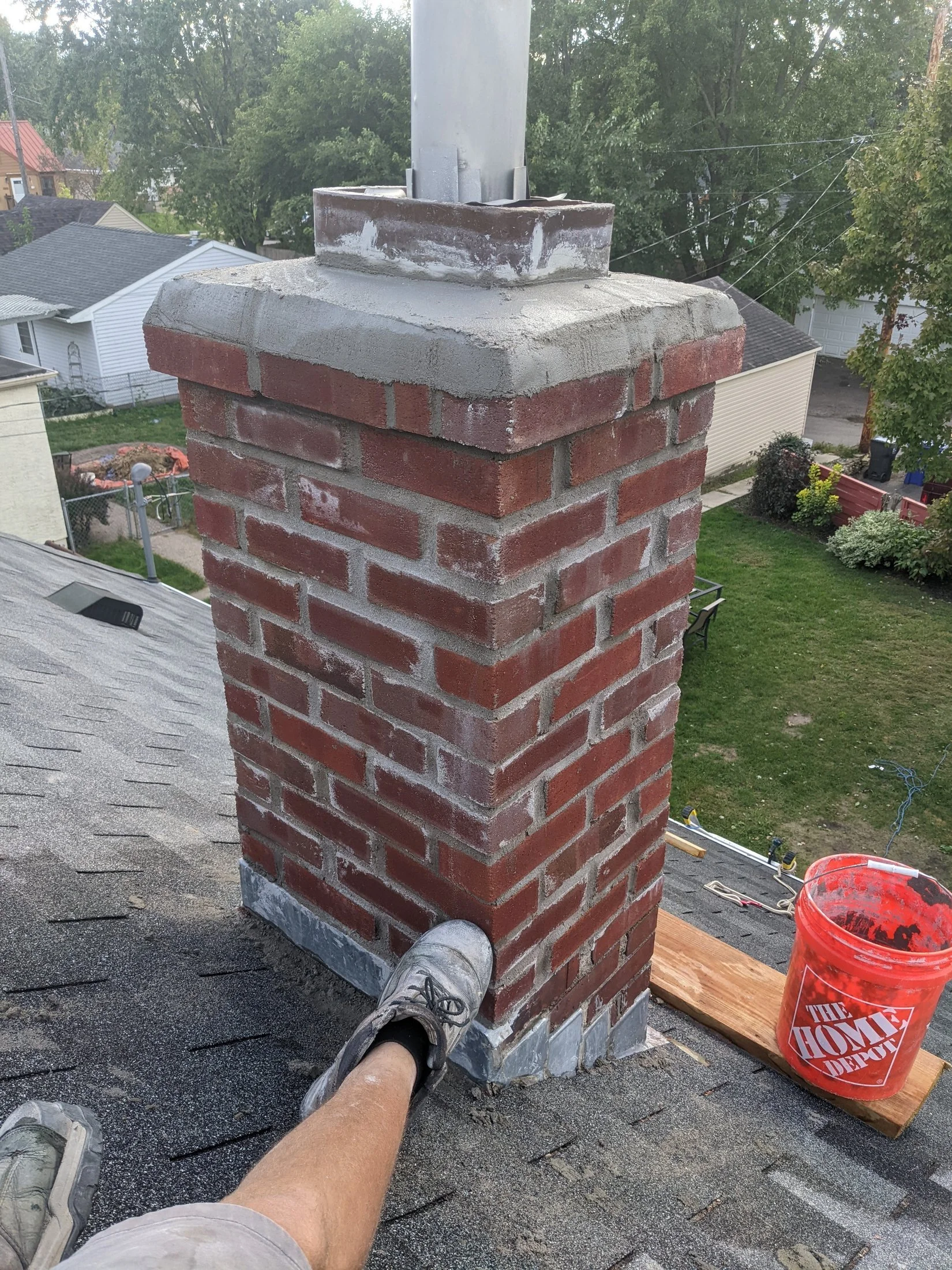
Chimney crowns and raincaps
On the recent housing, where sealing a sound cap is usually the right answer and costs a fraction of a recast.
Chimney repair and rebuild
Soft brick discipline on the old buildings. On the new ones, the trouble is almost always confined to the top.

What It Costs
No travel charge, and no minimum job size.
Tuckpointing a small area begins at $2,800 and minor brick replacement at $1,500. A rebuilt section of stone foundation begins at $3,200. Chimney repair on a single-story house begins at $3,500 and a recast crown at $5,500. Steps run $7,500 to $11,500.
Patios, terraces and walls get no figure, and in the middle of this city, that is not caution; it is the situation. Nobody can price what a thing is bearing on when the ground it sits in was placed there by somebody else, and the record of what they used is thin. Those are quoted once we have opened it, and opening it costs nothing.
Every one of those figures depends on square footage and on what we find when we look. They are rough guides to help you decide whether to call, not quotes. The exact number comes after the visit, and the visit is free.

What Customers Say
No review anybody has left us names Wayzata. What appears below is the live Google feed, not a testimonial we picked out, so it shows whatever is genuinely on it.
Google review, September 2025Tell us what is going on with your masonry
Tell us what you are seeing and attach photos if you have them. Sam comes out himself, and you get the options priced in writing. No charge either way, and no service call fee.
Common Questions In Wayzata
Probably very little, and that is the honest answer for a third of this city. The one thing worth checking is the crown on top of the chimney, because it goes first regardless of how well anything was built. Ground-level work is the other, and only because of what it may be sitting in.
That somebody drained organic ground and put material on top of it, mostly over the past century, and the soil survey records that rather than describing what is down there. For your house, it means nothing, because it was founded for the conditions and inspected. For a patio or a wall, it means the base is doing all the work, and nobody can tell you what it is standing on from the street.
Close, in the middle of town. The city's own assessment puts it at the lake surface along the shore and seven to ten feet down on the higher ground, and a well drilled in 2012 hit water two feet below grade. That is a reading from specific sites rather than from your garden, and we will not pretend otherwise.
Yes, and it is the decision that matters most on a wall that age. Lime mortar was meant to be the part that gives, which is why it is cheap to replace and the brick is not. Fill those joints with a modern mix, and you invert that: the wall still moves, but now the movement comes out through the faces of the units, and a brick that has lost its face is replaced rather than repaired.
We do masonry: walls, steps, terraces, chimneys and foundations. What we do not do is shoreline work, docks or riprap, and it is better said here than after somebody has driven out. Ring us anyway, and we will hand you a number.
Interior and fireplace work runs right through it. Exterior mortar is weather dependent, and we will say which side your job falls on rather than putting it in the diary and canceling.
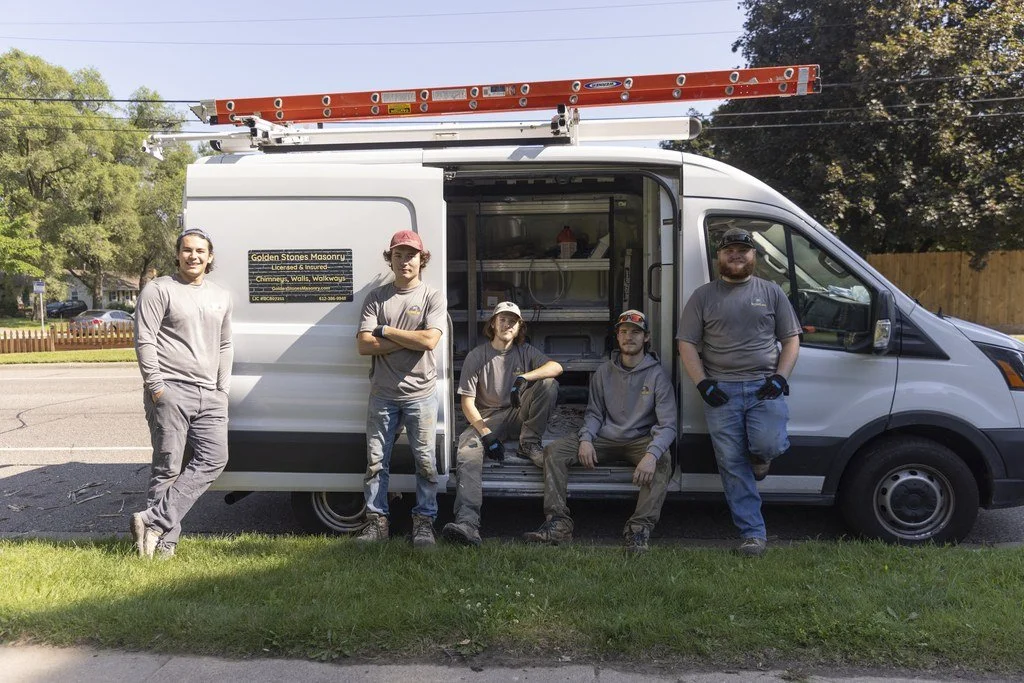
Get A Free Estimate In Wayzata
Tell us roughly when the building went up before anything else. In Wayzata, that one number sorts the work almost completely because the city spans three distinct building eras with very little in between.
If it is one of the older buildings near the lake, get the camera close enough to read the joints. At that age, the mortar tells us more than the brick does: what it was mixed with, how much of it is still there, and whether somebody has already been in with the wrong bag.
(612) 509-0718 · No travel charge, no minimum job size · In-person estimate at no charge