


Masonry Contractor in Bloomington
10 Years
Workmanship warranty, in writing

Bloomington's median house was built in 1972, and that number is misleading enough to be worth correcting straight away. The city was built in two waves, and the median lands in the gap between them.
16,859 Bloomington homes were built between 1940 and 1969. That is the second-largest post-war housing stock anywhere in our service area, behind only Minneapolis. Another 53.8 percent went up from 1970 onwards. Which of the two eras your house belongs to decides almost everything about what your masonry needs.
Veneer Ties Before 1970, Crowns and Stoops After
The first half, roughly 1940 to 1969, is 42.9 percent of the housing, and it is brick veneer over a timber frame. Those houses are now between fifty-seven and eighty-six years old, which is exactly the age at which the metal ties holding the brick skin to the frame have rusted enough to matter.
The second half, 1970 onwards, is 53.8 percent, and much of it is barely masonry at all. What it does have is chimneys, crowns, front stoops, brick accent panels and retaining walls, and those are now anywhere from six to fifty-six years old, which is their own moment of arrival.
A geological line runs through here too. The mapped edge of the limestone that underlies older Minneapolis passes near this city, and south of it the stone is absent or too deep to have ever been quarried. Put plainly: the stone-foundation work that fills our week north of here is largely not a Bloomington phenomenon, and a masonry company that tells you otherwise is reading from a template.
Only 3.3 percent of Bloomington's housing predates 1940, about 1,293 homes. They exist, and we work on them. They are simply not the city's story.

What We Get Called About Here
A brick front that has started to belly outward
The post-war veneer problem, and Bloomington has the second-largest stock of it in our area. The ties rust, the wall moves, and it is visible from the corner of the house long before it is visible from the street.
Cracked brick above a window, a door, or the garage
A corroded steel lintel lifting the masonry that sits on it. It is a detail of this construction era, and it arrives on a predictable timetable.
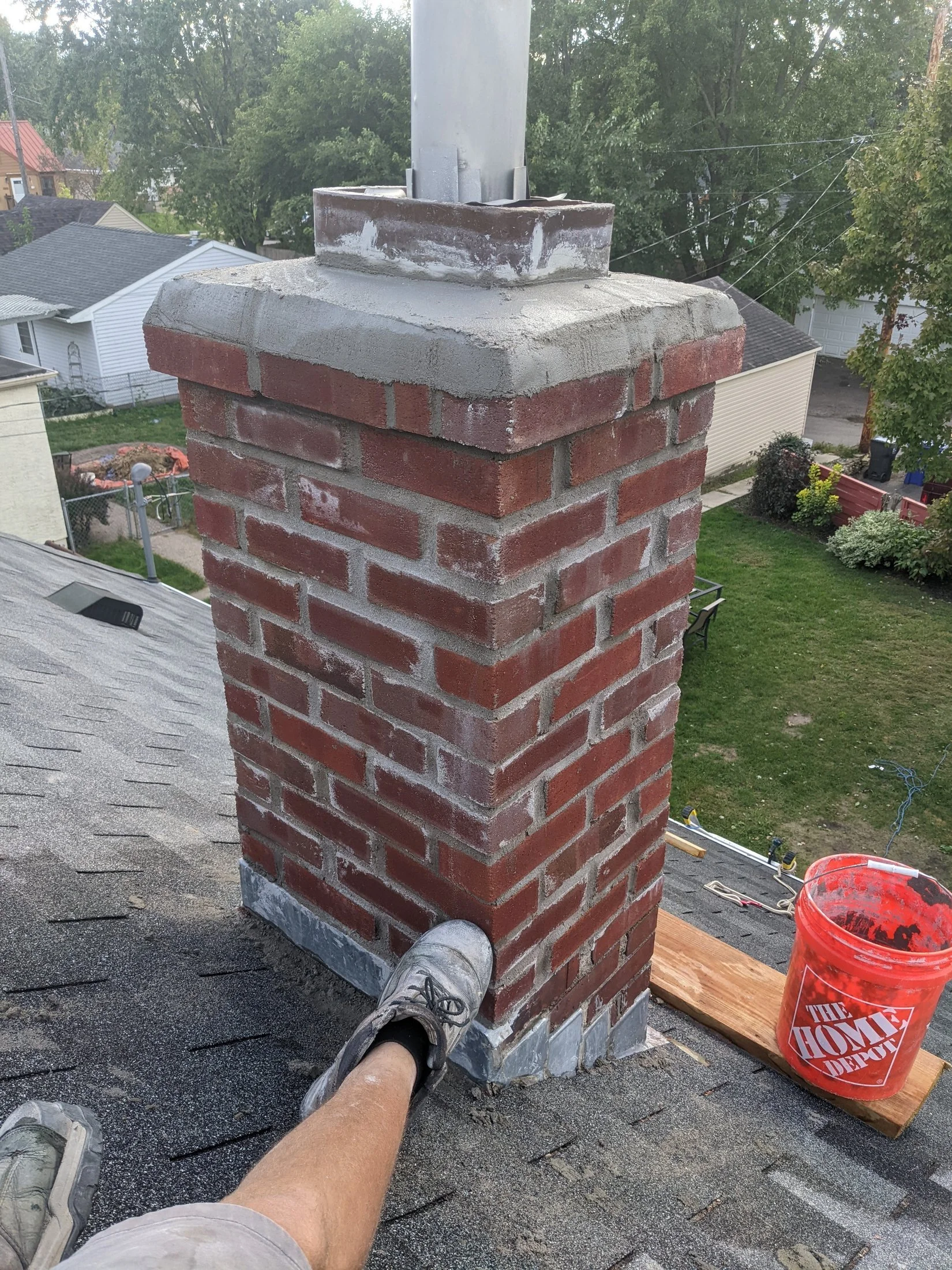
A chimney crown that is cracked or has been caulked
On both halves of the city. A 1950s stack and a 1985 stack are both now well past the point where the crown should have been looked at, and caulk over a cracked crown is what we tend to find has been done instead.
A front stoop or steps that have moved
Extremely common in the 1970s and 80s housing, where entries were frequently set on compacted fill rather than on footings taken below the frost line.
A retaining wall leaning forward
The later subdivisions are full of them, and a wall built as a garden feature, holding ground it was never designed to hold, announces itself after enough winters.
What We Do In Bloomington
Written for Bloomington's two housing eras. A job on a 1955 rambler and the same-named job on a 1985 house are different work, and these descriptions say which is which.

Brick veneer rebuild after wall-tie failure
This is a first-half service. If your house is from the 1950s or 60s and the front has started to move, this is what it is. If your house is from 1985, it almost certainly is not, and we will say so before anybody prices anything.
Lintel replacement
One of the few things on this list that applies across both of Bloomington's building eras, because steel angle over an opening was standard from the 1940s right through the 1980s. Age decides how far along yours is. Everybody has one.
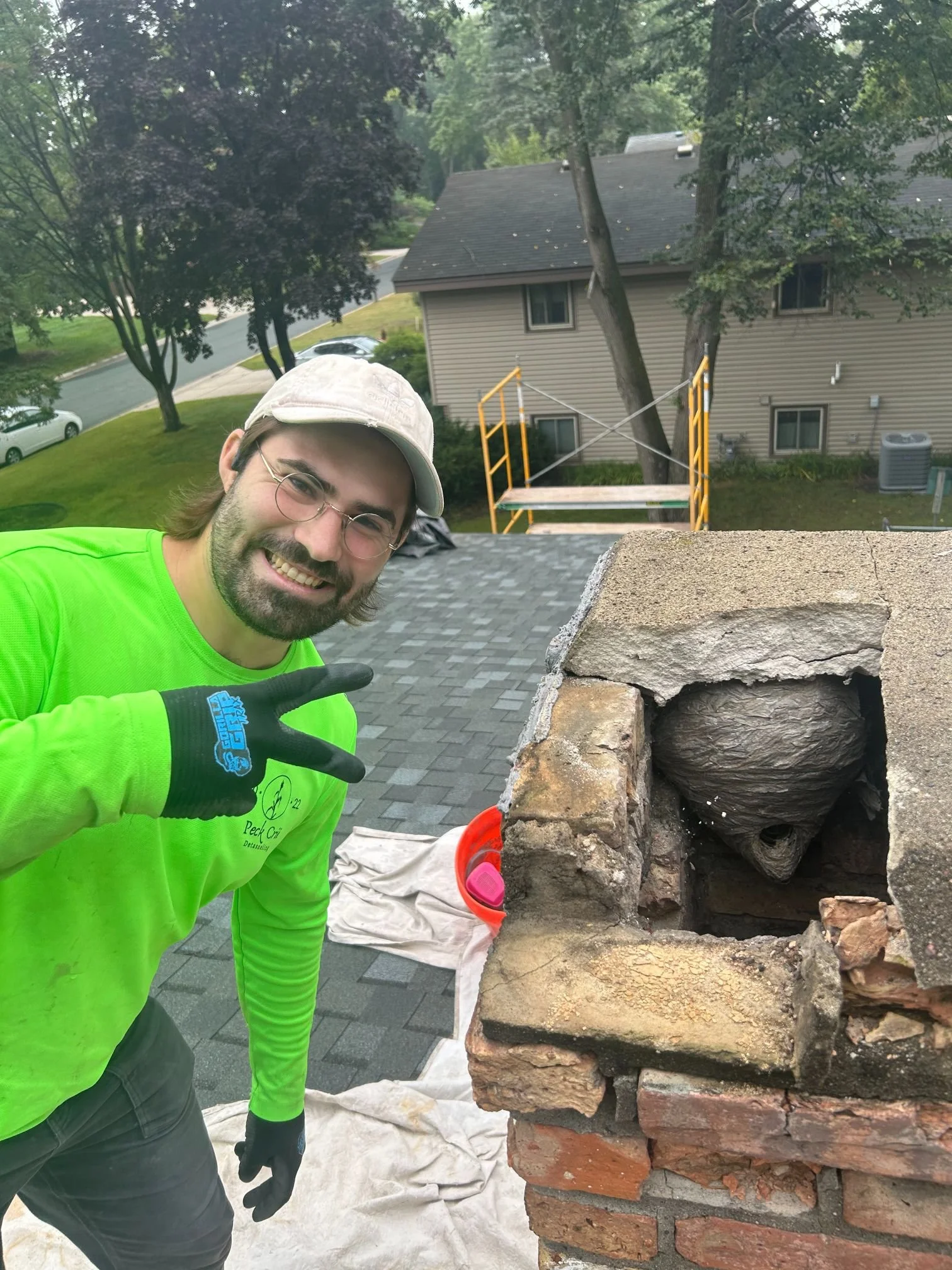
Chimney crown rebuild, sealing and raincaps
The most evenly distributed job in the city. A 1955 crown and a 1985 crown are both now past the point where somebody should have looked, and the difference between sealing one and rebuilding it is whether the concrete is still intact.
Front stoop and step rebuild
Weighted heavily to Bloomington's second half. The subdivisions built here in the 1970s and 80s produced a great many entries on compacted fill, and they are all converging on the same point.
Stone and boulder retaining wall repair
Almost entirely a second-half service. Bloomington's later housing sits on ground that was reshaped to build on in a way the post-war housing was not, and walls built as landscaping, doing a retaining job they were not designed for, are the ones that walk. Natural stone only, so if yours is modular block, we are the wrong company.
The pre-1940 minority
About 1,293 Bloomington homes were built before 1940. That is three percent of the city, and it is a different trade: soft brick, lime mortar, possibly stone below grade. If yours is one of them, say so when you call, because everything above is describing somebody else's house.
Tuckpointing where it is genuinely needed
Fewer in this city need it than need the services above, and we will tell you if repointing is not your problem.
Bloomington Publishes Its Own Salt Numbers
Bloomington carries more road in the Nine Mile Creek watershed than any other single city on the plan's own accounting: 384 lane-miles, 33 percent of the total, and 692 tons of chloride a year. The watershed's chloride plan puts the city under a 62 percent reduction requirement, and Bloomington is Smart Salting Level 2 certified, runs brine, tracks salt with calibrated on-truck software, and has an adopted chloride management plan.
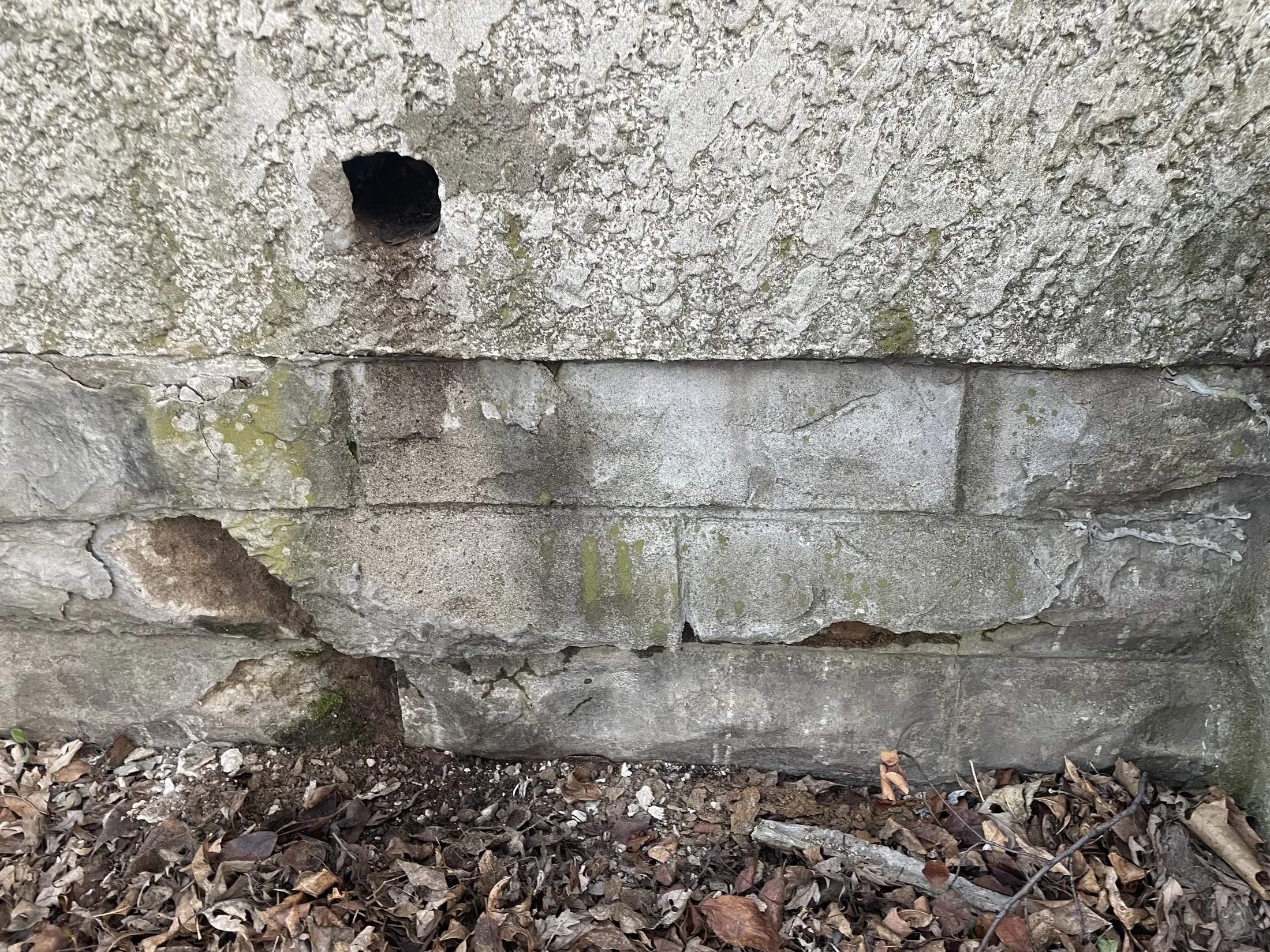
We mention it because it is unusually well documented here and because it explains something you may have noticed on your own property. Deicing salt destroys brick and stone at ground level faster than weather alone does. The bottom two or three courses beside a salted driveway or path are frequently a decade ahead of the rest of the wall.
The city's road salt does not damage your house. What sits on your own driveway does. It is worth repairing early, and it is one of the few places where sealing actually does something.

What It Costs
Nothing on this page is priced differently because it is Bloomington, and the drive is our problem.
The published numbers that apply most often here are $3,500 or more for chimney repair on a single-story house and about $5,500 for a crown rebuild, since crowns are the job this city has the most of. Minor brick replacement starts around $1,500. Veneer elevations, stoops, and retaining walls are priced at the visit because the variation on those is too wide to publish honestly.
Those are starting points and not quotes. Free in-person estimate, and Sam does it.
Every one of those figures depends on square footage and on what we find when we look. They are rough guides to help you decide whether to call, not quotes. The exact number comes after the visit, and the visit is free.

What Bloomington Customers Say
We have worked in Bloomington, and nobody has mentioned the city in any review, which is a gap, not a story. The live Google feed goes here, and you can read whatever is in it.
Google review, September 2025Tell us what is going on with your masonry
Tell us what you are seeing and attach photos if you have them. Sam comes out himself, and you get the options priced in writing. No charge either way, and no service call fee.
Common Questions In Bloomington
Probably, if it has brick on the front. From the war onwards, almost all residential brick in this metro is a veneer over a timber frame. Structural masonry stopped after the war. What that means, practically, is that the thing that eventually fails is the metal ties in the joints.
The median is genuinely unhelpful here, because the city was built in two waves and 1972 falls between them. Roughly 18,000 Bloomington homes predate 1970. If yours is one of them, the median is describing somebody else's house.
Unlikely. Bloomington sits near the buried southern edge of the limestone that gave Minneapolis its stone foundations, and only about 3 percent of the city's housing predates 1940. If you have stone, you have something unusual for this city, and we would want to see it.
Worth looking at, and usually fixable. Steps set on fill move with the frost. Steps on footings dug to depth do not. What decides the cost is whether we are resetting treads or excavating and starting again underneath.
No. Natural stone and boulder only. If you want a segmental block system, that is a different company, and we will say so on the phone, before anybody books a visit.
No. No travel charge anywhere in our service area, and no minimum job size.
Get A Free Estimate In Bloomington
Tell us roughly when the house was built when you get in touch. On a Bloomington property, that single fact tells us more than a description of the damage does.
Photographs of the elevation from the corner, and of anything specific you have noticed, get us most of the way before we arrive.
Call (612) 509-0718 · Free in-person estimate · 10-year workmanship warranty