

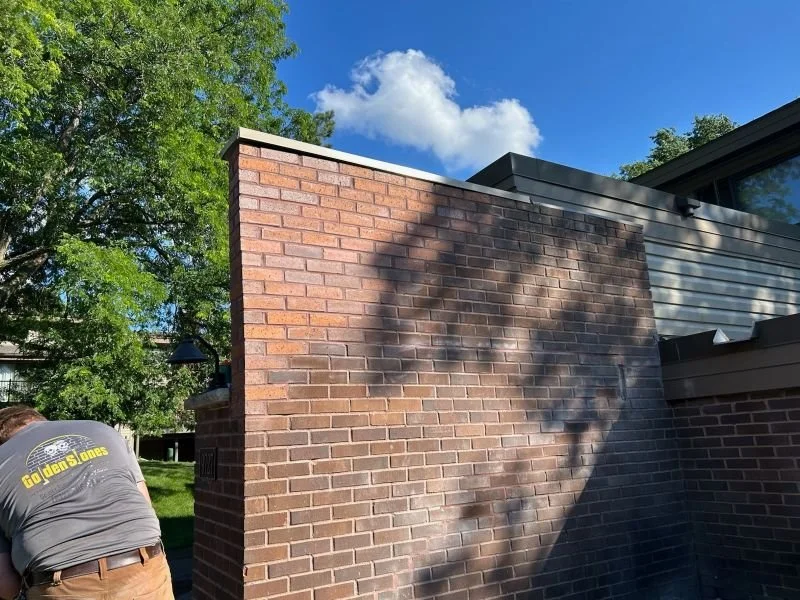
Masonry Contractor in St. Louis Park
10 Years
Workmanship warranty, in writing

6,108 homes in St. Louis Park were built in the 1950s and another 3,042 in the 1940s. Between them, that is more than a third of everything standing in the city, put up inside twenty years.
It matters because masonry from that period fails in one particular way, and it is not the way older brickwork fails. A house from 1952 usually has a brick face hung on a timber frame, tied back with metal fixings buried in the joints. Those fixings rust. When they go, the wall starts to lean away from the house it is supposed to be attached to, and no amount of repointing will bring it back.

What St. Louis Park Homeowners Call Us About
A brick front that has begun to bow out from the house
Rusting wall ties, and this city has the housing age for it. The steel fixings behind a post-war veneer swell as they corrode, pushing the brick outward. It shows up as a bulge you can see by sighting along the wall from the corner, and it is one of the few masonry problems that genuinely get worse quickly once they start.
A steel angle over a picture window that has lifted the brick above it
Wide openings were popular in the housing of this period, and the steel spanning them is now seventy years old. Corroded steel takes up more room than sound steel, so the courses above it lift and the joint line goes crooked.
A chimney stack that has been repointed once and never looked at again
Common on a house that has had four or five owners. The joints get done because they are visible from the ground. The crown on top, which is the part that actually keeps water out of the stack, gets left.
Mortar going soft on the pre-war houses
About 2,361 homes here predate 1940, so this is a real part of the city rather than a curiosity. Those walls were laid in softer mortar, and they want repointing in kind, not in something harder than the brick.
A front step or stoop that has parted company with the house
Houses here were founded properly. The step beside the front door frequently was not, and seventy winters is long enough for that difference to show.

What We Do In St. Louis Park
This city gets close to our full list, which is unusual for a suburb. That is entirely down to the age of the housing.
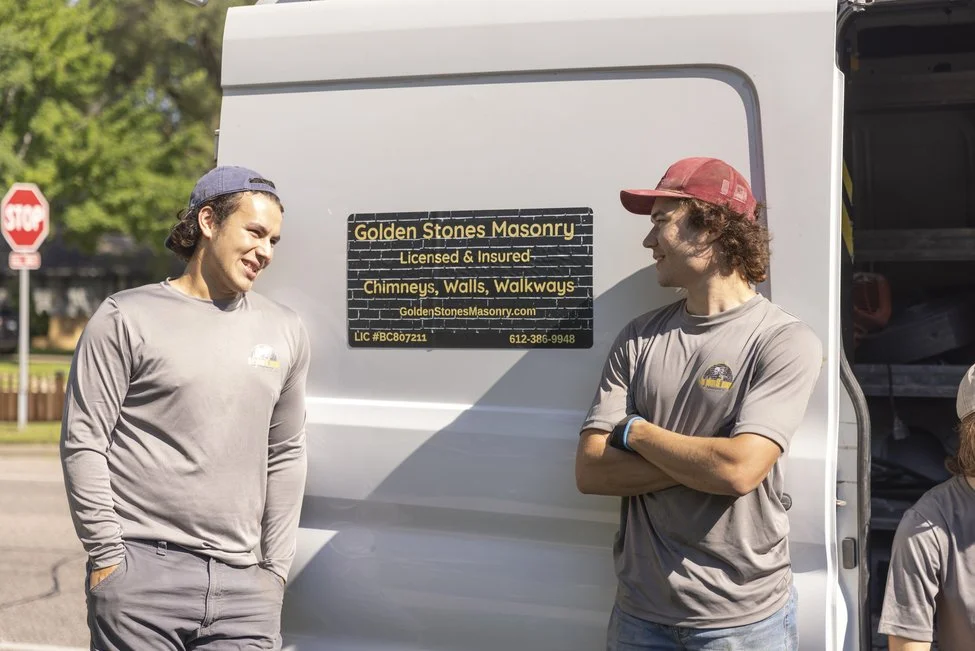
Brick veneer repair and wall tie replacement
The job that defines masonry work in this city. A bowing veneer wall has to come down over the affected area, the corroded fixings replaced with new ones, and the brick rebuilt. It is not a repointing job and anyone quoting it as one has not understood the wall. Our brick repair page explains how the failure works.
Lintel replacement over wide openings
The rusted steel comes out, the opening is carried on temporary support while the brick above is taken down and relaid, and the new steel goes in. On the wide front windows this housing is full of, this is a bigger job than it sounds and a smaller one than leaving it.
Tuckpointing on pre-war and post-war walls, done differently
The two need different mortar. A 1920s wall wants a soft mix that will give before the brick does. A 1955 wall does not. Grinding out and refilling to the wrong specification is how a well-meant repair shortens the life of a wall.
Chimney repair, rebuild and crown work
Stacks of this age are usually sound in the body and gone at the top. Where the spalled face count is up around the seven to ten, our rebuild page sets as the line we will say so and price the rebuild, and where it is not, we will not sell you one.
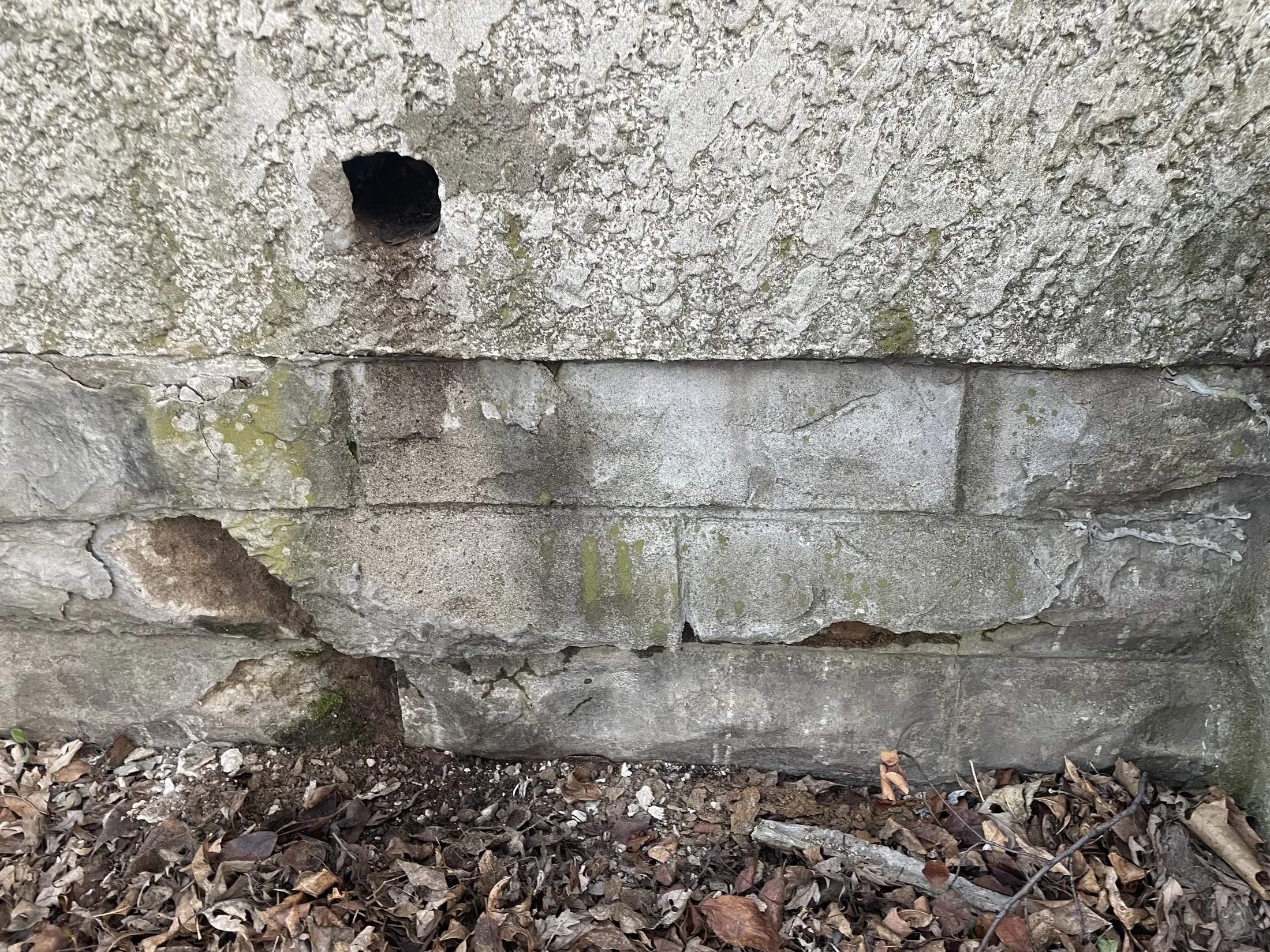
Stone and block foundation repair
For the older part of the city. Rebuilding failed sections of foundation wall where stones have moved rather than simply lost their mortar.
Basement tuckpointing and leak repair
Interior work on old foundation walls, which means it runs right through the winter when the outside work cannot.
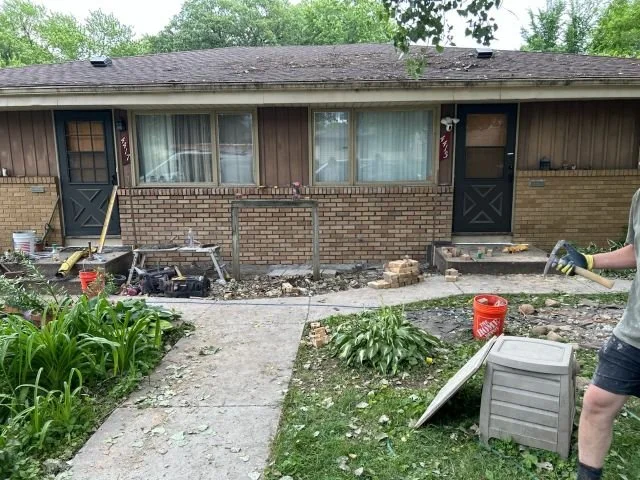
Steps, stoops and entryways
Taken out and rebuilt on a footing dug down past where the ground freezes. Most of the invoice is the excavation, and so is most of the reason it holds.
Patios, walkways and garden walls in natural stone
Flagstone and natural stone. We do not lay interlocking pavers or pour concrete patios and drives, and you will hear that in the first two minutes rather than at the end of an estimate.
Limestone Closer To The Surface Than You Would Guess
What matters about the ground here is not the limestone fifty to a hundred feet under it. It is the sand and gravel outwash plain on top. The atlas rates its aggregate potential as primary, which is a dry way of saying the ground here is worth digging up for what is in it. People did. Eight gravel mines were working inside the city by 1945. The largest covered better than forty acres between Louisiana and Texas Avenues. Another ran to roughly twenty-one square blocks.
Nearly all of that ground now has houses and apartments on it. We are not going to tell you your house is on a filled pit, because we have no way of knowing that from the street and neither does anybody else. What is worth knowing is that the ground under this city is not uniform, and that free-draining sand and backfilled pit are two very different things to set a footing on.
The sand does one useful thing. It drains. A stone foundation in a wet clay hole is a harder problem than the same wall in outwash sand, and on this side of the metro we are more often dealing with the second.

What It Costs
No travel charge, and no minimum job size.
Published starting points, which is what they are: $3,500 for chimney repair on a single-story house, $5,500 for a crown taken off and recast, $2,800 for tuckpointing a small area, $1,500 for minor brick replacement, $3,200 for a rebuilt section of stone foundation, and $7,500 to $11,500 for front steps.
Wall tie work is missing from that list on purpose. Until a section of veneer comes off, nobody can say how many fixings have failed or how far behind the face the damage runs. Quoting it from the street would be a number invented to win a phone call. It gets a figure after someone has opened it, and opening it costs nothing.
Every one of those figures depends on square footage and on what we find when we look. They are rough guides to help you decide whether to call, not quotes. The exact number comes after the visit, and the visit is free.

What Customers Say
No review anybody has left us names, St. Louis Park. What appears below is the live Google feed, not a testimonial we picked out, so it shows whatever is genuinely on it.
Google review, September 2025Tell us what is going on with your masonry
Tell us what you are seeing and attach photos if you have them. Sam comes out himself, and you get the options priced in writing. No charge either way, and no service call fee.
Common Questions In St. Louis Park
Look at the age and look at a window opening. Housing here from the 1940s and 1950s is nearly always a single-skin brick wall hung on a timber frame, and the brick at the edge of a window reveal will be one unit thick. Pre-war walls in this city are more often thicker. If you cannot tell from the ground, send a photograph of a window corner and we usually can.
It is the one masonry symptom we would rather look at sooner. A bulge means the brick is no longer tied back to the house properly, and unlike soft mortar it does not sit still for another decade. It is not a reason to move out. It is a reason to have somebody stand at the corner and sight along the wall.
Usually closer than people expect. Builder brick from that period was made in quantity, and a good deal of it is still findable. Matching a hundred-year-old brick is the harder problem, and this city has less of that.
Yes, and it is worth being specific about what changes. Interior basement work, foundation repair from the inside, and most fireplace work carry on regardless. Exterior repointing and anything that needs mortar to cure outdoors are weather-dependent, and we will tell you honestly which side of that line your job falls on.
Sometimes yes, and you will get a straight answer because we do not sell either one. We install no drain tile, no sump pumps, and no exterior membrane. If your wall is wet because water is being delivered to it, repointing the inside of it is the wrong first spend, and we would rather tell you that than take the job.
We have no way of telling you that, and we would not guess. Eight pits worked in this city, and most of the ground has been built over since, but which ground is a question for the city rather than for a mason standing in your yard. What we can tell you is what your footings are actually bearing on once we have dug.
Get A Free Estimate In St. Louis Park
Two photographs get us a long way. One of the walls, taken square-on from across the street, so we can see whether it is straight, and one close-up of whatever caught your eye. Stay off the roof and off ladders.
If you know roughly when the house was built, say so on the phone. In this city, that single fact tells us more than almost anything else you could describe, because a 1938 wall and a 1958 wall are two different trades.
(612) 509-0718 · No travel charge, no minimum job size · In-person estimate at no charge