

Masonry Contractor in Maple Grove
10 Years
Workmanship warranty, in writing

The median Maple Grove house dates from 1991, and 92.5 percent of the city went up in 1970 or later. There is almost no Victorian brickwork here to repoint.
What it is about is the short list a house of that age does carry, and rather more about the ground beneath it. Maple Grove's own planning document warns residents in writing about wet basements and heaving, and it has 2,000 acres along the north side of I-694 where the original ground was removed, and something else put back.

What Maple Grove Homeowners Call Us About
A front entry or apron sitting low at one corner
Where this city's ground does most of its damage. Bed an entry shallow into soil that stays saturated within a yard of the surface, and it will lift. Carry the footing down past the freezing depth onto something solid and it will not.
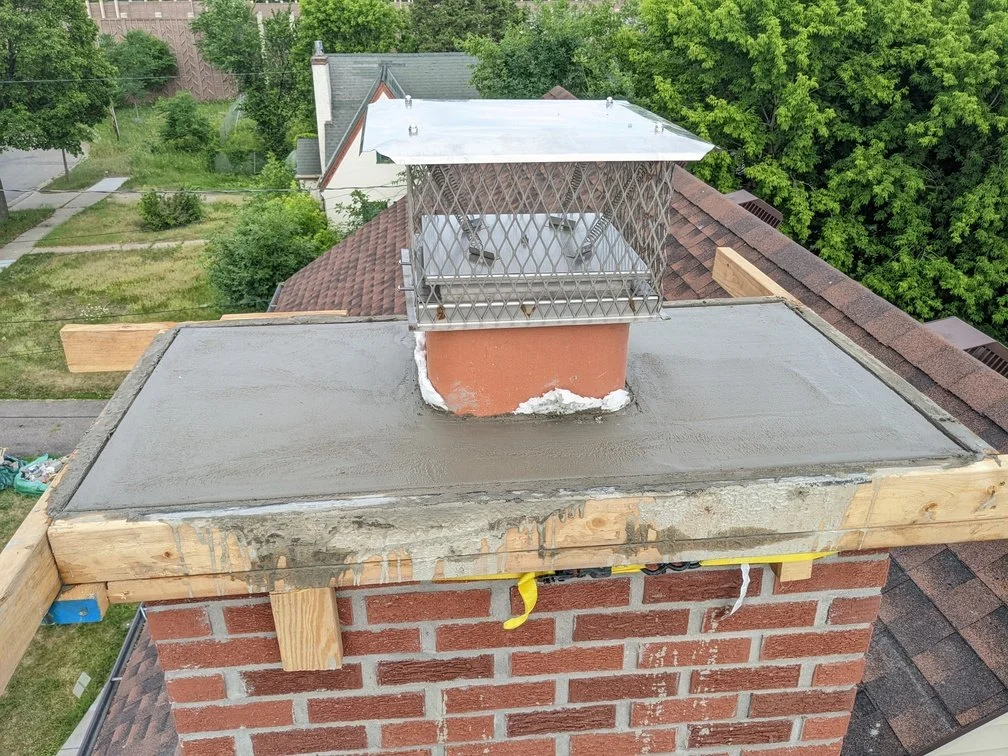
A chimney crown that has broken up
Some 6,392 houses here date from the 1980s and 5,066 more from the 1990s. A very large share of Maple Grove crowns were therefore poured inside the same twenty years, and the older half of them is now around the age where a crown starts asking for something.
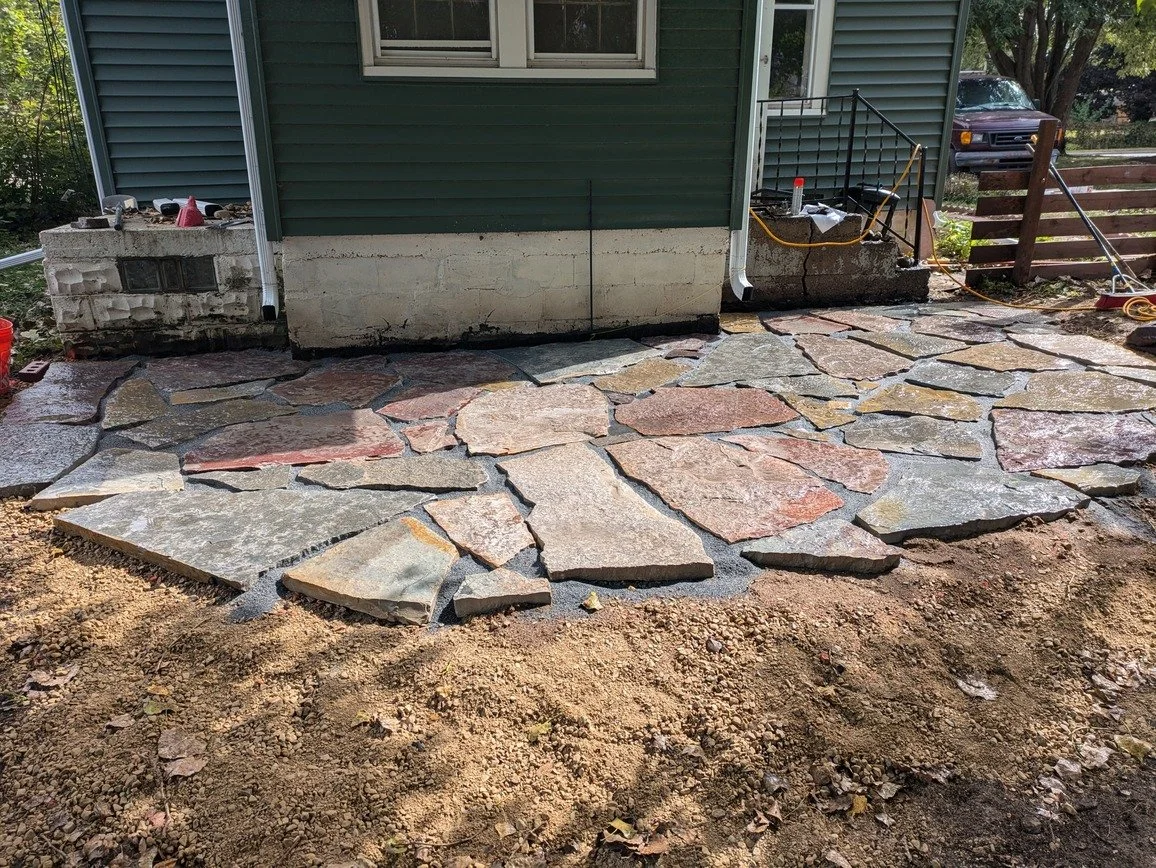
A patio or walkway that has gone uneven in one area
Common on ground that holds water at shallow depth, and more so where the base was not built to carry it. What is underneath decides this, not the stone on top.
A crooked joint line above the garage door
Steel angles went in across Maple Grove during the same twenty-year stretch that built almost everything here. They corrode and expand to their own schedule, and yours is unlikely to be far off your neighbors'.
A retaining wall leaning where the lot was regraded
Plenty of plots here were cut or filled to produce a flat building pad. Anything retaining that reshaped ground is founded on soil that has already been moved once, and what sits beneath the first course settles the argument.
What We Do In Maple Grove
Fewer items than our full catalog, because a house from 1991 simply does not have most of it. The first two are what this ground produces.

Entryway, stoop and apron rebuilds
Excavation and footing are the whole exercise, and between them they carry most of the invoice and all of the durability. Across roughly seventy percent of the till landscape that covers most of this city, water sits within a yard of the surface for part of the year, and depth stops being a line you can decline and still get a lasting job.
Patio and walkway repair in natural stone
Taken up, a base built underneath that both carries the load and moves water away from it, then relaid. Flagstone and natural stone exclusively. We do not pour concrete patios and drives or lay interlocking pavers.
Crown rebuilds and raincaps
Eleven thousand houses went up here across the 1980s and 1990s, so a very large number of crowns in this city are within twenty years of each other. What is worth knowing before you ring is that a crown with hairline crazing and no structural cracking can be sealed for a fraction of a recast, and one that has broken into pieces cannot be.
Lintel replacement
The failed steel comes out, the opening is carried on props while the courses above are taken down, and the new angle goes in before the brick returns.
Veneer and accent panel repair
Rebuilding the failed area of a face while leaving sound work alone. A thirty-year-old builder brick is a far shorter search than something fired in the 1890s.
Retaining walls in natural stone
Taken apart, the footing corrected, then rebuilt using whatever of your existing stone has held up. On ground like this, the footing and the water path behind the wall settle the outcome long before the stonework does. Block walls are somebody else's trade, and we say so in the first two minutes.
Chimney repair and rebuild
For a stack that has gone below the crown line. Thirty-five Minnesota winters do a good deal less damage than a hundred and twenty, so the tally of failed faces on Maple Grove housing usually stays under the seven to ten spalled faces our rebuild page sets as the line.
If your house predates 1970
There are 367 houses in Maple Grove older than 1940 and 1,776 more from the post-war decades. Together that is about seven and a half percent of the city, but if yours is one of them, the mortar, the method and the likely failures are all different. Mention the decade when you ring.
A Till Plain, And Two Thousand Acres That Were Dug Out
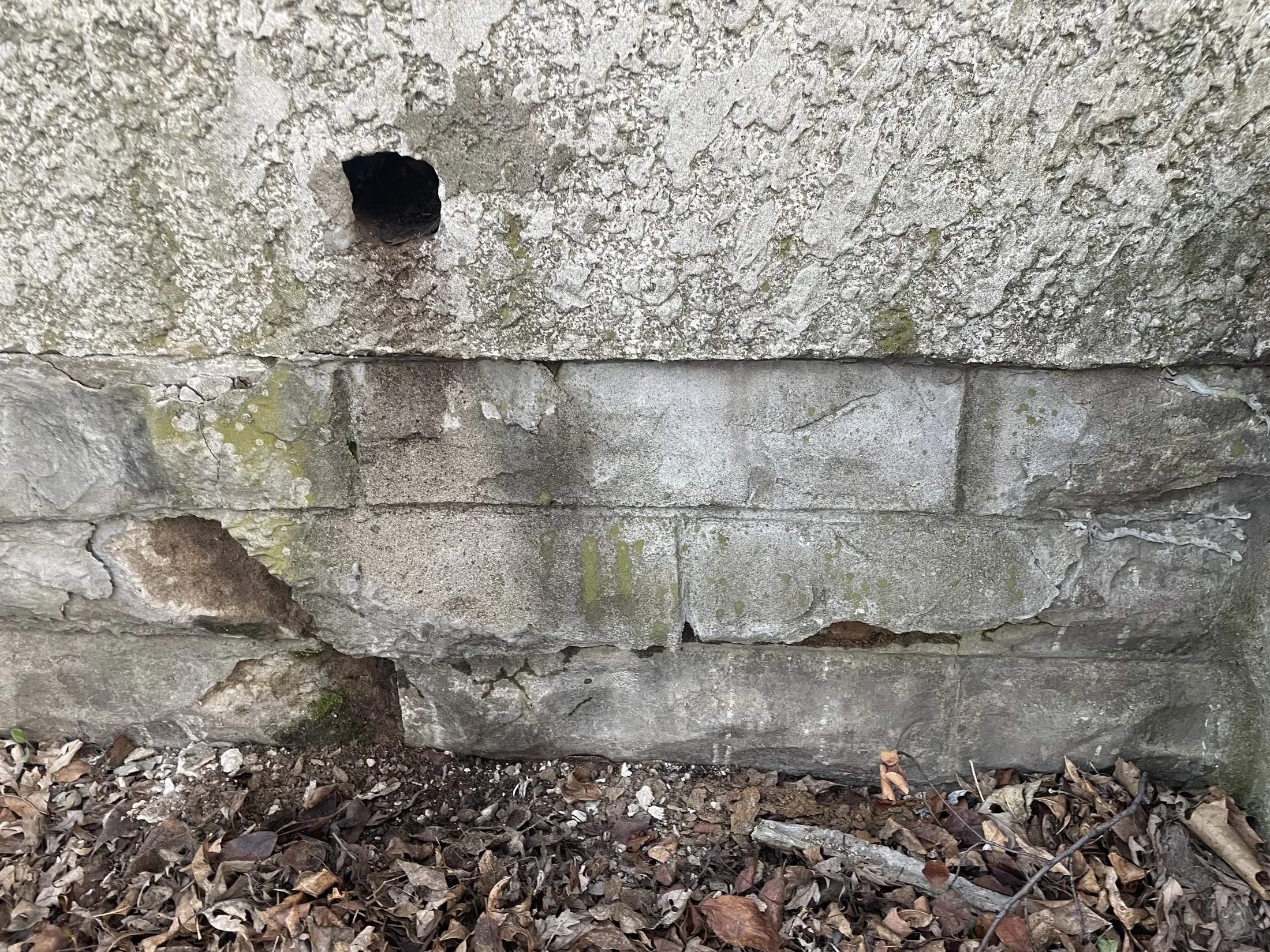
Start with what the city says about itself. Its comprehensive plan describes the till plain that covers Maple Grove this way. Soil wetness is a problem. Drainage downward is blocked by a layer of 'tight' soils, which, if not managed, can lead to wet basements on hilltop sites, road heaving, and septic tank backups during wet periods. And about 70% of this landscape has a seasonal high water table within 3 feet of the surface.
Then there is the mining district. Gravel was found here in the 1930s, and the area along the north side of I-694 became what the city calls the Gravel Mining Area, described in its own plan as approximately 2,000 acres, worked by several companies. Phased development of it started in 1998, and more than 1,200 acres have been built on since.
The environmental review the city commissioned for that area is blunt about what happened to the ground: for most of the AUAR area, native soils have been removed for gravel mining operations. Over 73 percent of it is classified as a gravel pit in the national soil survey, about a fifth as ground filled with material brought in from elsewhere, and the review notes that the filled share is probably higher than the survey shows. It puts groundwater there between zero and twenty feet below the surface, and at the most recent count, mining was still running on more than seven hundred acres of it.
Here is the part worth knowing before anybody quotes you. The soil survey does not describe what is in the ground in that district. It records that the ground was removed. The map unit covering nearly three-quarters of it is four-fifths composed of a component the survey simply calls "pits," carrying no drainage class, no horizon depths, and no soil description at all. The rest of that unit, and the fifth of the district recorded as filled, sit in classes used for ground people moved rather than ground that formed where it lies. And the review, which is formally asked how deep the mining went and how much was taken out, does not answer either question.
So there are genuinely two Maple Groves to build in. A loamy till plain that holds water high, and a large district where the original ground was carted off, and something else put back that nobody has published a description of. Neither is a reason to worry about your house, which is on footings designed and inspected for the site. Both are reasons why we will not tell you over the phone what a patio, a wall, or a front step is bearing on.

What It Costs
No travel charge, and no minimum job size.
Starting points: $3,500 for chimney repair on a single-story house, $5,500 for a crown taken off and recast, meaningfully less to seal one that is still sound, and $1,500 for minor brick replacement.
Ground level work gets no figure here, and in Maple Grove that is more than the usual caution. Nobody can say what an entry, a patio or a wall is bearing on before it is opened, and inside the mining district the original ground may have been carted away decades ago. Those get a number once we have dug, and digging to find out costs you nothing.
Every one of those figures depends on square footage and on what we find when we look. They are rough guides to help you decide whether to call, not quotes. The exact number comes after the visit, and the visit is free.

What Customers Say
No review anybody has left us names Maple Grove. What appears below is the live Google feed rather than a testimonial we picked out, so it shows whatever is genuinely on it.
Google review, September 2025Tell us what is going on with your masonry
Tell us what you are seeing and attach photos if you have them. Sam comes out himself, and you get the options priced in writing. No charge either way, and no service call fee.

Common Questions In Maple Grove
Around forty is when it starts for most of it, though in this city the ground moves one item up the list. Anything sitting at grade goes first, because it is in contact with soil that holds water high. The chimney top follows, then the steel over wide openings. The wall of the house is generally the last thing anyone thinks about.
The city maps the mining district and knows where the line runs, so the question of where is for them rather than for us. What is worth adding is that even inside it, the published record thins out fast. The soil survey classes most of that ground as pit and fill without describing what is down there, and the city's own environmental review does not state how deep the mining went or what came back in. So nobody can tell you from a document either. What we can tell you is what your footing is bearing on once we have dug down to it.
Because the till holds water rather than letting it drain. The city's own plan says a seasonal high water table lies within three feet of the surface across roughly 70% of that till landscape. Ground that is wet when it freezes lifts, and that is what moves steps and patios.
Usually just the failed section. Where the surrounding base is holding, we take up that area alone, build what is under it properly, and relay the stone. Where the base was wrong from the start, you will hear that from us rather than paying twice to discover it.
Exterior mortar work, yes, and we will tell you which side of that line your job falls on rather than booking it and canceling. Interior foundation work and fireplace work run right through.
Get A Free Estimate In Maple Grove
Photograph what you have spotted, then step back and take a second one so we can see where on the building it sits. From that, we can normally tell you over the phone whether there is anything here worth us both making time for.
One extra thing: in Maple Grove, it counts for more than anywhere else we work. Tell us whether that patch of ground stays wet after rain. One word from you can save an hour of guessing at our end.
(612) 509-0718 · No travel charge, no minimum job size · In-person estimate at no charge