


Masonry Contractor in Minnetonka
10 Years
Workmanship warranty, in writing

Minnetonka is really two cities as far as masonry is concerned. 4,145 homes here date from the 1950s and another 2,890 from the 1960s. Then 5,965 went up in the 1980s alone, which is nearly a quarter of the city.
Those two groups need different things from us, and for different reasons. The first has brick hung on a timber frame with metal fixings behind it that are now seventy years old. The second has chimney tops, entryways, and lintels arriving at forty. Tell us the decade on the phone and the conversation gets a lot shorter.

What Minnetonka Homeowners Call Us About
A brick front bulging away from a 1950s house
Rusting wall ties behind a veneer. It is the defining problem of the older half of this city, and it does not fix itself. Sighting along the wall from the corner will usually show it.
A chimney crown broken up on a 1980s house
With 5,965 houses raised across that single decade, a very large share of Minnetonka crowns share a birthday to within a year or two, and that is roughly when a poured cap begins to split.
An entry or apron that has settled unevenly
On silt loam till that holds moisture and heaves, anything not taken below the frost line eventually finds its own level. On a lot cut into a slope, which is most of them here, that happens sooner.
A retaining wall moving on reshaped ground
Building on collapsed, hummocky terrain means many lots were cut and filled to get a flat pad. Whatever holds that cutback is bearing on ground that was moved, and the base decides whether it stays.
Brick lifting over a garage door or wide window
The steel angle over wide openings corrodes and swells on its own schedule, and this city has two separate cohorts of it, one from the 1950s and one from the 1980s.

What We Do In Minnetonka
Split roughly the way the city is. The first three are for the older half, the next three for the 1980s build-out, and the last two apply everywhere.

Brick veneer repair and wall tie replacement
For the 1950s and 1960s housing. The affected area of veneer comes down, the corroded fixings are replaced, and the brick goes back. Not a repointing job, and anybody pricing it as one has misread the wall.
Tuckpointing and mortar repair
On the older stock, grinding out failed joints and replacing them in a mix matched to the age of the brick, which is usually not the strongest mix available.
Stone foundation repair
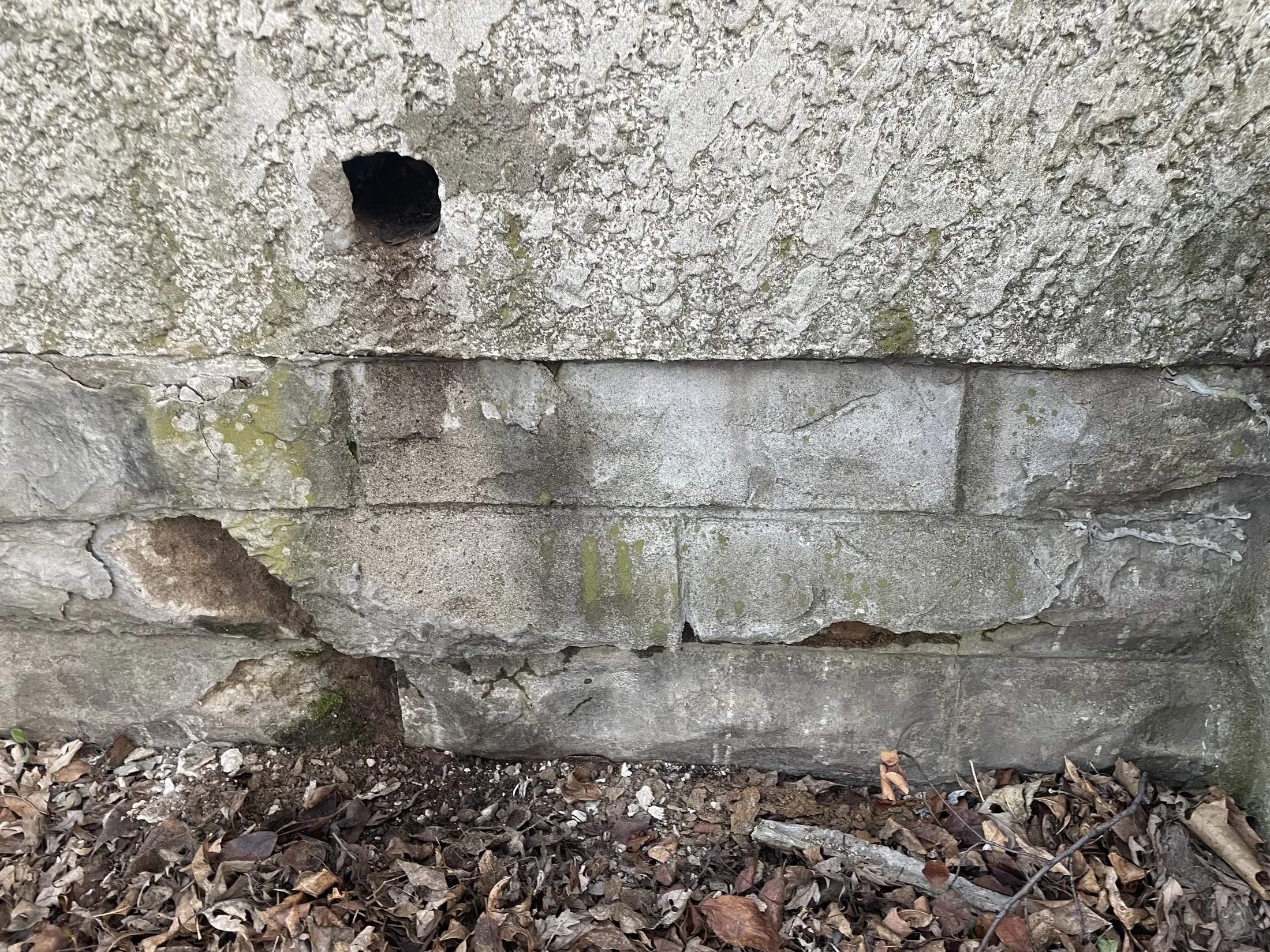
For the small pre-war group, about 616 houses across the whole city. Rebuilding failed sections where the stones themselves have moved, rather than walls that have only lost their pointing.
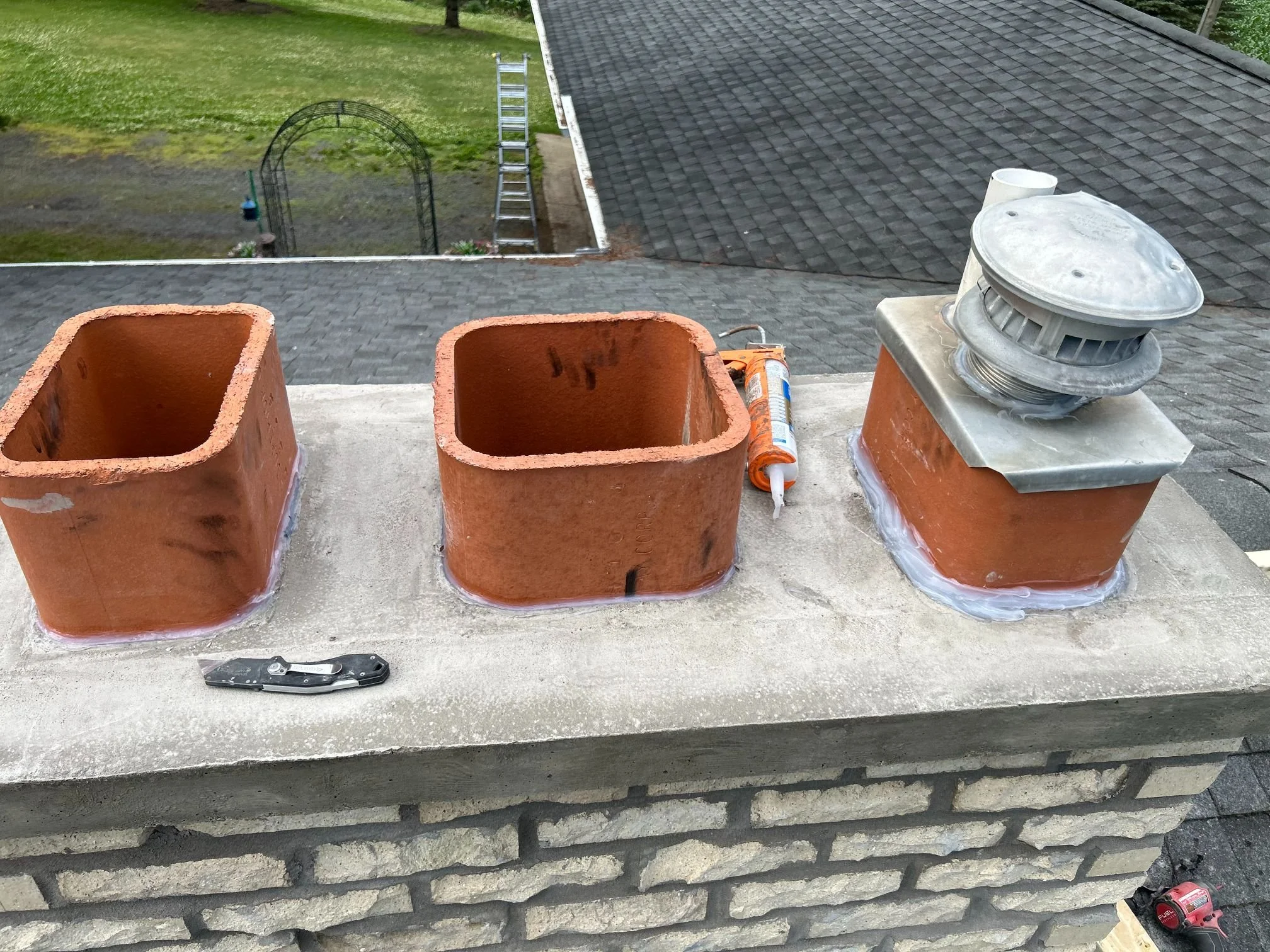
Crown rebuilds and raincaps
For the 1980s cohort, all of it arriving together. The method does not vary by city, so the detail lives on our crown page, which is straight about where sealing a sound cap stops being a real answer.
Lintel replacement
Corroded steel out, temporary support in, brick above relaid. Two cohorts of it in this city, thirty years apart.
Veneer and accent panel repair on newer housing
Localized rebuilds where units or mortar have gone on a 1980s face. Matching forty-year-old builder brick is considerably easier than matching a century-old one.
Steps, stoops and entryways
Rebuilt with the footing carried down beneath the freezing depth. On ground that lifts every winter, that decision is what separates a repair from doing the whole thing again in a couple of winters.
Retaining walls and garden walls in natural stone
Taken down, the footing and the water path behind it corrected, then rebuilt in stone. We neither build nor repair interlocking block, and we say so early.
Collapsed Ground, And Why The Lakes Are Where They Are
The ground under this city has a name in the state geological atlas. The unit is Heiberg stagnation, and the atlas's own attribute for how it was formed is collapsed.
What that describes is ice that stopped moving and melted where it stood, letting everything it carried slump into the hollows it left behind. That is where the kettle lakes came from, and it is why the ground here rolls the way it does. The material itself is a sandy till with a silt loam texture, and the atlas rates its aggregate potential as none, which tells you it is not the clean, free-draining sand you get on the sand plain cities north of the metro.
Silt loam retains moisture, and saturated ground lifts as it freezes. For anything bedded shallow, that is the practical upshot. The atlas also returns forty-nine distinct peat bodies within a two-and-a-half-mile radius of City Hall, which is a considerable quantity of soft, compressible material for one suburb to hold.
None of which is a reason to worry about the house itself, which was founded on designed footings and inspected. It is a reason not to assume anything about a patio, a garden wall or a set of steps until it has been dug.

What It Costs
No travel charge, and no minimum job size.
Where the numbers start: $3,500 for chimney repair on a single-story house, $5,500 for a recast crown, considerably less than that to seal one that is still sound, $2,800 for tuckpointing a small area, $1,500 for minor brick replacement, $3,200 for a section of foundation, and $7,500 to $11,500 for steps.
Two things are missing from that list. Wall ties and retaining walls both depend entirely on what is hidden behind or beneath them, and no photograph shows it. We quote those standing in front of them, which costs you nothing.
Every one of those figures depends on square footage and on what we find when we look. They are rough guides to help you decide whether to call, not quotes. The exact number comes after the visit, and the visit is free.

What Customers Say
No review anybody has left us names Minnetonka. What appears below is the live Google feed rather than a testimonial we picked out, so it shows whatever is genuinely on it.
Google review, September 2025Tell us what is going on with your masonry
Tell us what you are seeing and attach photos if you have them. Sam comes out himself, and you get the options priced in writing. No charge either way, and no service call fee.
Common Questions In Minnetonka
Around forty is where it changes. On a house of that vintage, the crown ages first, then the steel across wide openings, then whatever sits at grade on soil instead of a proper footing. The brick on the house is normally the last thing to ask for anything.
Very different. At that age, the question is what is holding the brick onto the house. Metal wall ties buried in the joints rust, swell, and let the veneer move outward. That is a structural repair, not a cosmetic one, and it is worth having looked at.
Ice that stopped moving and melted where it stood, leaving hollows that became lakes and hummocks between them. The state atlas calls the ground collapsed, which is exactly what happened to it. For your purposes it means a great many plots here were cut and filled to produce a level pad, and a footing on made ground is a different proposition from a footing on undisturbed soil.
Only where it happens to sit beneath something of yours. Forty-nine peat bodies are mapped inside two and a half miles of City Hall, and peat stays soft and keeps compressing. Your house is properly founded, so it is not a concern. A garden wall or a patio is another matter, and neither should be assumed to be on firm ground before a spade goes in.
Usually closer than people expect, because it was made in volume and much of it is still findable. The harder match is the small pre-war group, and you will hear that before the work starts.
The outside work does, and we will say so rather than book you and cancel. Fireplace work, interior foundation repair, and basement tuckpointing carry on through it, which in a city with this much 1950s stock is a real part of the year.
Get A Free Estimate In Minnetonka
A photograph taken square on from across the street, plus a close-up of whatever you noticed, gets us most of the way to an answer on the phone. Stay off the roof.
The single most useful thing you can tell us here is the decade the house was built. In a city split evenly between the 1950s and the 1980s, that one number determines which of the two entirely different jobs we are talking about.
(612) 509-0718 · No travel charge, no minimum job size · In-person estimate at no charge