
Basement Leaking Where Wall Meets Floor? The Cove Joint Cause
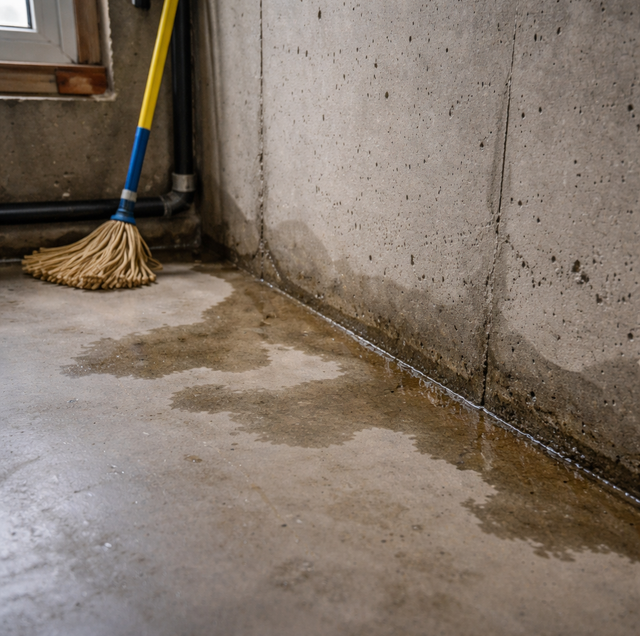
Quick Answer: Water showing up where the basement wall meets the floor usually comes through the cove joint, the seam where the foundation wall sits on top of the footing. When the water table around the house rises, hydrostatic pressure pushes groundwater up through that seam. It is a drainage problem far more often than a wall defect, and the lasting fix is moving water away from the foundation rather than patching the joint.
You mop up the puddle along the base of the wall, and a few days later it is back in the same line. The water is not dripping from a crack overhead, and the wall above the waterline looks dry. It is arriving right at the corner where the floor and wall meet, sometimes as a slow weep, sometimes as a visible trickle after a wet stretch. That specific location is the clue, and it points to something most homeowners have never heard named.
What The Cove Joint Actually Is
A poured or block foundation is built in two stages. First, a wide concrete footing is poured into the ground to spread the building's weight across the soil. Then the foundation walls are built on top of that footing. The two are not fused into one solid mass. Where the bottom of the wall rests on the footing, there is a seam. That seam runs all the way around the perimeter of the basement, and it is called the cove joint.
The cove joint is not a defect or a sign of poor workmanship. Nearly every basement has one, because the footing and the wall are almost always poured or laid at different times. Concrete does not bond permanently across a cold joint like that, so a hairline gap remains at the transition. Under normal, dry conditions, that gap does nothing. It becomes a problem only when there is standing water in the soil pressing against it.
Hydrostatic Pressure And The Water Table
The water table is the level below the ground where the soil is fully saturated. It rises and falls depending on how much water is soaking into the ground and how well that water drains away. After heavy rain or a fast snowmelt, the soil around a house can hold far more water than it normally does, and the water table climbs. During a dry stretch, it drops back down.
When that saturated zone rises above the level of the basement floor, the water in the soil has weight, and it presses in every direction, including up under the slab and sideways against the walls. That pressure is called hydrostatic pressure. Water under pressure will find the lowest-resistance path into the basement, and the cove joint is often exactly that path. The seam is already there; it sits right at floor level, and the water is being pushed straight into it. So it seeps in along the bottom of the wall and spreads across the floor.
This is why the leak is tied to conditions rather than to a season. A long soaking rain does it, a rapid thaw does it, but so does a chronically high water table or a yard that never drains properly, and those cause seepage in any month of the year. A dry summer week can stay leak-free while a wet one floods, regardless of the calendar.
Why This Is Not The Same As A Crack Leak
It helps to sort basement leaks by where the water shows up. Water running down from partway up the wall, following a visible vertical or diagonal line, is a crack leak, and it usually means the wall itself has fractured and water is coming through the body of the wall. That is a different repair.
Cove joint seepage behaves differently. The wall face above stays dry, and the water appears only at the floor line, frequently along a long run of the perimeter rather than at one narrow point. Think of a saturated sponge sitting in a shallow tray of water: the water does not shoot through the middle of the sponge; it wicks in around the bottom edge where the sponge meets the tray. The foundation behaves the same way, taking on water at the seam at its base rather than through its face. Reading the location correctly matters, because sealing a crack that is not there does nothing for a cove joint problem, and the water keeps coming.
What Makes It Worse
The cove joint leaks when water collects in the soil against the foundation. Several common conditions cause exactly that, and most of them are about drainage rather than the foundation itself.
Failed or clogged footing drains: Many homes have a perforated drain pipe buried alongside the footing to carry groundwater away before it can build up. Over decades, these pipes clog with silt, collapse, or fill with root growth. Once the drain stops moving water, the soil beside the footing stays saturated, and pressure builds right at the cove joint.
Grading that slopes toward the house: The ground next to the foundation should fall away from the wall so surface water runs off. When soil settles over time, or was graded flat to begin with, water pools against the foundation and soaks straight down to the footing.
Downspouts dumping at the base of the wall: A roof sheds an enormous volume of water during a storm, and downspouts concentrate it. When a downspout empties right at the foundation with no extension, it delivers hundreds of gallons into the exact soil that presses against the cove joint.
A naturally high water table: Some lots simply sit low, near a wetland, or over dense clay that holds water. On those properties, the saturated zone rides high year-round, and the foundation is fighting standing water as a baseline condition rather than an occasional one.
How The Leak Gets Fixed
Because the real problem is water against the foundation, the durable solutions manage that water. They fall into interior and exterior approaches, and the right one depends on the property.
Interior drainage and a sump: The most common lasting repair is an interior drain tile system. A channel is cut into the perimeter of the basement floor, a perforated pipe is set below the slab to collect water arriving at the cove joint, and the floor is patched back over it. That pipe carries the water to a sump pit, where a sump pump lifts it and discharges it well away from the house. Instead of fighting to keep water out of the seam, this approach gives the water a controlled place to go the moment it arrives, so it never builds up on the floor.
Exterior waterproofing: The exterior approach addresses the water before it reaches the wall. The foundation is excavated down to the footing, the outside face is cleaned and coated with a waterproof membrane, and a new footing drain is installed in fresh drainage stone to carry groundwater away. It is the most thorough fix because it stops water on the soil side, though it is also the most involved since it requires digging around the foundation.
Grading, gutters, and downspout extensions: Some of the most effective work happens above ground and is well within reach for a homeowner. Re-sloping soil so it falls away from the foundation, keeping gutters clear so they actually carry roof water, and adding downspout extensions that discharge several feet from the wall can meaningfully lower the amount of water reaching the cove joint. In a mild case, correcting drainage at the surface is sometimes enough on its own.
If water is pooling anywhere near outlets, the furnace, or the sump pump's own wiring, treat it as a shock hazard and keep clear until power to that area is cut and the situation is assessed. Excavation and any foundation or structural repair belong with a qualified contractor.
When It Signals A Bigger Drainage Problem
An occasional damp line after an exceptional storm is one thing. Water arriving at the cove joint on a regular basis is the foundation telling you the soil around it stays saturated, and that is worth taking seriously. Persistent seepage keeps the base of the wall and the slab wet, which invites mold, ruins finished space, and over years contributes to the kind of soil movement that stresses a foundation. If the leak returns every wet spell, if it appears along long runs of the perimeter, or if you also see it coming up through the floor and not just at the wall edge, the drainage system around the house is not keeping up and needs a real plan rather than another round of patching.
Frequently Asked Questions
It rarely holds. Hydraulic cement packed into the seam is fighting the full force of hydrostatic pressure with nothing relieving the water behind it, so the pressure commonly finds a new exit a few feet away or pushes the patch back out. Interior sealing can slow a very minor weep, but it manages a symptom rather than the water load, which is why drain-based systems are the standard repair for recurring cove joint leaks.
More than most people expect. Every foot the water table rises above the floor adds roughly 62 pounds of upward and inward pressure per square foot of foundation surface, which is why even a pinhole-width seam can weep steadily. That same pressure is what can lift and crack an unweighted basement slab from below, not just push water through the cove joint.
No, and it is a common mismatch. A dehumidifier only removes moisture already in the air and does nothing about liquid water entering under pressure. Waterproof masonry paint is rated for damp walls and light vapor, not for water being driven through a seam, and hydrostatic pressure typically blisters or peels it off within a season.
Usually not. Standard homeowners policies treat groundwater and surface water seepage as an excluded maintenance issue rather than a covered sudden event, which is different from, say, a burst supply line. Some insurers offer a separate water backup or seepage endorsement, so it is worth reading your specific policy language before assuming either way.
Sometimes, but only if it is placed and pitched to intercept the water actually reaching the foundation. A yard French drain set uphill of the house can lower the water arriving at that side, yet it does nothing for water rising from a high table directly beneath the slab. That is the situation an interior drain tile and sump is built to handle, which is why the two are sometimes used together.
Dry the area, then lay a sheet of plastic taped tight over a section of floor and a section of the wall base overnight. Condensation only under the plastic points to vapor moving up through the slab, while beads or a wet line at the taped edge along the wall base points to liquid water entering at the cove joint. The two problems overlap on wet lots, and the plastic test is a quick way to see which one is active before anyone opens the floor.
Get the cove joint traced to its real source — and the water routed away for good. Golden Stones Masonry serves St. Paul and the Twin Cities. Call (612) 509-0718.
