
Why Chimneys Leak: 6 Water Entry Points to Find First
Quick Answer: Chimneys leak at a handful of predictable spots: a missing or damaged cap that lets rain fall straight down the flue, a cracked crown (the concrete slab on top), failed flashing where the chimney meets the roof, deteriorated mortar joints and spalling brick that soak up water, a missing cricket behind a wide chimney, and porous unsealed masonry. Flashing failure is the most common cause. The fix depends entirely on which point is letting water in, so the leak has to be located before it is sealed.
A chimney is the one part of a house that stands up above the roofline and takes weather on every side at once. The roof around it has shingles, underlayment, and gutters shedding water away. The chimney has none of that. It is a masonry column exposed at the top, on all four faces, and along the seam where it punches through the roof. Water finds the weak spot, and on a chimney there are several predictable ones.
That is worth understanding before anyone climbs up with a bucket of sealer. A leaking chimney is almost never a single mystery hole. It is water entering at a known point, running downhill inside the structure, and showing up somewhere lower than where it got in. Chase the stain, and you will often miss the source. Learn the entry points and the fix usually becomes obvious.
Why A Chimney Is So Easy For Water To Enter
Think of the chimney as a brick straw standing in the rain. The top is open to the sky, so anything falling straight down has a clear path unless something covers it. The four walls are brick and mortar, both of which absorb water rather than shed it. And the base is welded to the roof by thin metal, which is doing the hard job of keeping a straight-sided masonry box watertight against a sloped surface.
Two kinds of weather work on all of that at once, year-round. Wind-driven rain pushes water sideways into joints and up under metal that a vertical drip would never reach. And freeze-thaw cycling- water that soaks into masonry, freezes, expands, and thaws again- pries mortar and brick apart from the inside over many repetitions. Neither one is a seasonal problem you can ignore half the year. A summer thunderstorm drives rain into a bad flashing joint the same way a cold snap splits a saturated brick face. A durable chimney has to resist both.
Below are the entry points, roughly from the top down.
A Missing or Damaged Chimney Cap: The cap is the covered screen that sits over the flue opening at the very top. Its job is simple: keep rain, snow, animals, and debris from dropping straight down the open flue. When the cap is missing, rusted through, or was never installed, rain goes directly into the flue and down into the firebox or smoke chamber. That water can rust a damper, saturate a liner, and stain the wall around the firebox from the inside.
The fix is a new stainless steel or copper cap sized to the flue. It is a small part with an outsized job, and it also keeps birds and squirrels out of the flue.
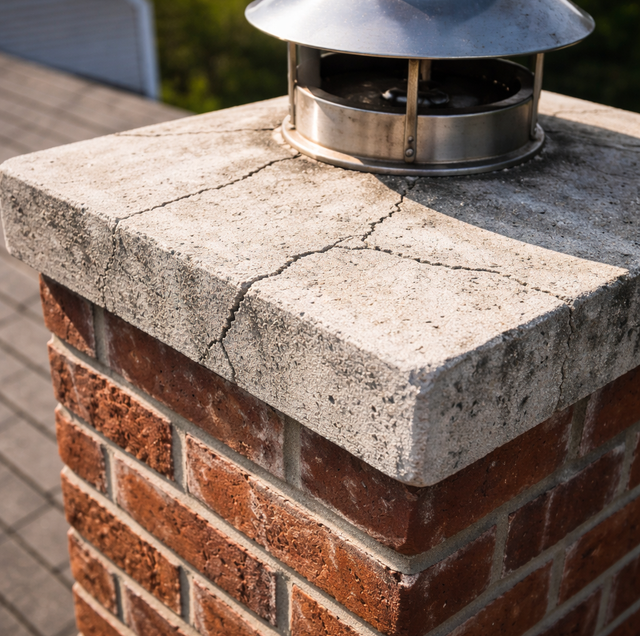
A Cracked Chimney Crown: The crown is the concrete slab poured across the top of the masonry, sloped to shed water away from the flue. It is not the same as the cap. The crown is the wide top surface; the cap covers only the flue hole in the middle of it. Because the crown is exposed concrete, it cracks over years of expansion and contraction. Once it cracks, water runs into the joint, soaks into the masonry below, and freeze-thaw widens the crack every cycle.
Hairline crown cracks can be sealed with a flexible crown coating. A crown that is crumbling or broken through needs to be rebuilt with a proper overhang and drip edge so water is thrown clear of the brick.
Failed Flashing Where The Chimney Meets The Roof: Flashing is the layered metal that seals the joint between the chimney and the roof. Done right, it is two parts: base flashing that runs up the chimney face and step flashing woven into the shingles, plus counter-flashing set into a cut mortar joint and bent down over the base. This is the single most common source of chimney leaks. The metal can rust, the sealant at the counter-flashing can dry out and pull loose, or the whole assembly can have been done poorly the first time.
The fix is to re-flash the joint: fresh step and counter-flashing, the counter-flashing let into a clean-cut mortar joint (a reglet) rather than surface-caulked, so it sheds water instead of relying on a bead of caulk that will fail.
Deteriorated Mortar Joints and Spalling Brick: Brick and mortar are porous by nature. Sound joints and a good brick face shed most water, but old mortar turns sandy and recessed, and brick faces flake away in a process called spalling. Once joints are open and brick faces are pitted, the masonry acts like a sponge, holding water inside the wall where freeze-thaw can do its slow damage and where moisture can migrate to the interior.
The repair is tuckpointing, also called repointing: the failed mortar is ground out to a consistent depth and packed with fresh mortar matched to the original. Badly spalled brick gets cut out and replaced. Restoring the joints restores the wall's ability to shed water.
A Missing Cricket Behind A Wide Chimney: On a chimney wider than about 30 inches, the uphill side, the face pointing up the roof slope, collects runoff and debris that pile against the masonry and sit there. A cricket (or saddle) is a small peaked structure built behind the chimney to split that water and send it around both sides. Without one, a wide chimney becomes a dam, and standing water eventually beats the flashing on the uphill face.
The fix is to build a cricket, flash it into the roof and the chimney, and give the water somewhere to go.
Unsealed, Porous Masonry: Even with sound joints and good brick, a masonry chimney absorbs some water through the face of the brick itself. Over decades, that absorption feeds spalling and interior dampness. The answer is a breathable water repellent, a vapor-permeable product that lets the wall dry outward while resisting liquid water driving in.
The critical caution: do not seal a chimney with a non-breathable paint or waterproof coating. A film-forming sealer traps moisture inside the masonry, and trapped water freezing behind a sealed face accelerates spalling instead of preventing it. The repellent has to breathe.
How To Tell A Flashing Leak From A Crown Or Masonry Leak
Where the stain shows up is the best clue to which entry point is failing, and it can save a lot of guessing.
A flashing leak usually appears at the ceiling or wall right where the chimney passes through the roof, often on the interior close to the chimney's base or in the attic against the framing beside the chimney. Water is entering at roof level and showing up at roof level.
A crown or upper-masonry leak tends to show lower and more diffuse: a damp firebox, staining inside the firebox or smoke chamber, efflorescence (white mineral crust) on the chimney's exterior brick, or a musty smell near the fireplace. Water entered at the top and traveled down inside the flue or the wall before it surfaced. A cap failure specifically points to water in the firebox itself, since the flue is the open path from the cap straight down.
None of that is a substitute for a look at the actual assembly, but the pattern narrows it fast. Stains high and at the roofline point at flashing; stains low and around the firebox point at the cap, crown, or masonry above.
Where the stain shows up is the best clue to which entry point is failing. Stains high and at the roofline point at flashing, while stains low and around the firebox point at the cap, crown, or masonry above.
Why Guessing Wastes Money On A Chimney
The reason chimney leaks get sealed twice is that people treat the symptom. A stain by the fireplace gets a tube of caulk run around the flashing; the flashing was fine, and the real culprit, a cracked crown two feet higher, keeps feeding water down the flue. The water simply reappears after the next storm.
Water in the firebox or flue can hide a cracked flue liner or a corroded damper, and a compromised flue is a combustion-safety issue, not a cosmetic one. If a chimney has been leaking, the flue should be inspected before the fireplace is used again, and the fireplace left unused if there is any chance the liner is damaged.
Frequently Asked Questions
Yes. Water that enters at the flashing or crown can travel along the top of the ceiling drywall, run down a framing member, or follow the chimney chase inside a wall cavity before it finds a spot to surface. A stain in an adjacent room or one floor down does not mean the leak moved; it means the water traveled before it showed. The chase itself, the framed enclosure around a chimney in some homes, acts as a hidden highway for that travel.
Efflorescence is the white, powdery, or crusty deposit that appears on brick when water moves through the masonry, dissolves natural salts, and leaves them behind on the surface as it evaporates. It is a symptom that water is passing through the wall, not just wetting the face. Brushing it off treats the appearance; the salts return until the moisture source is closed. On a chimney, persistent efflorescence usually points to a crown or joint problem above the stained area.
A yearly inspection is the common professional recommendation, ideally paired with a look at the cap, crown, flashing, and mortar joints together rather than one at a time. The spring and fall shoulder seasons are practical windows because the weather is mild enough for exterior masonry work and any damage from the harder months is visible. Catching a hairline crown crack early is a coating; catching it late is a rebuild.
Only if the cap is the actual entry point. A cap stops rain falling straight down the flue, so it solves firebox-from-above leaks. It does nothing for a failed flashing joint, a cracked crown, or open mortar, because those let water in around the cap, not through the flue. This is why locating the leak first matters; a cap installed against a flashing leak leaves the real problem running.
No, and the difference matters on prefab chimneys. A crown is poured concrete on a masonry chimney. A chase cover is a metal top used on framed chimney chases that enclose a factory-built (prefab) flue. Chase covers are often galvanized steel that rusts and develops a low spot in the middle where water pools and eventually perforates. The fix is a stainless steel or aluminum chase cover with a cross-break so water sheds instead of ponding.
It is usually a false economy. When shingles come off, the old step and counter-flashing are already bent, sometimes rusted, and the sealant at the reglet is aging. Setting new shingles against tired flashing is a common source of leaks that appear a year or two after a roof job. Fresh flashing tied into the new shingle courses and a re-cut counter-flashing joint is the durable choice while everything is already open.
Have a stubborn chimney leak located and sealed at the source — before it hides liner damage or splits more brick. Golden Stones Masonry serves St. Paul, Minneapolis, and Eagan. Call (612) 509-0718.
