
Why Are My Basement Walls Bowing or Leaning? The 5 Causes
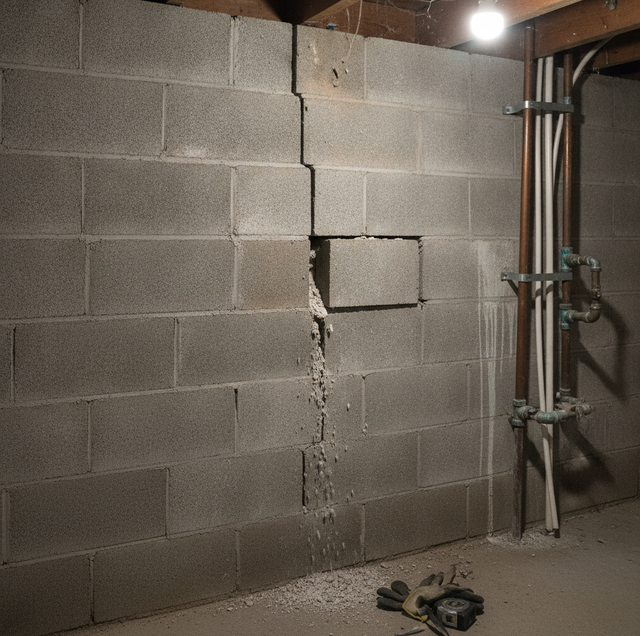
Quick Answer: A bowing or leaning basement wall means the soil outside is pushing in harder than the wall can hold back. The pressure comes mostly from water-saturated soil, swelling clay, freeze-thaw movement, and loads near the foundation. A horizontal crack across the middle of the wall is the classic warning sign. The lasting fix handles the water first, then reinforces the wall with carbon-fiber straps, steel beams, or wall anchors, depending on how far it has moved.
A basement wall is holding back a small mountain. On the other side of that concrete or block is several feet of packed soil, and all of it is leaning on the wall around the clock. Most of the time, the wall wins that contest quietly, year after year, and you never think about it. When it starts to lose, it does not fall over in a night. It gives ground slowly, curving inward at the middle or tipping in at the top, and the first hint is usually a crack you almost walk past. Reading that early warning correctly is the difference between a manageable repair and a wall that has to come out.
What Actually Pushes a Basement Wall In
Every bowing wall comes down to one imbalance: lateral soil pressure on the outside exceeds the wall's ability to resist it. Lateral pressure is just the sideways push of the earth against the buried part of the wall, and it is always there. What turns a normal, survivable push into a wall-bending force is one or more of the drivers below stacking on top of it.
Water in the soil: This is the big one. When the ground around the foundation gets saturated, the water fills the spaces between soil particles and adds its own weight and pushes against the wall. That added force is hydrostatic pressure, and it can roughly double the load the wall has to carry. Saturated soil shows up when drainage is poor: gutters overflow or dump runoff right at the foundation, downspouts empty a few inches from the wall instead of well away from it, the yard slopes toward the house rather than away, or the natural water table sits high. Every one of those sends more water into the soil that the wall is holding back.
Clay that swells and shrinks: Many areas sit on clay-rich soil, and clay does something sand never does: it absorbs water and expands, then dries out and shrinks. A wet spring swells the clay against the wall, driving it inward. A dry stretch pulls the clay back and leaves a gap. Over many wet-dry cycles, that back-and-forth works the wall the way you would loosen a fence post by rocking it, and the wall tends to keep the inward set it gained while wet.
Freeze-thaw movement: When wet soil next to the foundation freezes, the water in it expands and shoves against the wall, a push often called frost heave. When it thaws, the ground settles again. That freeze-thaw cycle is a real stressor on a foundation in any cold-winter climate, but it is one stressor among several, not the whole story. Cold weather works on a saturated wall in winter, and swelling clay plus warm-season hydrostatic pressure work on that same wall the rest of the year. A wall failing only because of frost is rare; a wall failing because water, clay, and frost are all leaning on it at once is common.
Weight near the foundation: Soil is not the only thing that loads the wall. A driveway, a parking pad, a heavy vehicle, a loaded trailer, or a big pile of fill sitting close to the house adds surcharge, an extra downward-and-outward force that the buried wall feels as more inward push. Tree roots play a quieter version of the same game, both prying at the wall as they grow and drying out clay soil unevenly, so it moves.
The wall itself: How a wall fails depends on how it was built. A block, or CMU, wall is a stack of hollow units held together by mortar joints, and those joints are the weak line. Block walls typically crack along a horizontal mortar joint near mid-height, then bow inward at that same middle. A poured concrete wall is one continuous piece, so it resists bowing longer but eventually cracks under sustained pressure, often with a horizontal or diagonal line, and can lean or shear at the base.
The Warning Signs, Read From Least to Most Serious
Not every crack in a basement is a structural alarm. The trick is knowing which marks mean the wall is under real pressure and which are just concrete being concrete.
A thin vertical hairline crack, especially one that runs from a window corner or from the floor straight up, is usually due to shrinkage. Concrete and mortar give off water as they cure and pull themselves slightly tighter, and a narrow vertical line is often the harmless result. It is worth watching, not worth panicking.
A horizontal crack running across the middle of the wall is the one to respect. That line means the wall is being bent inward, with the outer face in tension right where the soil is pushing hardest, and it is the single clearest sign of a bowing wall. In block walls, it often follows a mortar joint straight across; in poured walls, it can wander but still runs mostly level. Treat any horizontal crack as structural until a pro tells you otherwise.
Stair-step cracks climbing diagonally through the mortar joints of a block wall point to movement, too, often a mix of settlement and lateral push. A wall that is visibly leaning in at the top, or sliding in at the base while the top stays put, has already moved enough to see, and so has one that shows a clear bulge where the middle pooches inward. Doors and windows on the floor above that suddenly stick or fall out of square can be the same movement telegraphing upward through the frame. The more of these you can check off at once, the less time the wall has been quietly waiting for attention.
How Much Movement Is Too Much
The measurement that matters is deflection: how far the wall has traveled from where it should be, plumb and straight. A wall that has bowed inward less than an inch over its height is generally in the range where reinforcement can hold it. Around two inches of deflection, the situation is more serious and the repair menu narrows. Past that, and especially when the wall is also cracked through and shifting at the base, rebuilding moves onto the table. These are rules of thumb a professional confirms with a straightedge and level, not hard cutoffs, because a two-inch bow in a sound poured wall is a different animal from a two-inch bow in cracked block.
Just as important as how far is whether it is still moving. A wall that bowed years ago and then stopped is a different problem from one that is moving now. The cheapest instrument you own tells you which you have: mark the crack with a dated pencil line and measure the gap every few weeks. If the crack widens or the bow deepens, the wall is active, and the clock is running. If nothing changes across a couple of months and a couple of rain cycles, the movement may have stabilized. Either way, that record is gold to whoever evaluates it.
Fixing It: Water First, Then the Wall
A bowing wall has two problems, and they get solved in that order. The wall is the symptom. The water and soil pressure behind it are the cause, and reinforcing a wall while leaving the cause in place is like propping a door shut against a rising flood.
So the first work is drainage. Clean and extend the gutters so that the roof water actually leaves the roof. Move the downspout discharge several feet out from the foundation, so it is not soaking the soil the wall is fighting. Regrade the ground so the first several feet slope away from the house. Where water still collects against the wall, an exterior or interior drain tile system with a sump can carry it off before it builds hydrostatic pressure. Take the water pressure away, and you stop feeding the force that bent the wall.
Then comes structural reinforcement, matched to how far the wall has moved. For a wall with minor bowing that is still relatively straight, carbon-fiber straps bonded vertically to the inside face add tensile strength and lock the wall against further inward movement, with almost no intrusion into the room. For more pronounced bowing, steel I-beams set against the wall and anchored to the floor and the floor joists above brace it, and can sometimes be tightened over time to coax the wall back. Wall anchors reach out through the soil to steel plates buried in stable ground away from the house, then tension the wall outward against those plates, which can straighten a wall as well as hold it. When the wall has moved too far, cracked through, or crumbled at the joints, rebuilding the section is the honest answer, usually paired with fixing the drainage that caused it so the new wall does not repeat the old wall's history.
The right choice among these is not a guess. It follows from the deflection whether the wall is active, what type of wall it is, and what the soil and water are doing, which is exactly why a wall showing structural signs is evaluated before anyone picks a method.
Do Not Wait Out a Moving Wall
Here is the part that decides how much this costs you: a bowing wall does not heal, and left alone, it tends to get worse, not hold steady. Every wet season reloads the soil, every freeze and thaw works the crack a little wider, and a wall that is already bent resists the next push less than it did the last one. That is progressive failure, and its worst case is a wall that shears, collapses inward, and takes part of the house above it with the drop. A hairline you are monitoring can wait for a calm evaluation. A wall that is actively leaning, sliding, or bulging should be looked at now, before the soil gets its next chance to push.
Frequently Asked Questions
Almost always, yes, and it comes down to the direction of force. A vertical crack is usually the wall shrinking as it cures or settling straight down, and while it can let water in, it rarely signals a wall under sideways attack. A horizontal crack means the wall is being bent inward by lateral soil pressure, with the crack opening on the tension side, right where the push is strongest. That is the mechanical signature of a bowing wall. If the horizontal crack is also wider at one end, or the wall above it tilts in, the bending is well underway.
More precisely than a pencil mark. To gauge deflection, a mason drops a plumb line or runs a laser from the top of the wall to the base and measures how far the middle has pushed in past that straight reference, since the bow is almost always worst at mid-height. To judge whether it is still active, they often glue a crack-monitor gauge, a two-part tell-tale, across the crack; its overlapping scales read horizontal and vertical movement down to a millimeter each time you check it over the following weeks. A wall that reads steady across a wet-to-dry swing is likely an older, stabilized bow that can be reinforced on a planned schedule, while one that keeps opening is active and moves the timeline up. Those readings, not the raw inch of bow alone, are what set the repair method and the urgency.
The drainage half of the job, cleaning gutters, extending downspouts, and regrading soil away from the house, is homeowner-friendly and worth doing regardless. The structural half is not a DIY project once the wall has actually bowed. Carbon-fiber straps must be bonded to properly prepared concrete to develop their strength; steel bracing must be sized and anchored to the framing; and wall anchors require excavation to set plates in stable soil and controlled tensioning to avoid overloading the wall. Getting any of those wrong can leave a wall that looks braced but is not. The method is matched to the measured deflection, which is a call for someone who can read the wall.
Both, in that order, because they are cause and symptom. The soil pressure and especially the water behind it are what bent the wall, so drainage comes first: gutters, downspout extensions, grading, and drain tile where needed. If you reinforce the wall but leave water pooling against it, hydrostatic pressure keeps loading the repair and can push a braced wall further or find a new weak spot. Fixing drainage without reinforcing an already-bowed wall, on the other hand, removes the force but leaves the wall in its bent, weakened shape. A complete repair does both: kills the pressure, then restores the wall's strength.
Neither works alone, and framing it as one or the other misses how these walls actually fail. Wet soil raises hydrostatic pressure year-round and swells clay against the wall in warm, rainy stretches. Freezing turns that same wet soil into an expanding wedge that shoves in winter, then relaxes in the thaw. In a cold-winter climate, the two hand off across the seasons: spring and summer bring saturated, swelling clay, and winter brings frost push, so the wall rarely gets a real rest. The common thread between both is water in the soil, which is why controlling drainage helps against both versions of the problem.
Both approaches exist, and the wall's condition decides. For limited, stabilized bowing, interior reinforcement is common and less disruptive: carbon-fiber straps bonded up the inside face to stop further inward movement, or steel I-beam braces anchored between the floor slab and the floor joists to hold the wall. Wall anchors go a step further, connecting the wall to a steel plate set in the yard soil via a rod, and tightening them over time can even pull a wall back toward plumb. Excavating the outside is the bigger job, reserved for walls that need to be physically straightened, rebuilt, or re-waterproofed with fresh drainage, but it is also the only way to relieve the soil pressure directly and correct the water that caused the problem. A mason matches the method to how far the wall has moved, whether it is still active, and what is driving the water.
Have a basement wall evaluated before the next wet season loads the soil again — catch bowing while a reinforcement still holds it. Golden Stones Masonry serves St. Paul and the Twin Cities. Call (612) 509-0718.
