
Cracks Above a Brick Window? Blame the Lintel
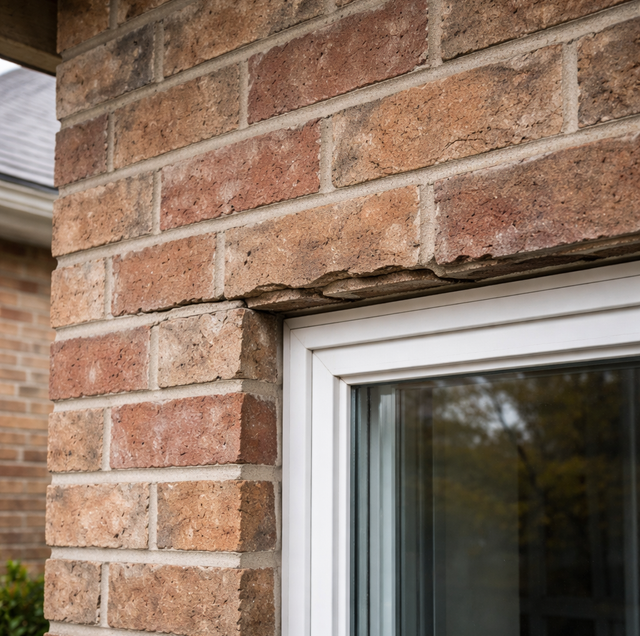
Quick Answer: Cracks above a brick window or door usually mean the lintel, the horizontal support carrying the brick over the opening, has rusted and swelled or is sagging under load. Rust can grow to several times the steel's original volume and lift the brick above it, cracking and displacing it. The fix is to replace or treat the lintel, rebuild the affected brick, and add flashing and weep holes so water drains instead of pooling on the steel.
A crack running above a window is easy to write off as a house being a house. Old buildings shift, plaster splits, hairlines open and close with the weather. But a crack that sits directly over a brick opening, especially one that steps diagonally through the mortar joints, is often pointing at a specific piece of hidden steel doing its job badly: the lintel.
Reading that crack correctly is the difference between a small repair now and a bigger, wetter, more expensive one later.
What a Lintel Actually Does
Brick is strong when you stack it and press straight down, and weak when you ask it to span an empty gap. A window or door is exactly that: a hole in the wall with courses of brick sitting above it that have nowhere to land. Something has to carry that load across the opening and hand it back to the solid brick on either side. That something is the lintel.
In most brick-veneer homes, the lintel is a steel angle, an L-shaped bar of steel tucked into the mortar bed above the opening. One leg of the angle runs horizontally under the first course of brick; the other leg stands up behind the brick, hidden inside the wall. The brick above rests on the horizontal leg, and the steel carries that weight sideways to the masonry beside the window. Older or higher-end homes may use a stone or precast concrete lintel, or a brick arch that carries the load through its own geometry, but the everyday version is that painted steel angle.
While it is sound, you never notice it. The wall reads as continuous brick, and the steel quietly holds the line. Failure is what makes it visible, and by the time it is visible, the steel has usually been struggling for a while.
How a Steel Lintel Fails
Steel fails for one of two reasons above an opening, and often both at once.
Rust That Grows and Pushes: A brick wall is not waterproof. Rain drives through the face of the brick and runs down the back of it, and if there is no flashing to catch that water and route it out, it collects on the top of the steel lintel and sits there. Steel plus water plus air equals rust, and rust is the real troublemaker because it does not just weaken the metal; it expands. Iron oxide can occupy several times the volume of the steel it came from. Trapped between the brick above and the steel below, that expanding rust has to go somewhere, so it lifts.
Masons call it rust jacking. The swelling steel and its rust layer jack the brick upward, opening the mortar joint directly above the lintel, cracking individual bricks, and pushing the lower courses out of plane. It is slow, it is relentless, and it works year-round: freeze-thaw cycling drives moisture deep into the joints in the cold months, and plain humidity, sprinkler spray, and wind-driven rain keep the steel damp the rest of the year. The steel does not care what season it is, only whether it is wet.
Steel That Simply Sags: The second failure is simpler to picture. A lintel that was undersized, spans too wide an opening, lost too much thickness to corrosion, or was never bearing properly on the brick beside it will deflect under the weight it carries. As it bows downward in the middle, the brick above follows, and you get a sagging course and cracking where the masonry can no longer stay in its original line. A lintel can rust-jack and sag in the same wall, which is why the cracking pattern above a failing opening is often a messy mix rather than one clean line.
The Warning Signs to Look For
Lintel trouble tends to announce itself above the opening, not beside it. Watch for:
- A horizontal crack running along the mortar joint just above the window or door, sometimes with the brick above it lifted slightly proud of the brick below.
- Stair-step cracks climbing diagonally through the mortar joints from the upper corners of the opening.
- A rust stain, an orange or brown streak bleeding down the brick or weeping from the joint right at the lintel line, which means water is already reaching the steel.
- A visible gap opening under the first course of brick, where the rusting steel has pushed the masonry up and away from the angle.
- Brick that is bowing outward, displaced, or no longer flush with its neighbors above the opening.
- A sagging brick course that dips in the middle of the span.
- Windows or doors that stick, bind, or no longer close square, which can mean the opening itself is deforming as the support above it moves.
One of these on its own may be minor. Several of them stacked over the same opening is a lintel telling you it is done.
Why It Matters More Than It Looks
A cracked joint over a window is not just cosmetic, and it does not hold still. Once the seal above the opening is broken, water gets in more easily, which feeds more rust, which lifts more brick, which opens the crack wider. The failure accelerates itself.
Brick that has been lifted, cracked, and shoved out of plane above head height over a doorway or window is loose masonry waiting for gravity. If bricks over an opening are visibly displaced or bulging, keep people from underneath and get it assessed rather than waiting to see if it holds.
Because a lintel sits over a load-bearing part of the wall, a cracking or sagging one can also be a structural signal, not a surface blemish. That is a case for a professional evaluation, not a wait-and-see.
How the Fix Actually Works
Filling the crack and painting over it is the one thing not to do, because the steel underneath keeps rusting behind fresh caulk and the brick keeps lifting until the repair splits again. A real lintel repair deals with the steel and the water together.
Support, Then Replace or Treat the Steel: Because the lintel is carrying the brick above it, that load has to be temporarily supported, or shored, before the steel comes out. Shoring a live masonry load is skilled work with real consequences if it is done wrong, which is why lintel replacement belongs with a mason and not a weekend. Depending on condition, the steel is either replaced with a new, properly sized and corrosion-protected angle, or, if it is caught early and still sound, cleaned down and treated to stop the corrosion before it becomes structural.
Rebuild the Brick That Moved: The bricks that were cracked, jacked, or displaced come out and go back in true, rebedded on and around the new lintel so the wall is continuous and flat again. Reusable brick is salvaged and matched; broken units are replaced.
Flashing and Weep Holes So It Cannot Recur: The reason the first lintel rusted was standing water, so the repair has to give water a way out. That means through-wall flashing above the lintel to catch moisture inside the wall and direct it outward, and weep holes, small open gaps left in the mortar joint just above the flashing, so that water drains to daylight instead of pooling on the steel. Without flashing and weeps, a brand-new lintel is just a future rust problem on a timer.
Telling a Lintel Crack From Other Cracks
Not every crack near a window is a lintel. The location and pattern usually sort it out.
A lintel crack lives right at the top of the opening, running horizontally along the joint just above the window or door, or stepping up diagonally from the upper corners. It often comes with a rust stain or lifted brick, the fingerprints of the steel below.
Settlement cracks come from the ground, not the opening. When a foundation drops unevenly, cracks tend to run diagonally from the corners of openings, but the pattern usually continues well beyond the window and shows up across the wall, often widening toward the top and pointing back toward the part of the house that sank. Settlement affects the whole panel of brick, not just the strip over one lintel.
A control-joint or expansion-related crack is the wall relieving its own movement. Long brick walls are built with vertical joints designed to open and close as the masonry expands and contracts, and a straight vertical crack running floor to roof, especially near a change in wall height or a long uninterrupted run, is often that movement rather than a failing support. It is vertical and full-height, where a lintel crack is horizontal and parked over the opening.
When the signs overlap, or when a crack sits over a load-bearing opening and keeps growing, that ambiguity is itself the reason to have it looked at instead of guessed at.
Frequently Asked Questions
There is no fixed expiration, because it depends almost entirely on whether water was kept off the steel. A galvanized or well-protected angle with working flashing and clear weep holes can carry a wall for many decades. A bare or thinly painted angle with no flashing, sitting in a wall that lets water pool on it, can start rust-jacking in a fraction of that. The variable is not age; it is exposure, which is why two identical houses on the same block can be years apart in lintel condition.
Surface paint on already-corroded steel rarely holds, because rust keeps advancing underneath the coating and lifts it off. Proper corrosion treatment means mechanically cleaning the steel back to sound metal first, then applying a rust-converting or barrier coating rated for structural steel, and it only makes sense while the angle still has its thickness. Once the steel has lost real section or the brick above is already jacked, treatment alone is past its window, and the lintel needs replacing.
No, and that is a point in their favor, since a stone or precast concrete lintel has no steel to corrode. They fail differently instead: a stone or precast lintel can crack if it is undersized or overloaded, and a brick arch can drop or open at the joints if the masonry beneath one end shifts and loses its support. So the rust-jacking story is specific to steel angles, but any lintel can still fail structurally.
Every opening in a load-bearing masonry wall needs something spanning it, but the form changes with the span. Wide openings and garage or patio doors carry the most load and often use heavier steel or a reinforced beam. Very small openings, and openings in a non-load-bearing veneer panel, may use a light angle or, in some historic work, a brick arch or a stone header doing the same job. If there is brick above a hole in the wall, some form of lintel is carrying it.
It can be, and it is a commonly missed cause. When rust-jacking lifts the brick and opens the joint above a window, it also tends to disturb or bypass the flashing that is supposed to keep water out over the opening. Water then enters at the head of the window rather than the sill, which is why a leak that shows up along the top of the frame after cracking appears above it often traces back to the lintel, not the window unit itself.
It depends on the failure mode, and the direction is a clue. Rust-jacking pushes upward, so it tends to lift the course directly above the lintel and open the horizontal joint from below, sometimes leaving the brick proud. Sagging pulls downward, so it drops the center of the span and opens cracks that fan out toward the top as the brick tries to follow the bowing steel. Seeing which way the brick has moved helps a mason read whether corrosion, deflection, or both are driving the failure.
Get the crack above your window read before more brick moves — a quick lintel assessment tells you whether it needs treatment or a rebuild. Golden Stones Masonry serves St. Paul, Minneapolis, and Eagan. Call (612) 509-0718.
