

Foundation Cracks vs. Normal Settling: How to Tell
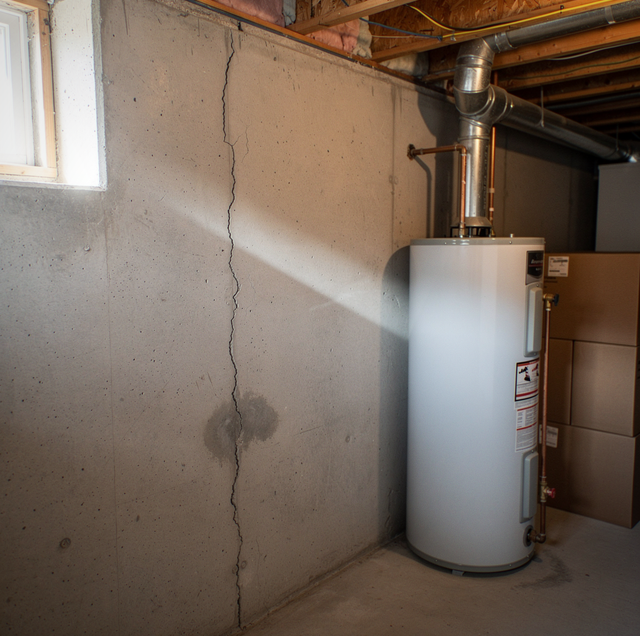
A thin line running up the basement wall behind the water heater is easy to miss for months, until the day the light hits it just right and you can't stop noticing it. The question that follows is almost always the same one: is this just what an old house does, or is it something that needs attention now? Most homeowners have no real way to answer that on their own, because a crack by itself doesn't tell you much. What it looks like, where it runs, and how it behaves over time tell you almost everything.
Not Every Basement Crack Signals a Problem
Poured concrete shrinks slightly as it cures, and that shrinkage keeps happening in small amounts for months, sometimes longer, after the forms come off. As the water in the mix evaporates, the concrete contracts, and that contraction has to go somewhere. Thin vertical cracks, often no wider than a credit card is thick, are one of the most ordinary results of that process. They tend to appear near the center of a wall panel rather than at a corner, and they usually remain the same width from top to bottom.
New construction also settles slightly as the soil beneath the footings compresses under the weight of the house during the first several years. That settling is uneven by nature, since soil density varies even across a small lot, so a house can develop a handful of small cracks as it finds its resting position. That kind of movement is ordinary: it's simply the materials and the ground beneath them settling into place.
Crack Width and Direction Tell You More Than Length
Length alone is a weak clue. A twelve-inch crack that stays hairline-thin the whole way is often less concerning than a crack only a few inches long that has already opened up wide at one end. Direction and width are what actually carry the real information.
Vertical cracks, running straight up and down with a consistent width, are the least concerning pattern in a poured wall. Diagonal cracks, running at roughly a 45-degree angle, are more common near the corners of window and door openings, where the wall is naturally weaker and uneven settling puts the most stress. Horizontal cracks are the pattern that deserves the most attention: a crack running side to side across a foundation wall usually points to lateral pressure pushing in from outside, not simple settling from above.
Width matters on its own scale. A hairline crack you can barely catch a fingernail on is typically low-concern. A crack in the range of an eighth of an inch is worth watching. Once a crack opens past a quarter inch, or wide enough to slide a coin into, it's outside the range that normal shrinkage and settling usually produce, and it's worth having someone look at it directly rather than guessing from a photo.
Stair-Step Cracks Follow the Mortar Joints for a Reason
Concrete block and brick foundations don't crack the way a poured wall does, because they aren't one continuous piece of material. Mortar joints between each block or brick are the weakest point in the wall, so when the footing beneath one section settles faster than the section next to it, the crack follows the path of least resistance: diagonally along the mortar joints, in a pattern that looks like a staircase.
This stair-step pattern usually widens as it moves toward a corner, which is often where the ground beneath the footing has shifted the most. It's frequently paired with a small visible step where one block or brick sits slightly proud of the one next to it, not perfectly flush the way it would sit in a wall settling evenly. A stair-step crack that's still narrow and hasn't reached the top of the wall is worth documenting and watching. One that's widening, or that has already traveled most of the wall's height, points to active differential settlement rather than finished settlement.
A Bowing or Bulging Wall Is a Different Problem
A crack is a break in the material, while a bowing wall is the material itself moving out of place. You can often catch it by holding a long level or a straightedge against the wall: a wall that's supposed to be flat but curves inward in the middle, or leans in more at the top or bottom than the rest of the wall, is bowing.
A bowing or bulging foundation wall is a lateral pressure problem that needs a professional assessment. Don't attempt to dig along the exterior of a bowing wall yourself. Excavation near a foundation under pressure can be hazardous, and it's a job for a professional with the right equipment and support.
That lateral pressure usually comes from soil outside the wall pushing in, the same kind of force a door feels when someone leans their full weight against it from the other side. Clay-heavy soil is the main driver: it swells when it takes on moisture and shrinks as it dries out, and that swelling generates real pressure against the foundation wall it's sitting against, causing the wall to ease and then build again on the same wet/dry cycle the soil goes through. Where the ground freezes, winter adds another push on top of that: water in the soil expands as it freezes, giving a wall already under lateral stress from wet clay an extra shove with every freeze-thaw cycle. A bowing wall rarely stays exactly where it is. It's one of the clearer signs that a foundation issue needs a professional evaluation rather than a wait-and-see approach.
Doors and Windows That Stick Can Be a Foundation Clue
A door that sticks on a humid afternoon and swings free again once the air dries out is telling you about the weather, not the foundation. That kind of seasonal swelling in wood framing and door slabs is normal and doesn't need to be connected to anything happening below the house.
A more meaningful pattern looks different. When a foundation settles unevenly, the framing sitting on top of it can rack slightly out of square, and that racking shows up as multiple doors or windows in the same area of the house binding at the same time, or a door that used to close cleanly now catching consistently at the top corner. A diagonal gap opening up between a door frame and the wall around it, especially on an upper floor above a spot where you've also noticed a foundation crack, carries real weight; a single sticky door on its own usually doesn't. Framing issues like this are secondary evidence. They support what a crack is already telling you; they rarely tell the story by themselves.
Whether a Crack Is Growing Is What Actually Matters
A crack that opened up years ago and hasn't changed since is a very different situation from one that's actively widening now, even if the two look similar side by side today. Tracking movement doesn't require anything complicated. Marking the tip of a crack with a pencil line and the date, and doing the same at a couple of points along its width, gives you a simple record to check against a few weeks or months later.
Active cracks tend to move on the same wet/dry cycle as the soil around them: clay expands as it takes on moisture during wet stretches and pulls back as it dries out, and a crack that's still active often opens and eases along with that swing. Where the ground freezes, winter adds another driver on top of that: freezing water in the soil pushes inward against the wall, and freezing water inside the crack itself wedges it further open; movement in a stable crack simply doesn't show the rest of the year. A crack that grows noticeably through a wet stretch, or through the cold months in a freezing climate, and then holds steady the rest of the year is worth a second look even if its current width still seems modest. Repeated checks build a trend, and the trend is what you can actually rely on.
What Efflorescence on a Foundation Crack Is Telling You
A chalky white deposit around a crack or along the base of a foundation wall is efflorescence, a mineral salt left behind after water that carried those minerals through the concrete or masonry evaporates at the surface. People sometimes mistake it for mold or a surface coating, but it's a natural byproduct of moisture moving through porous material. Its presence is a direct sign that moisture is finding a path through the wall, whether through a crack, a porous section of block, or a joint that's lost its seal.
Efflorescence around a minor crack doesn't necessarily mean the structure is at risk. It does mean water is getting in somewhere it shouldn't, and left alone, that moisture path tends to keep working: it can carry more salts to the surface over time, contribute to spalling on the interior face of the wall, and create the kind of persistent damp conditions that make a basement uncomfortable and encourage mildew. A crack with efflorescence around it is a reasonable trigger to get both the crack and the water source it's exposing looked at together.
When to Call a Professional Instead of Watching and Waiting
A few patterns move a crack from something to note into something to act on: a horizontal crack anywhere on a foundation wall, a crack wider than roughly a quarter inch, a crack that's visibly grown since you first marked it, a bowing or bulging wall, and a stair-step crack that's widening or paired with sticking doors and windows in the same part of the house. Any one of those on its own is worth a professional look. Two or more together move it from "worth checking" to "worth checking soon".
Photograph any crack you're tracking next to a tape measure or ruler each time you check it, with the date visible in the shot. That gives whoever inspects it later a clear before-and-after record, rather than just a memory of how it looked a few months back.
A foundation inspection doesn't require guesswork on your part. A trained eye can usually tell within a single visit whether a crack fits the normal-settling pattern or whether it's part of something that needs repair, and can check things a homeowner generally can't, like whether the wall is plumb along its full height, how the crack behaves under light pressure, and what the drainage and grade around the footing are doing.
Frequently Asked Questions
A hairline crack that's stable and shows no efflorescence often doesn't need structural repair, but sealing it with an appropriate crack filler is still worth doing, since even a narrow opening can let water vapor and, during heavy rain, small amounts of liquid water into the wall over the years. Sealing is a maintenance step, not a fix for an active structural crack.
Most of the settling a new foundation will ever do occurs within the first 1 to 5 years, as the soil beneath the footings compresses under the weight of the completed structure. Homes older than that can still develop cracks, but those later cracks are more often tied to soil moisture changes, tree root activity, or drainage issues than to the original settling process finishing up.
Cracks usually develop gradually, but a sudden crack can appear after a specific event, such as a heavy, fast rainfall that saturates the soil around the foundation, a burst or leaking pipe that soaks the ground next to the footing, or nearby excavation work that disturbs the soil supporting the wall. A crack tied to a clear, sudden event is worth looking at sooner rather than adding to a watch list.
No. A poured wall is a single continuous piece of concrete without mortar joints to follow, so uneven settling in a poured foundation typically shows up as a diagonal crack radiating from the corner of a window or door opening, rather than the zigzag stair-step pattern seen in block and brick walls. When the crack doesn't start at an opening, it often starts at the wall's weakest cross-section instead: a utility sleeve, a form tie line, or a beam pocket, since that's where the concrete has the least material to resist the stress.
Adhesive crack monitors are the most precise option: small plastic gauges installed across the crack with a printed scale that reads width changes down to about a hundredth of an inch, far finer than the pencil-mark method most homeowners start with. They're inexpensive and worth using once a crack is borderline and you want a clear, dated record before deciding whether to call someone.
They can be. Diagonal drywall cracks radiating from the top corners of doors and windows often show up when the framing above an uneven foundation racks slightly out of square, stressing the drywall at those weak points first. A single small drywall crack is common in almost any house, but several appearing at the same time in the same area, especially alongside a foundation crack below, points toward the same movement rather than two unrelated issues.
Schedule a foundation crack evaluation — get a clear read on whether what you're seeing is normal settling or something that needs repair. Golden Stones Masonry serves St. Paul and the Twin Cities. Call (612) 509-0718.