

Why Pavers Heave and Shift in Winter: It Starts Below
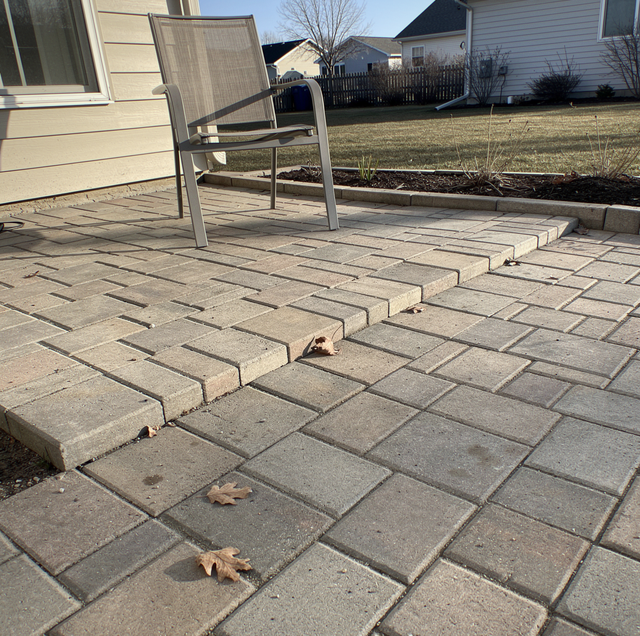
You covered the furniture in the fall, and the patio was flat. When the ground opens up again, there is a ridge running across it, two or three courses wide, high enough that a chair rocks on it and low enough that nobody saw it under the snow. At one joint the corner of a paver stands proud of its neighbor, and you catch a toe on it.
Nothing is wrong with the pavers. No cracks, no crumbling faces, the same units somebody set there. They have been moved, and pavers do not move on their own. A paved surface is a stack of layers: the subgrade, the compacted base, the bedding course, the units, the joint sand, and the restraint holding the perimeter in. Movement at the surface is the work of one of those layers, so reading it means starting at the bottom.
Three Different Motions, Three Different Repairs
Sort the motion first. Three things move a paved field, and they are not versions of one problem.
| Motion | Direction and timing | What it looks like from above |
|---|---|---|
| Heave | Upward, with the freeze, often eases by spring | A ridge or raised lip standing proud of the field |
| Settlement | Downward, permanent, worse each year | A dish that holds water after rain |
| Creep | Sideways, permanent, never reverses | Joints opening on one side, pattern out of square |
Heave can recover once the ground below thaws and drains, sometimes to within a few millimeters of where it started. The other two never reverse on their own.
The distinction determines the repair: a ridge that flattens by early summer is a drainage problem under a layer that is otherwise sound, while anything that holds through summer means the layer underneath has changed shape.
Set two nails at the patio edge as reference marks, lay a straightedge across the ridge between them in late fall, then measure the same gap in early summer. Two readings separate a seasonal lift from a permanent one.
The Subgrade Is Where Ice Lenses Grow
The soil beneath the base determines whether heave is possible at all, and the mechanism is not the one most homeowners are told about. Water expands roughly 9 percent when it freezes, which does not explain a ridge: 9 percent of the water in a few inches of soil raises a surface a small fraction of an inch. Patios lift an inch. Sometimes two.
What produces that is ice lens formation. As the freezing front works down into fine-grained soil, ice already formed draws unfrozen water toward it through the pore network, and that water freezes onto the underside of the growing crystal. The lens is not limited to the water already there: it keeps pulling more from below and thickens into a layer of clear segregated ice, and everything above rises by that thickness.
Soil type governs the pull. Silt is the worst material in the ground for this: its pores are fine enough for strong capillary action and open enough for water to move quickly, so a lens is fed about as fast as it can freeze. Silty clays heave badly. Clean coarse sand and open-graded gravel barely heave at all, because pores that large carry almost no capillary rise.
Three conditions must hold at once: soil that is frost-susceptible, water available to migrate into it, and freezing temperatures that reach that layer. Take away any one and the heaving stops. Everything built above the subgrade is an attempt to remove one of them.
The Base Either Drains or Holds Water
The base spreads the load and determines where water goes, which is the job that matters in cold weather. A dense-graded crushed aggregate runs particle sizes down through the fines, compacts to a tight, strong platform, and holds water in those fines. An open-graded base is washed stone in a narrow size range, commonly a No. 57 gradation, holding 30 to 40 percent voids after compaction and passing water straight through.
Either works over ground that drains. Over a low-permeability subgrade, a dense-graded base with no outlet becomes a basin: rain and snowmelt come in through the joints, sink to the bottom of the excavation, and sit at the one elevation where they do the most harm. The water condition is then delivered from above all winter to soil that was already frost-susceptible. A base that traps water is worse than no base at all, because the excavation created a water supply the natural ground never had. Two details prevent it: an outlet at the low end and a geotextile fabric between the subgrade and the base that keeps soil fines from pumping up into the stone.
Compaction shows up years later. Base goes down in lifts of about four inches, because a plate compactor's energy does not reach the bottom of a thicker layer, and eight inches dumped and rolled once leaves the lower half loose. A field that lifts as one plate and comes back down is invisible. A field where one part of the base is saturated and the next is not gets a ridge along the line between them. Differential heave breaks a patio. Total heave usually does not.
The Bedding Layer Is Thin, and It Moves
Between base and pavers sits about one inch of coarse washed sand, screeded flat and left uncompacted until the units are down and vibrated in. Over an open-graded base, the bedding is small stone chips, a No. 8 or No. 9 gradation, so it does not choke the drainage the base provides.
Thickness is the first way it goes wrong. Bedding much thicker than an inch and a half consolidates under traffic, never uniformly, so a surface laid over sand used to cover a badly screeded base takes on shallow ruts along the paths people walk.
Migration is the second. Fine sand set on large open stone with no choking course works down into the voids, and support disappears in patches rather than everywhere at once. Water does it faster: any route that lets water run sideways under the surface carries sand with it. That is why a dish holding rain is nearly always bedding rather than subgrade.
The Pavers Are a Field, Not a Set of Pieces
A concrete paver has almost no structural relationship to its neighbors by itself. Interlock is what makes a field behave as one surface, and it works in three directions: vertical load transfer through the joint sand, so a footstep is carried by a group of units; resistance to rotation under an edge load, from unit thickness and full joints; and horizontal restraint from the laying pattern. Herringbone at 45 or 90 degrees breaks every continuous joint line, while running bond leaves straight lines a field can slide along.
Thickness follows use, roughly 60 mm for foot traffic and 80 mm where a vehicle runs. Under a heaving base, the unit moves with whatever is beneath it, whichever thickness it is. Face flaking on the paver itself, where the surface sheds thin scales and shows the aggregate underneath, is a water-inside-the-unit failure and says nothing about the layers below.
It is also why lifting and resetting pavers over a base nobody has assessed so often goes wrong: the courses on both sides of the opening lose the restraint they were relying on, and the reset run heaves again next winter, with a disturbed edge on each side.
Joint Sand Controls Water at the Surface
Joints run about 2 to 5 mm wide and are filled with sand for the full depth of the unit. That column of sand is the medium through which one paver hands load to the next, and a joint filled halfway transfers load halfway.
The joints also control the surface's water. Full joints shed most of what lands on them toward the perimeter and admit the rest at a rate the base can carry away. Open joints take in everything during the season when the base has the least spare capacity, because its lower part may already be frozen. Water that enters the bedding in December is not leaving until spring.
De-icing is where owners make a bad patch worse. Rock salt drives chloride into the paver face, multiplying the freeze-and-thaw cycles it undergoes in a season, and a heaved area is already taking that punishment through the open joints beside the lip. Traction sand and an early shovel hold the line until working weather.
Edge Restraint Is the Layer That Fails Quietly
Every paved field is trying to spread outward. Each footstep and wheel load pushes the units a fraction sideways, and the only thing standing against it is the perimeter restraint: spiked edging set on the compacted base and pinned through it, a concrete haunch against the outer course, or a soldier course bedded in concrete. The perimeter is also the coldest part of the assembly, losing heat upward and sideways at once, so frost reaches deeper at the edge than under the middle.
When restraint goes, the sequence is a loop rather than a single failure. The outer courses creep outward. Creeping opens the joints. Open joints let in more water and lose their sand. Wet bedding with less sand above it supports less, so units move more freely, pushing the edge farther and opening the joints wider. Each winter starts from a worse position than the last, and nothing in that circle breaks on its own. Restoring the edge is what stops it.
A retaining wall that leans or bulges is answering to soil pressure behind it rather than to frost beneath a horizontal surface, and it is judged on different measurements.
Why One Corner Goes First
Damage requires difference, one part of the assembly behaving unlike the part beside it, and two places supply it more reliably than anywhere else.
The first is a downspout. A roof plane of a thousand square feet draining to a single outlet delivers an enormous volume to a single spot at grade, and if that spot sits beside paving, it feeds water straight into the soil along the field's edge. Carrying the discharge past the paving removes one leg of the requirement where it was strongest.
The second is the wall of a heated building. A basement wall radiates heat outward all winter, so frost does not penetrate as deeply in the first few feet off the house as it does in the open. The freezing front runs at an angle through that zone, so the depth of the lift changes across a short distance and the surface has to bend to take it. The backfill there was also dug out and put back, usually with the fine soil that came out of the hole, and rarely compacted to the density of undisturbed ground.
Two nearby failures look related and are not. Cracking in the foundation wall itself follows soil pressure and moisture against that wall. Stone or masonry steps carry a footing, and a riser geometry the flat field does not have, so cracking or bowing there is read differently.
A heaved joint standing a half inch proud is a trip hazard, and snow hides it completely. Mark the high edge with a stake before the first snowfall, and keep foot traffic off that run until the surface has been reset.
Frequently Asked Questions
Often, partly. What catches people out is the stretch of weeks when the upper soil has thawed, but the ground below is still frozen, so meltwater cannot drain, and the thawed layer sits at its weakest bearing strength of the year. Keep vehicles and heavy deliveries off it then.
Lift one unit at the field edge and look at what is under the bedding. Angular crushed stone shows fractured faces that interlock and resist being pushed apart by hand. Rounded material, bank-run gravel or pea stone, never locks, whatever compaction it got.
No. It binds the joint against washout and weed growth, which is worth having, but it does nothing below the bedding course where heave starts. It also carries an installation trap: swept into damp joints or activated over a dirty surface, it can crust and haze, and that crust sheds water to the perimeter rather than through the joints.
Only with the machine set for it. Raise the skid shoes until the auger housing clears the high lip by more than the lip stands proud, and take the first pass across the ridge rather than along it, so the housing rides over the step instead of driving into its face. A blade catching a raised edge can shear the corner off a unit and throw the piece.
A paver field is not built to frost depth the way a footing is. It is built to drain, which removes a different leg of the same requirement. Frost depth is not fixed either: ground kept bare by shoveling freezes deeper than ground under snow cover, because snow insulates. That is why a cleared walkway heaves while the lawn beside it does not.
The units themselves are almost always reusable, since heave moves them rather than damaging them, and the work sits in the layers underneath. Before anything is lifted, photograph the pattern and mark the perimeter course, including the direction of any cut units, so the reset closes at the joint width it started with.
Have a heaved patio assessed before the next freeze — a look at the base and the drainage tells you whether it needs a reset or a rebuild. Golden Stones Masonry serves St. Paul and the Twin Cities. Call (612) 509-0718.