
Natural Stone for a Fire Pit: What Actually Holds Up
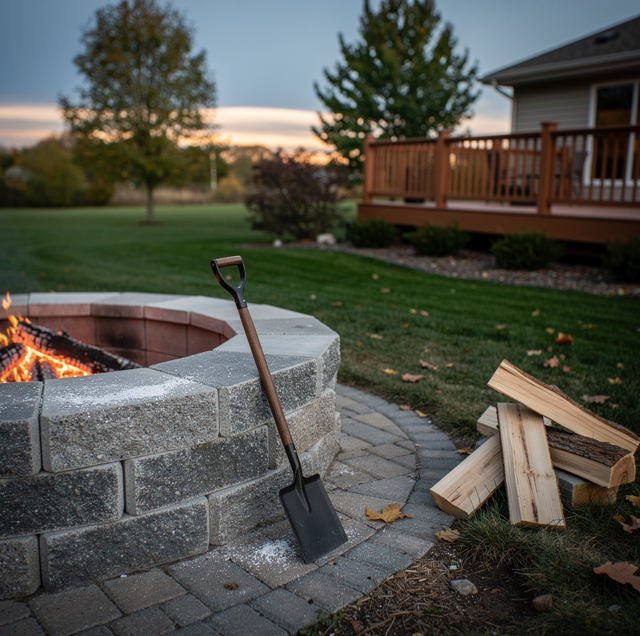
You feel the stone warm under your palm before the flame reaches it, and once your fire has burned an hour, you feel heat coming off the ring itself, not just the coals. Sparks lift against the dark, wood pops and settles, and the smell clings to your jacket long after you're back inside.
What you are sitting around is the stone you picked before you struck the first match, and every stone responds to your fire differently once you actually start using it. You're choosing a material that has to sit inches from your open flame, night after night, and still hold its shape for you, year after year, whatever you eventually pick for your own yard.
Why a Fire Pit Asks More of Its Stone Than a Patio Does
A patio spends its life absorbing slow seasonal heat and whatever moisture the weather sends it. A fire pit ring carries both of those loads plus something a patio never faces: a direct flame a few inches from its face, climbing from ambient temperature to several hundred degrees in minutes and dropping back just as fast once the fire dies down. That swing repeats every time you use it, and it's the swing itself, not the peak temperature alone, that does the damage over time.
That is one reason a paver rated for patio wear is not automatically rated for a fire pit ring. The two jobs look similar from the yard, but one asks a material to survive foot traffic and freeze-thaw, and the other adds rapid, repeated thermal cycling on top of both. Whatever the ring is built from has to meet all three demands at once, not just the two a typical outdoor-stone product was ever tested against.
Comparing the Common Fire Pit Building Materials
Four material classes turn up in most backyard fire pit quotes, and they don't perform the same against direct flame, freeze-thaw, or time. The table below compares them on the traits that actually determine how a ring holds up, not on look alone.
| Material | Direct-flame tolerance | Freeze-thaw behavior | Typical lifespan |
|---|---|---|---|
| Dense natural stone (granite, quality fieldstone) | High when dry and dense | Very good; low water absorption | Decades |
| Quarried flagstone, used as a cap | Good away from direct flame | Good if dense-grained | Decades |
| Fire-rated manufactured concrete pavers | Moderate; only the rated products | Good when rated for the climate | 15 to 25 years |
| Standard patio pavers, not fire-rated | Poor; can spall or fracture | Variable | Not recommended |
A "fire-rated" label matters as much as the material class underneath it. A manufactured paver built for a walkway isn't the same product as one engineered to face an open flame, even when the two sit side by side on a supplier's shelf and look nearly identical to you.
What Cracks a Fire Pit Stone Before It Should?
Thermal shock, not age, is what cracks most fire pit stone early. The face closest to the flame heats and expands faster than the cooler stone behind it, and that mismatch puts the surface layer under stress it was never built to carry. Once a hairline fracture opens, every fire after it widens the gap a little more, until a chunk finally lets go.
Cold nights make that swing sharper, since a ring can run several hundred degrees at the face while the air a foot away sits near freezing, and that gap is exactly what drives the fracture along fastest. Heat does its own version of the same damage the rest of the year, though, since bone-dry stone with no residual moisture to buffer it heats and cools even quicker than stone that still holds a little from the last rain, which is why a dense, well-chosen material earns its keep on a July night as much as it does after a hard winter freeze, and why the failure you eventually see traces back to hundreds of small swings, not any single one. Denser stone with less internal pore space simply has less room for that swing to do damage in, which is the same property that made it worth paying more for in the first place.
Granite, Fieldstone, and Flagstone Are Not Interchangeable
Granite is a dense igneous rock with very low porosity, and that structure is exactly what lets it shrug off both thermal cycling and freeze-thaw better than almost anything else you could set around a flame. Less pore space means less room for water to sit inside the stone, so the whole piece expands and contracts together, not in patches. It costs more and weighs more to move, which is the trade-off you accept for that performance, and it's rarely the material that fails first in a ring built from it.
"Fieldstone" isn't one material; it's a shape category, and what a supplier calls fieldstone can be granite, gneiss, or a softer sedimentary rock depending on the deposit it came from. Two loads labeled the same way at the yard can behave completely differently once they sit next to real flame, so the parent rock underneath the label matters far more than the label itself. A mason who handles fieldstone regularly can often tell the difference by weight and by how the surface feels underfoot, but you generally cannot sort it that way yourself from a photo or a pallet at the yard.
Flagstone is sedimentary and naturally layered, which makes it a strong choice for a seating cap or a surrounding patio surface but a weaker one as the ring facing itself. Direct, repeated heat can drive those layers apart along their own natural bedding planes over a season or two, a failure mode granite and dense fieldstone simply don't share with it, and it's worth asking a mason which role each stone is actually suited for before you assume any "natural stone" performs the same way once it sits an inch from open flame, not just underfoot.
Why Porous or Wet Stone Is a Hazard Before It's Ever a Flaw
Some stone types, river rock especially, carry water inside their pore structure long after the surface looks dry to you. Set one of those into a fire pit and the trapped moisture turns to steam far faster than it can escape, and the stone can shatter outward with real force, throwing sharp fragments toward anyone standing nearby.
Porous or water-saturated stone can explode when heated, throwing sharp fragments toward anyone near the fire; have your mason confirm each stone's fire rating and moisture level before it goes in.
That risk is a material-selection question rather than a cosmetic one. Stone with a visibly open, sponge-like pore structure, and anything pulled straight from a riverbed or a wet yard, belongs on the list of materials a mason rules out before the first piece is set, not one you discover is a problem after your first real burn.
How the Base and Ring Construction Decide What the Stone Can Do
The stone itself is only part of the answer. What sits beneath and behind it shapes the rest: a compacted base below frost depth keeps the ring from shifting, and a liner insert absorbs direct flame contact so the facing stone mostly handles radiant heat instead.
Mortar matters just as much as the stone it holds. A mason lays flame-facing joints in a fire-rated, refractory mix, not the standard type used on a garden wall, since ordinary mortar breaks down under heat no matter how good the stone is.
What Cracks a Fire Pit's Stone When It Burns Gas Instead of Wood?
A gas fire pit runs cooler and more evenly at the burner than an open wood fire does, but it concentrates that heat at a few fixed points: the burner pan, the fire glass or lava rock bed, and the metal ring closest to the flame.
Cracking risk concentrates around those points, not across the whole face, as it does with wood.
A wood-burning pit exposes its entire interior face to higher, more variable heat and to embers that can land anywhere inside the ring, which is a wider and less predictable load than a gas burner puts on the same stone. Because a gas line and its connection are involved in one of the two builds, that part of the work belongs to a licensed installer and falls well outside anything covered here.
Matching the Stone to How the Fire Pit Will Actually Be Used
A fire pit you light twice a season asks far less of its stone than one that runs most weekends from spring through fall, and that gap in use is worth weighing honestly before you spend more on a premium material than your own habits will test. Frequent, hot, hours-long fires reward the densest, lowest-porosity stone you can afford; occasional smaller fires give a wider range of materials room to hold up just fine.
Seating distance changes the outcome too. Stone with high heat retention keeps a ring of chairs comfortably warm well past the usual two or three feet, but it also concentrates reflected heat if your seating sits closer than that, which is worth checking against your own patio layout before you commit to a material you can't easily swap out later. A lighter-colored, lower-density stone gives up some of that retained warmth on a cool night, a real trade for anyone who plans to sit close in.
None of that changes as much as one condition does: how close the pit sits to a deck, a fence, or the house itself. Even the best fire-rated stone doesn't reduce the clearance a structure needs from open flame, so a tight site turns the real decision into a placement question you settle before you ever choose a material, not the other way around. Move the pit, and almost any well-chosen stone on this page can work; keep it tight against a structure, and the strongest material available won't change what the clearance itself requires of you.
Frequently Asked Questions
You can, but the two rarely expand and contract at the same rate once real heat cycles through them again. A mismatched seam is usually the first place a hairline crack or gap opens up on you, so your mason will typically keep your flame-facing ring in one material and save any mixing for your cap, safely away from direct heat.
Yes. A darker stone absorbs more radiant heat and holds it longer after your fire dies down, so the rim can stay warm to your bare skin well after the flames themselves are out. That gap matters most for young children and pets moving around your fire pit once you assume it has cooled, since the flame is gone well before your stone underneath it ever quite catches back up.
Clearance to a combustible structure is set by the structure and your fuel type, not by which stone faces the ring, and no material choice shrinks that distance for you. A fire-rated ring still needs the same distance from your deck or fence that a lower-grade one does, so confirm your own required clearance before you settle on a spot, and treat that as a separate step from choosing your material, not a substitute for it.
Either approach can work, and which one fits depends on the stone you're using more than on your own preference. A mortared ring uses a fire-rated mix at every flame-facing joint for strength, while a dry-stacked ring relies on stone weight and your compacted base instead of mortar, which asks you to use larger, heavier units and fit them carefully so your ring stays stable through a full season, even once you then start building noticeably bigger fires in it every single week.
Sometimes, and it depends on what that stone already went through before you set it aside for later use. Reused stone can carry hairline stress fractures from an earlier freeze-thaw season that stay invisible until direct heat opens them further, so a piece that served your patio well for years can still fail its very first fire in your ring. Have your mason look over leftover material before it goes in, since that stone's history matters here in a way it never did while you walked across it every day.
Yes, and it changes the outcome more than most people expect going in. A steel or masonry liner insert takes the direct flame contact in place of the facing stone, so the facing material only has to tolerate radiant heat and freeze-thaw, not open fire against its surface every time the pit is lit. That shift widens the range of stone that can work safely on the outside of a ring, since the liner absorbs the harshest part of the load the facing stone would otherwise carry alone, without you paying for it twice. It doesn't remove the freeze-thaw question, and it doesn't make a porous stone safe again, but it can let your mason offer you a material that would never survive direct flame contact by itself.
Get a fire pit material recommendation built around your own yard — a mason can weigh your site's sun and wind exposure, expected use, seating layout, nearby structures, and freeze-thaw conditions before you settle on granite, fieldstone, flagstone, or a fire-rated manufactured stone for the finished ring. Golden Stones Masonry serves St. Paul and the Twin Cities. Call (612) 509-0718.