

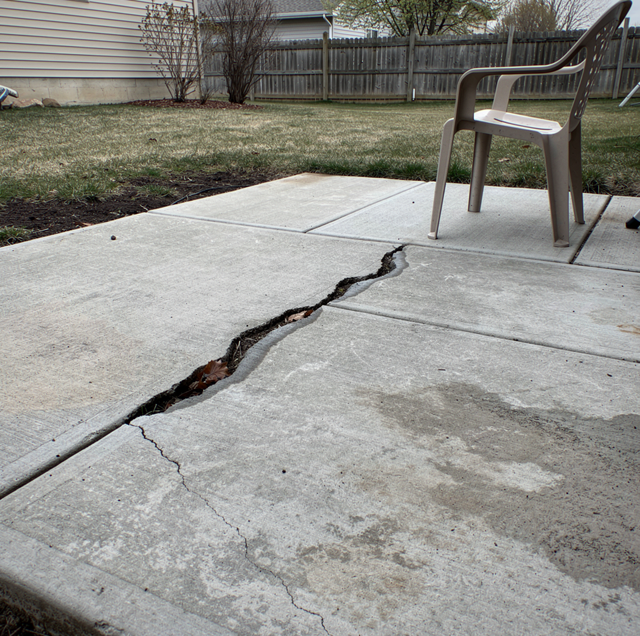
A poured concrete patio is a single slab: one piece of material placed and left to cure as a rigid whole. A paver patio is built the opposite way: a field of separate units set on a compacted base and a thin layer of bedding sand, held in place by sand packed into their joints and by restraint running along the edge. That difference in how each is built is also why each one fails on its own terms. A rigid slab cannot flex or shift piece by piece, so movement in the ground beneath it appears as a crack running across its face. A paver field is made of parts that can move independently, so the same ground movement appears as a dip, a raised course, or a joint pulled open, while the units themselves can remain intact. The two surfaces are repaired on different terms as well: a crack in a slab is patched and sealed in place, or the damaged panel is cut out and repoured, and the patch remains visible for the life of the patio. A section of pavers is lifted, the base beneath it is corrected, and the same units go back down, which is why a paver repair can disappear into the surrounding field in a way a concrete repair does not.
Concrete and pavers compared on build, movement, repairs, base failure and wear:
| Concrete Slab | Paver Patio | |
|---|---|---|
| How it is built | One continuous slab placed and cured, divided by control joints | Separate units set on a base, bedding sand, and joint sand, held in by edge restraint |
| What ground movement does | A crack runs across the face of the slab | A course dips, rises, or shifts out of line while the units stay whole |
| Where trouble shows first | At corners, re-entrant corners, and around posts or drains | At the edges of the field and in low spots |
| What a repair looks like | A patched or sealed crack, or a panel cut out and repoured | Units lifted, the base corrected, and the same pavers relaid |
| What a failed base means | A slab section is broken out and repoured | The base under the lifted area is reworked before the pavers go back |
| Surface wear | Scaling or a spalled surface over time | Joint sand loss and weeds between units |
A Slab and Why It Cracks
Concrete shrinks as it cures. As water leaves the mix, the slab pulls inward across its entire area. The ground beneath it grips its underside, so it cannot shrink freely, and the tension releases as a crack forms wherever it is weakest. Control joints give it a planned place to do that instead: shallow grooves tooled or cut into the surface create a weaker line, so the crack that shrinkage was always going to produce follows the groove rather than running across the middle of a panel.
Once the slab has cured, the remaining risk is what happens under it rather than inside it. A concrete patio sits on a base of its own, compacted gravel or soil, and if that base settles unevenly, the rigid slab above cannot follow the new shape without cracking. A slab does not bend to match a dip in the ground the way a flexible surface can; it either remains supported everywhere beneath it or cracks where support ends. Load adds to the same weakness at specific points. A corner carries less concrete around it than the middle of a panel does, and a re-entrant corner, where an L-shaped step or a post interrupts the slab's edge, concentrates stress at the point with the least material to resist it. That combination, thin geometry meeting settlement or load at the same spot, is why a crack can start at a corner and travel inward rather than starting at the center of a panel.
A Paver Field and Why It Shifts Instead
A paver field has no shrinkage to release and no continuous body to crack because it was never placed as a single piece. Each unit is free to move on its own, held to its neighbors only by the sand packed into the joints between them and, at the perimeter, by a restraint that keeps the whole field from spreading outward. That structure means a paver patio does not fail the way a slab does. Instead of a crack, ground movement beneath one part of the field shows up as a dip where support has gone, or a raised course where the underlying base has risen, while the units on either side of the disturbed area can remain flat and intact.
What a Repair Looks Like on Each
A concrete repair, whether it is a sealed crack or a repoured panel, is bonded to the slab it is repairing. New concrete does not exactly match the color, texture, and weathering of the surrounding slab, and the repaired area remains visible as a distinct patch for as long as the patio is in service. Sealing a crack keeps water out, which slows further damage, but it does not make the crack disappear from view.
A paver repair reuses the units already in place. Because the units themselves are not the part damaged by the ground movement that displaced them, lifting the affected section, correcting whatever shifted beneath it, and resetting the pavers in the same pattern restores the field to its original appearance. The repair can vanish once the joint sand is swept back in. The trade-off runs the other way during the work itself: a concrete repair can be carried out without disturbing the surrounding surface, while a paver repair requires lifting more of the field than the damaged section alone to reach the layer that needs correcting.
Drainage and the Base Under Both
Both surfaces depend on what sits beneath them, and water works against either kind of base. A concrete slab needs the ground under it to hold its shape; a paver field needs its base to keep draining so the bedding layer under the units does not turn saturated and soft. Water that collects under a patio, whichever kind sits on top, softens the material supporting it, and a base that has lost its bearing capacity in one spot settles or shifts there before it does anywhere else.
The starting point for both is a grade that sheds water away from the foundation line rather than pitching it back toward the house. A patio sloped even slightly the wrong way sends rain into the same low corner, and water held there works on the base under either surface. Water pooling on the surface after a rain marks a low spot, caused by a grade set wrong or a base that has settled beneath it.
A garden hose left running slowly at a patio's highest point shows where water travels across the surface, and any spot where it stops and gathers is a low spot that holds rain too.
Tree Roots and Heavy Loads
A root growing under a patio pushes on whichever surface sits above it, and the two respond differently: a slab cracks along the line the root follows, while a paver field lifts in a course that traces the same path and can be reset once the root is addressed. A heavy load left in one place for a long stretch- a hot tub, a loaded planter, a parked vehicle- asks something different of each surface: a slab spreads that weight across its whole rigid body, while a paver field relies on the base directly under the load to carry it, since the units on either side only share weight through the sand in the joints. Concentrated weight on ground that was not built to carry it is a base problem before it becomes a surface problem, on either kind of patio.
A raised slab edge or a lifted paver is a trip hazard and is marked or kept clear until repaired. Buried gas and utility lines are located through the utility locate service before a mason digs or breaks out concrete.
Choosing a Patio Surface by Use and Repair
Deciding between the two starts with how you plan to use the space and what a future repair would mean for that use. A slab provides an uninterrupted plane, which suits an area meant to read as one continuous surface, such as a dining space against the house or a wide pad. A paver field gives up that continuity in exchange for a repair that can vanish into the pattern, which suits a surface likely to need attention again, a walkway near a downspout or a patio built over ground that has already shown some settlement.
Frequently Asked Questions
Not always. A hairline crack that runs straight across one panel can be a shrinkage crack settling into the joint pattern; sealing it to keep water out is enough. A crack that runs diagonally from a corner and keeps widening can mean the base is moving, rather than shrinkage, and that kind is worth having looked at before it reaches the next panel.
Sometimes, if the slab underneath is sound. A solid, uncracked, unsettled slab can serve as part of the base for a new paver surface set over it, since it already gives a flat, stable platform. A slab that is cracked or has settled cannot: movement still happening in that old concrete telegraphs straight up through the bedding and shows in the paver joints above it, so a slab in that condition gets removed rather than built on.
No. Control joints divide a slab into panels, so a single crack confined between two joints is addressed at that panel: cut out and repoured, while the rest of the slab continues to do its job undisturbed. A patio that shows cracking in several panels at once signals trouble in the base under the whole surface rather than a local weak spot.
Yes. A stamped or exposed-aggregate finish breaks the surface into texture and shadow lines that a crack can hide inside for a while, so early cracking on a textured patio can go unnoticed longer than it would on a smooth one. A broom-finished or smooth-troweled slab shows a crack as soon as it opens, which gives an earlier warning of the same underlying movement.
Yes, on a mortar-set patio laid over a concrete slab. A paver field set on sand over a compacted base keeps sand joints, because sand lets each unit move slightly with the load and the base, while a rigid mortar joint over a flexible base cracks when that base shifts.
The seam between the patch and the original concrete tells it. A patch doweled or bonded into the old slab sits flush with it as both age, while a patch simply placed against the cut edge, with nothing connecting the two, can separate along that seam into its own small crack or a slight step.
Line up patio installation or repair — a compacted base, poured concrete or pavers set and restrained, and relaying or crack repair on a patio that already shows movement. Golden Stones Masonry serves St. Paul and the Twin Cities. Call (612) 509-0718.