

Emergency Masonry in Minneapolis
On a Sunday afternoon in May 2011, a tornado crossed North Minneapolis. Six months later, the City was still counting houses with damaged roofs and chimneys. It shows what storm damage to a chimney turns into when the weather closes in before the repair is done.
10 Years
Workmanship warranty, in writing
May 22, 2011, in North Minneapolis
The National Weather Service rated the North Minneapolis tornado EF1, with an estimated peak wind of 100 mph. It touched down in St. Louis Park, crossed a corner of Golden Valley and entered Minneapolis between Glenwood Avenue and 16th Avenue. Inside the city, it intensified, and the Weather Service's survey reports that garages and sheds were demolished and roofs were partly torn off. The heaviest damage ran from Penn and Broadway to the Camden Bridge, where the tornado crossed the Mississippi.
Roofs, garages, and the chimney are the parts of a house that withstand the wind and falling trees. In the Near North and Camden communities, about seven in 10 and six in 10 of the houses on the City's records were built before 1940, so a stack hit that day had in many cases stood 70 years or more, and a blow to joints that old can open them well below the crown.
Reports logged with the Weather Service that afternoon describe roofs and second stories missing or damaged on houses around Lowry and Logan Avenues. Where the wind opened up an upper story, the chimney running up through it may be damaged both inside the house and above the roof, so the stack is checked along its full height, from the room under the roof to the crown.
EF1
Peak wind speed, EF1
What City Inspectors Were Still Finding in November
MPR News reported on November 15, 2011, that the tornado had damaged about 3,600 properties in north Minneapolis. City inspectors told the station that about 500 still had damaged roofs, chimneys, or electrical masts, and that 232 of those were still under blue tarps, nearly six months on. In late September, MPR reported that the City, the county, the state, and nonprofit groups were raising money to help as many people as possible finish repairs by December, so the houses would not sustain further damage in the cold.
For masonry, the problem there was the calendar. A tarp keeps rain off for a while. It does not hold a damaged stack together, and a cracked crown or open joints left through a winter of freezing and thawing come out of it worse than they went in. Fresh mortar has to cure before it freezes, so on a stack damaged late in the year, whatever goes on it in the meantime may have to hold through the cold.
How the first visit and the permanent repair are scheduled, and why they run on different timelines, is on our emergency masonry page.
3,600
Properties damaged, citywide
Whose Tree Is on the House
In Minneapolis, who takes a fallen tree off a chimney depends on where the tree stood. The Minneapolis Park and Recreation Board looks after boulevard trees, the ones between the curb and the sidewalk. The Park Board removes boulevard trees that fall on houses; a tree from your own yard goes to a tree service.
After a big storm, the Park Board works down a published order. Emergency routes are opened first, then every other street, and only then do its crews remove downed boulevard trees from homes, garages and other structures. The storm on the evening of June 21, 2013, shows what that order looks like in practice. The state climatology office recorded more than half a million homes and businesses losing power, and three days later the Park Board's bulletin said some streets were still blocked by trees with power lines tangled in them, waiting for the utility to clear the lines before the trees could come out.
So a chimney under a boulevard tree can wait on two other crews before we can touch it: the utility, if a line is caught in the branches, and then the Park Board. If a line is down in the tree, the Park Board advises staying away and calling 911.
The Park Board also takes reports of public trees that are leaning or have broken branches or hanging limbs, and clearing hanging limbs is on its storm list. Nobody should be on a roof beneath a hanging limb, so report it before anyone climbs up to the chimney, us included.
When the Park Board collected storm debris after that June, it collected only tree debris, not construction or other materials. So brick that came off a chimney was not something that storm pickup took away.
Questions After a Minneapolis Storm
A tree or a large limb fell on the chimney. Who comes first?+
The tree comes off first, because nothing on the chimney can be braced or taken down to a stable course while that weight is on it. Then us. If a brick has come loose and could fall onto a door, a walk, or a driveway, keep people away from it; that is the first thing we deal with.
The roof and the chimney were both damaged. Which gets repaired first?+
Each gets protected first: the roof by the roofer. For the permanent work, the chimney goes before the new roof, and we do the flashing at the chimney ourselves.
Bricks from the chimney landed in the yard. Should we keep them?+
Yes. Stack the whole ones somewhere dry and out of the way. Whether they go back up in the rebuilt stack is Sam's call at the visit.
The chimney is under a tarp, and the weather has turned cold. Does it all have to wait?+
The visit does not. Sam can look at it in winter, tell you what the cover is doing and what it is not, and price the permanent repair in writing.
When a Storm Takes the Top of a Stack
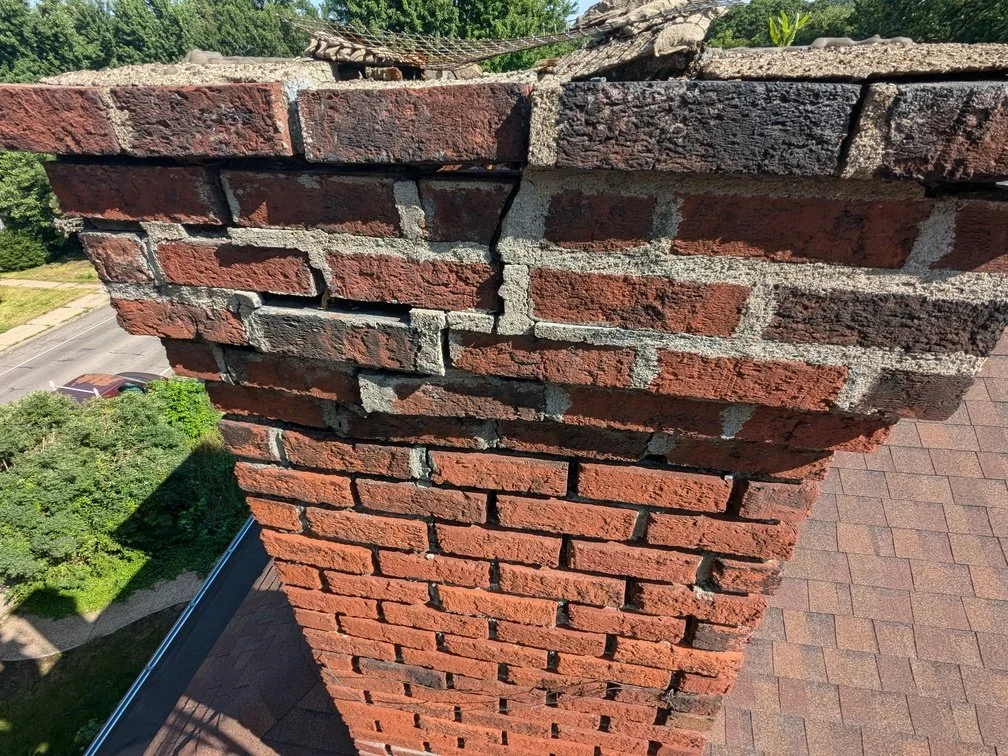
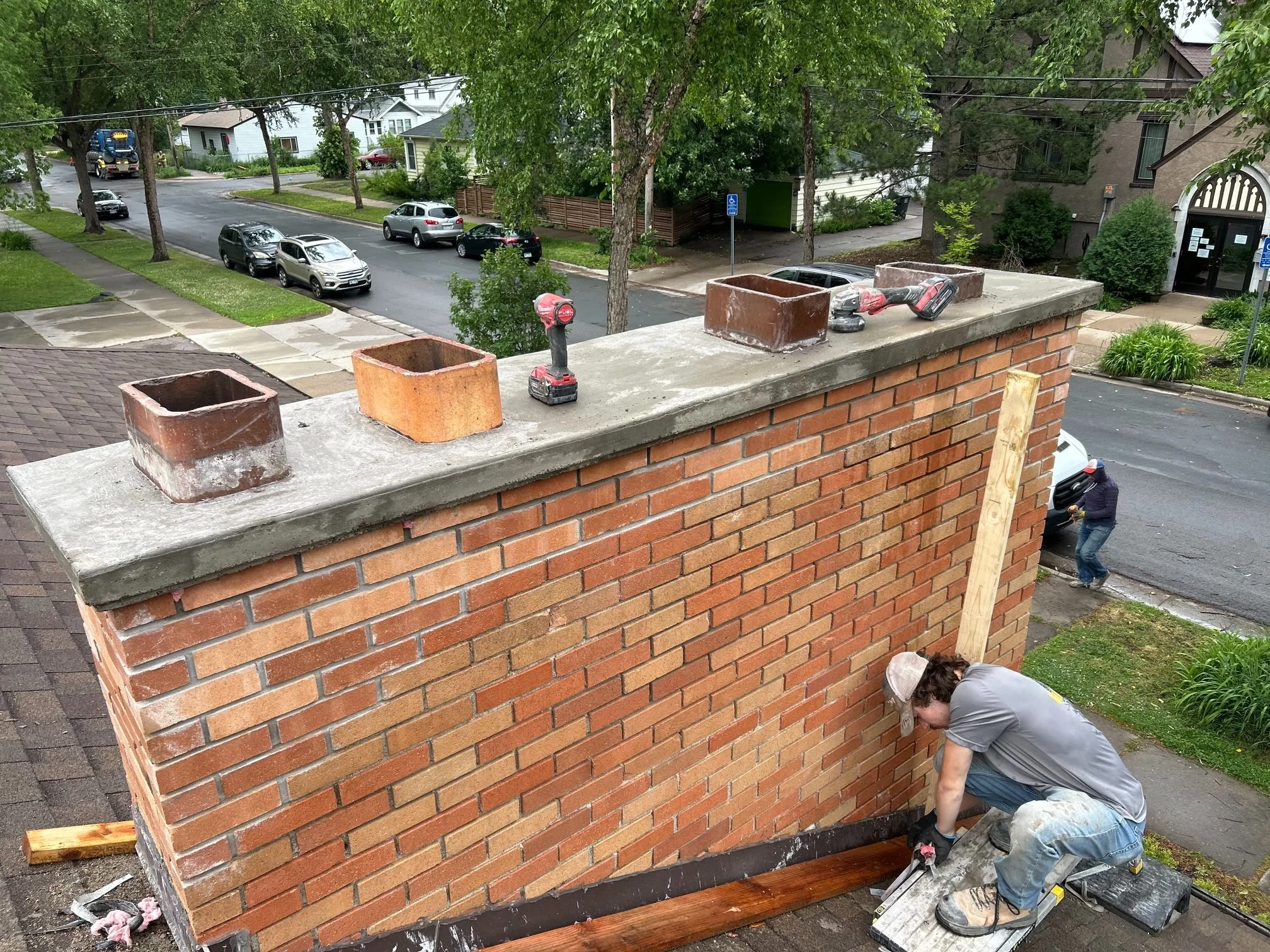
Storm damage to the brick of a stack ends in one of two jobs. If a limb or the wind has taken the crown and a few courses off the top, the permanent work is putting the top back: new courses on sound brick and a new crown. If the blow has cracked the stack lower down or pushed it out of line, the job is a rebuild, and it reaches as far down as the damage does. On a Minneapolis house with rooms under the roof, how far down that goes, and how the stack is reached from inside, are covered on our chimney rebuild page for Minneapolis.
Until then, protection on a damaged stack means taking down brick that could fall, covering the open top of the stack to keep as much rain out of the flue and the house as the damage allows, and leaving the rest for the permanent repair.
Where a roof is partly torn away, the flashing at the chimney can go with it. Then water gets in at the base of the stack even when the brick above looks whole, so the flashing is part of what gets protected first and part of what gets rebuilt later.
Water that has already reached ceilings or floors inside is a job for a water-restoration company. Flue liners, sweeping, and gas lines or appliances of any kind go to the trades that handle them.
Calling After a Storm
Anything active needs a phone call. To judge how fast it needs someone, Sam asks:
For active leaks, we work evenings and weekends, and urgent scheduling costs more, which we tell you before you agree. Exterior mortar work is scheduled for weather mild enough for it to cure.
What Customers Say
What appears below is our live Google feed rather than testimonials we picked out, so it shows whatever is genuinely on it.