

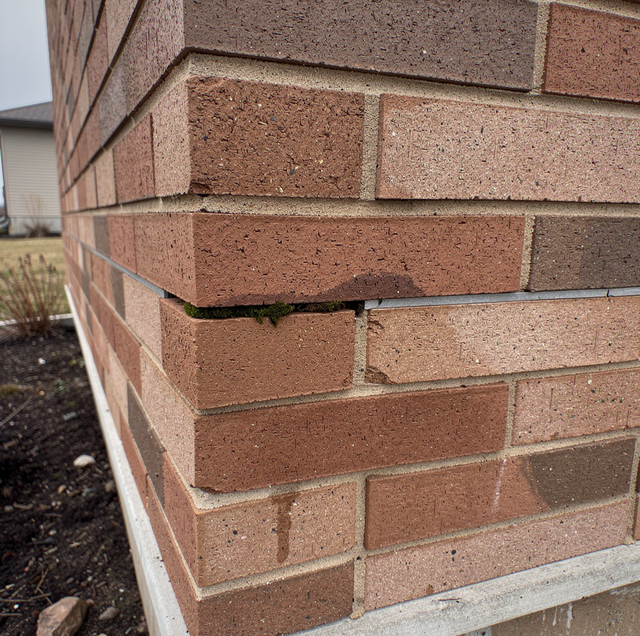
Brick looks like a single, solid material, but it has to do two jobs that pull against each other. It has to keep rain and snowmelt from soaking straight through, and it has to let go of whatever water gets in anyway, drying back out through the same face it took the water in through. A homeowner asking about waterproofing is thinking about the first job only: keep water off the brick. But a wall that sheds water and can no longer dry can end up worse off than a wall that was never sealed at all. Whether sealing helps or hurts depends on which of those two jobs a given product performs, and whether the wall's real problem is even one that sealing can solve.
How Brick Takes On and Gives Up Water
The clay a brick is fired from stays riddled with tiny open channels even after the kiln, and those channels are what let a wall pull in rainwater the moment it lands. Left alone, an unsealed brick wall draws that moisture in during wet weather and lets it back out as vapor once the surrounding air dries, through the same channels it came in by. That cycle, wetting and drying, is normal and built into the material. The wall stays sound as long as drying keeps pace with wetting.
Sealer chemistry splits into two families, and they treat that cycle in opposite ways once they are on the wall:
| Sealer type | What it does at the surface | What happens to moisture already inside |
|---|---|---|
| Breathable penetrating water repellent | Lines the channels from within with a water-repelling chemistry, so rain beads and rolls off | Water vapor can still pass through, so the wall keeps drying outward |
| Film-forming coating | Lays a continuous skin, glossy or matte, on top of the brick face | Blocks both liquid and vapor, so moisture already inside has nowhere to go |
That difference, whether vapor passes or not, is the one the rest of the decision turns on.
What a Breathable Repellent Does
A penetrating repellent, built on silane or siloxane chemistry, changes the brick from within its pores rather than covering them. The chemistry lines the channel walls so liquid water no longer clings to them, without ever plugging the opening itself. Rain hitting a treated wall gathers into beads and drips off the face instead of being drawn in, cutting the total load the brick has to carry. Because the opening stays clear, vapor already sitting inside the wall keeps finding its own way out through that same route, the one it relied on before treatment.
That combination, less water going in and the same drying path staying open, is why a breathable repellent is the product a mason reaches for when a wall's brick and mortar are otherwise sound, and the only goal is reducing how much water the face takes on. It reduces the wetting side of the cycle without touching the drying side. It is not a permanent fix; a repellent's water-shedding effect can wear off over years of weather and traffic, so it needs periodic reapplication rather than a single one-time treatment.
Why a Film-Forming Sealer Can Trap Water and Damage the Face
A film-forming product, an acrylic or a straight paint, works the opposite way: it lays a continuous layer across the surface rather than soaking in. That layer blocks liquid water from reaching the brick, which sounds like an upgrade over a repellent, but it blocks the wall's vapor path at the same time. Any water that is already in the brick, from a leak, from construction moisture, from a wet season before the coating went on, is now sealed in behind a skin it cannot pass through.
A wall's climate decides what that trapped water turns into. Where the temperature cycles above and below freezing through the year, water sealed behind a film has nowhere to go before the next freeze, and the pressure of that trapped, expanding water is what forces the brick's face to crack and pop loose. Where the wall never freezes, that trapped water does not spall the face, but it still has no way out, and the film has turned a wall that used to dry into one that holds its water. Either way, the film has closed the only exit a wet wall had, so coating a wall that already holds moisture leaves that moisture in place, and on a wall that freezes, it is the water that spalls the face.
Watch bare brick after a rain. A face that darkens evenly and dries back to its normal color is working; a patch that stays dark after the rest has dried, or a peeling coating, marks a spot a mason should trace.
When Sealing Is the Wrong Fix
Sealing only ever addresses how much water the brick face takes on. It does nothing for water entering the wall through an opening rather than through the pores of the brick itself, and treating a wall with an active leak as a sealing job wastes the work, because the water source never went away.
A wall with cracked, crumbling, or recessed mortar joints needs those joints repaired before any sealer goes on, because coating over a failing joint does nothing to seal the gap where water is entering. The same logic applies above the wall: a cracked or poorly draining chimney crown, or flashing that has failed at a roofline or window head, is a water source that sits above the brick and feeds it from the top down, and no amount of surface treatment on the wall below changes what is landing on it from up there. Seal the face of a wall whose real problem is a leaking crown or an open mortar joint, and the water keeps arriving through the same route it always did; you have only added a coating over an unresolved leak.
Timing matters as much as the source of the leak. A wall that is still wet, whether from a recent rain, a spring thaw, or moisture the brick picked up during construction or a recent repair, should not be sealed while that moisture is still working its way out. A repellent applied to damp brick has to compete with water already moving outward, and a film applied to damp brick traps that moisture in immediately rather than eventually. The wall needs a real dry stretch first, not just a dry-looking surface, before either type of product goes on.
How a Mason Decides
Deciding whether a wall needs sealing, and which kind, starts with figuring out why the question is being asked. A wall that is simply older and porous, with sound mortar and no active leak, is a clear case for a breathable repellent aimed at reducing wetting. A wall with visible mortar failure, a damaged crown, or interior staining that tracks to a specific spot needs that source found and repaired first; sealing comes after, if it is still needed at all, not instead of the repair.
Reading the wall correctly also means checking what is already on it. A previous owner or a well-meaning DIY coating job can leave a film-forming product on brick that would otherwise be a good candidate for a breathable repellent, and applying a new penetrating sealer over an existing film does not fix the problem underneath. Figuring out what is already there, the condition of the mortar and flashing, and whether the wall is dry all the way through are judgment calls that come before a product is chosen, which is why this decision is worth a professional look rather than a trip to a hardware store shelf.
Frequently Asked Questions
Mist a small, out-of-the-way patch. Water that soaks in and darkens the brick means no working repellent is there; water that beads on an unchanged-looking surface points to a penetrating repellent; a surface that looks glossy or plasticky when dry, or that peels, points to a film-forming coating, which needs identifying before any new product is chosen.
A penetrating repellent sits within the pores, so the treated face keeps its color and texture without a sheen, though some formulas can slightly darken brick. A film-forming coating leaves a visible layer, and as it ages, it can yellow, chalk, or peel in patches.
No. A repellent is made for above-grade brick that takes rain on its face; a wall below grade holds back soil water pressing against it from outside, and keeping that out takes a waterproofing membrane and drainage on the soil side, not a surface treatment.
No, because stone porosity varies by type. A dense stone such as granite already sheds nearly all the rain that hits it, takes on little water, and can go unsealed, while a softer, more porous stone such as limestone or sandstone can absorb water more like brick and may be a better candidate for a breathable treatment.
No. The joint between a window frame and the brick is sealed with a flexible sealant bead, a separate product from a masonry repellent. A repellent soaks into brick and mortar but does not bridge that gap, so a leak at the frame perimeter requires the sealant joint to be redone.
No. A breathable repellent can go on only the elevation that faces the prevailing wind-driven rain, and because it leaves the vapor path open, the treated and untreated walls still dry the same way; a film-forming coating on one wall does not have that property.
Commission a masonry waterproofing assessment — a check of the mortar, crown, flashing, and any existing coating, then a breathable repellent where the wall is sound and dry. Golden Stones Masonry serves St. Paul and the Twin Cities. Call (612) 509-0718.