
Chimney Cap vs. Chimney Crown: The Difference That Protects Your Home
Ask two homeowners to point at their "chimney cap," and you will often get two different fingers pointing at two different parts. One means the metal cage sitting over the flue opening; the other means the flat concrete slab across the whole top. Both parts exist; they do completely different jobs, and mixing them up is how people end up paying to fix one while the real problem sits untouched. If you have been told your chimney needs work up top, it helps to know exactly which piece anyone is talking about.
The Crown: The Concrete Slab That Sheds Water
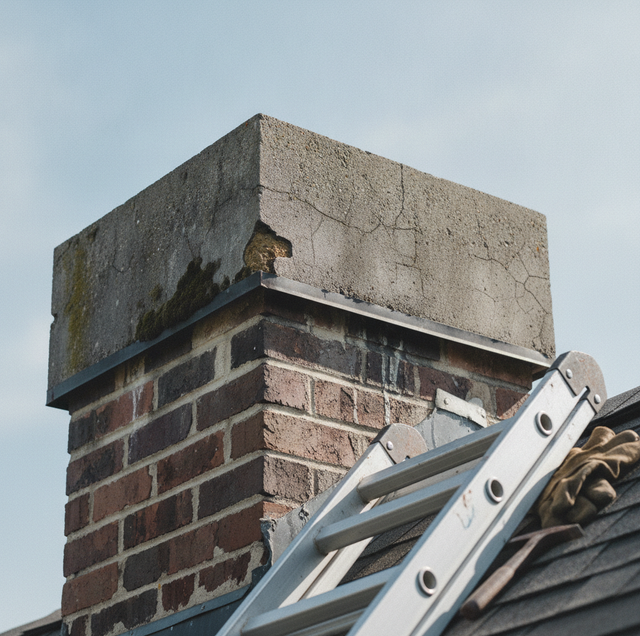
The crown is the masonry part. It is the sloped slab of concrete or mortar that covers the entire top of the chimney stack, spanning from the outer edge of the brick inward to the flue tiles. Its whole purpose is to move water. Rain and snowmelt run off that slab and, if it is built correctly, drip clear of the brickwork below rather than soaking into it.
A crown built to last has a few features you can actually look for. It slopes downward from the flue toward the outer edges, a pitch masons call the wash, so water never pools in the middle. It overhangs the brick face by roughly two to two-and-a-half inches, and the underside of that overhang carries a drip edge, a small groove or lip that forces the running water to let go and fall away from the wall rather than curling back against the brick. A properly formed crown is also thicker at its outer edge, on the order of two inches, so it resists cracking. Around each flue liner that pokes through, a flexible sealant joint lets the clay tile expand and contract without splitting the concrete.
When a crown is missing those details, or when it simply ages and cracks, water stops being shed and starts being absorbed. That is where the damage begins.
The Cap: The Metal Cover Over the Flue
The cap is a much smaller part, and it is metal, not masonry. It sits over the flue opening itself, the hole through which the smoke actually travels up. A typical cap is a stainless steel or copper hood on legs, with mesh screening on the sides and a lid on top. Galvanized versions exist and cost less, but they rust sooner in a climate that swings between wet and freezing.
The cap earns its keep in several ways at once. The lid keeps rain and snow from dropping straight down the flue. The mesh sides double as a spark arrestor, catching embers that ride up the draft so they do not land on the roof or nearby trees. That same mesh blocks squirrels, raccoons, and nesting birds from climbing in. And the hood shape helps stabilize the draft, reducing the gusty downdrafts that can push smoke back into the room on a windy day.
If your chimney serves more than one appliance, say a fireplace and a furnace, it may have two or more separate flues rising side by side. You can cover each opening with an individual single-flue cap, or fit one larger multi-flue cap that spans them all in a single unit. The multi-flue version is usually the tidier fix on a wide crown with several liners.
Why the Two Get Confused
The overlap comes from the fact that both parts sit at the very top and both keep water out, just at different scales. The crown protects the masonry mass, the whole brick stack. The cap protects the opening, the flue passage. Think of the crown as the roof over the chimney and the cap as the manhole cover over the shaft. One is broad and structural; the other is small and swappable.
Here is how they line up side by side.
| Feature | Chimney Crown | Chimney Cap |
|---|---|---|
| Material | Concrete or mortar slab | Metal (stainless, copper, or galvanized) |
| Covers | The entire top of the stack | Only the flue opening(s) |
| Main job | Sheds water off the brickwork | Blocks rain, animals, and embers at the flue |
| Extra function | Seals around the flue liners | Steadies the draft, arrests sparks |
| Fails by | Cracking, crumbling, no overhang | Rusting, blowing off, crushed mesh |
| Fix | Patch, seal, or full rebuild | Straight swap for a new one |
What Goes Wrong When One Is Failing
A cracked or deteriorating crown is the more serious of the two because it allows water to enter the body of the chimney. Once moisture gets behind the brick face, cold weather turns it into a wedge: water freezes, expands, and pops flakes off the brick surface, the failure masons call spalling. Repeated wet-cold-thaw cycling widens mortar joints and can loosen brick over several seasons. Warm months do their own damage, baking and shrinking a saturated crown so the next round of water finds even wider cracks. A failing crown rarely stays a crown problem; it becomes a whole-chimney problem.
A missing or failed cap causes trouble of a different kind. With the flue open to the sky, rain pours straight down onto the smoke shelf and damper, rusting the metal and staining the firebox. Animals treat the open flue as a chimney-shaped den and pack it with nesting material that blocks the draft, creating a genuine fire and carbon monoxide hazard. Without the mesh, embers can drift out onto the roof. And without the hood to direct airflow, a gusty day can send smoke curling back into the room. None of that soaks the masonry the way a bad crown does, but it puts the flue and everything connected to it at risk.
Telling Which One Needs Attention
You can learn a lot from the ground with a decent pair of binoculars on a clear day. On the crown, look for visible cracks radiating from the flue, crumbling or flaking concrete, green moss or dark staining that signals it is holding water, and whether it actually overhangs the brick with a lip or sits flush. A crown poured flush to the brick with no overhang was doomed from day one, because water runs straight down the wall. On the cap, look for rust streaks, a hood that is dented or knocked askew, mesh that is torn or crushed, or an opening with no cap on it at all.
What you cannot judge from the ground is how deep a crown crack runs or whether the sealant around the liners has let go. A hairline surface crack and a structural split can look identical from forty feet down, and only one of them can be brushed with a sealer. That is the line where a close-up inspection earns its cost.
Getting Both Parts Working Together
A sound chimney top is really a system of two cooperating parts, and neglecting either one lets water win. The good news is that the two rarely need the same kind of work. A cap is almost always a clean swap: unfasten the old one, set and secure a properly sized replacement, and the flue is protected the same afternoon again. A crown lives on a repair spectrum instead. Fine surface cracks can be cleaned out and sealed with a flexible crown coating that flexes with the concrete; broader damage may call for a mortar patch that restores the slope and overhang; a crown that is crumbling through its thickness usually has to be torn off and rebuilt to the right dimensions. Matching the right fix to the right part, and the right part to the right symptom, is what keeps a small job from turning into a rebuild.
Frequently Asked Questions
Then the parts have different names but the same jobs. A factory-built, or prefab, chimney is a metal flue running up through a framed "chase" instead of a brick mass, and in place of a poured masonry crown it has a metal "chase cover" (sometimes called a chase pan) capping the top of the chase to shed water, plus a cap over the flue pipe itself. The chase cover is the crown's counterpart, and it tends to rust through and leak where a masonry crown would instead crack, so on a prefab chimney you watch for rust streaks and water pooling on the pan rather than spalling brick. It still needs both the cover and a cap to be sealed.
Once a crack lets water past the surface, it travels into the mortar joints and behind the brick face. In cold weather, that trapped water freezes and expands roughly nine percent, prying flakes off the brick, which is spalling, and widening the joints a little more each thaw. In hot, dry stretches, the saturated masonry bakes and shrinks, opening fresh cracks for the next rain. Left alone across a few years, a single crown crack can loosen brick, rot out a liner, and even push moisture into the attic where the chimney passes through.
The crown seals the masonry, but it leaves the flue opening wide open by design, that is, the hole the smoke uses. With no cap, rain and snow fall straight onto the smoke shelf and damper, birds and squirrels nest in the shaft, and embers can float out onto the roof, which is why the cap's mesh doubles as a spark arrestor. There is a slower cost too: rain running down an uncapped flue keeps the liner and damper wet, and mixed with creosote, that moisture turns acidic and eats at metal and mortar from the inside, shortening the life of parts the crown never touches. A crown does none of these jobs.
Watch for the symptom, not just the part. Water stains creeping down the inside chimney wall, white salt-like efflorescence on the brick, or flaking brick faces point to a failing crown letting moisture into the masonry. A visible bird's nest, animal noises, a rust-streaked cap, or smoke that blows back into the room point to a cap that is missing, rusted, or has crushed mesh. When both a leak and an open flue appear together, an older chimney often needs attention in both areas.
It depends entirely on how far the damage has gone, which is exactly what is hard to judge from below. Thin surface cracks are often sealed with a brushable elastomeric crown coat that stays flexible through temperature swings. Cracks up to about a quarter inch can sometimes be filled and the surface re-sloped with a patching mortar. But a crown that is crumbling, missing its overhang, or cracked clean through has to be broken off and re-poured with a proper wash, a two-inch-plus edge, and a drip lip, which is not a patch job. Sealing over a structurally failed crown just hides the leak.
For a climate that cycles hard between wet and freezing, yes, and it comes down to how they age. Galvanized steel is the cheapest and rusts first, often streaking the brick with orange within a few years. Stainless steel resists that corrosion and is the common mid-tier choice. Copper costs the most, never rusts, and weathers to a patina many homeowners want on a visible chimney. All three perform the same mechanical job; the difference lies in how many freeze-thaw seasons they survive before the mesh and legs begin to fail.
Have a pro tell you whether it is your cap, your crown, or both — book a chimney-top inspection. Golden Stones Masonry serves St. Paul and the Twin Cities. Call (612) 509-0718.
