

Signs Your Chimney Needs to Be Rebuilt, Not Just Repaired
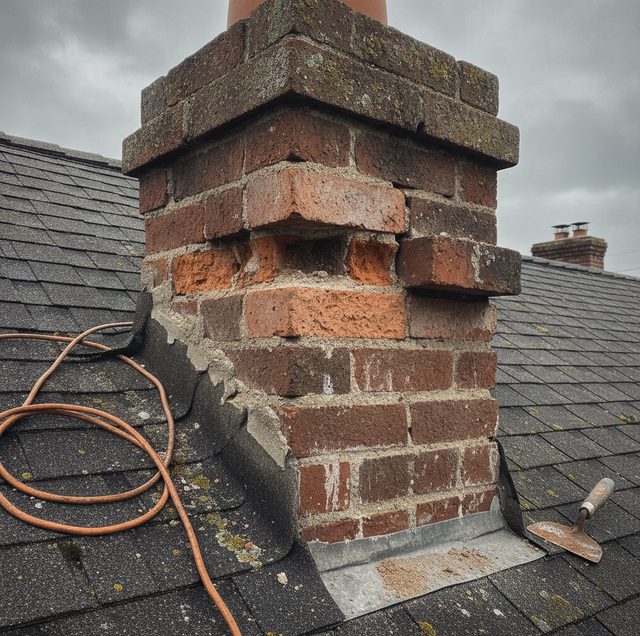
You find a chunk of brick in the flower bed below the chimney, look up, and notice the stack does not sit quite as straight as it used to, with crumbling mortar and a cracked top. The question is whether a mason can patch it or whether the whole thing needs to come down and go back up. That difference is significant, and getting it right matters because patching a chimney that needs rebuilding is money spent twice.
Most chimney problems are repairable. A handful of them are not, and those are the ones that signal a rebuild. Knowing which is which starts with what is actually failing.
Repair Fixes Damage; Rebuild Fixes Structure
The line between the two comes down to whether the chimney's structure is sound or compromised. A repair addresses localized, surface, or single-component damage on a chimney that is still structurally solid: a cracked crown, some spalling brick, a section of bad mortar, or damaged flashing. A rebuild is for a chimney whose masonry structure itself has failed or deteriorated so widely that patching would not hold. So the real question is not how bad it looks, but how deep the damage goes and how much of the chimney it affects.
The Signs That Point to a Rebuild
A few specific conditions move a chimney from the repair column into the rebuild column.
A leaning or separating chimney is the clearest one. If the stack is tilting, pulling away from the house, or no longer plumb, the structure has shifted, and no amount of surface repair will straighten a chimney that is leaning. This one usually means rebuild.
Widespread spalling is another. Spalling is when brick faces flake, crumble, or pop off as moisture inside them freezes and expands. A few spalled bricks can be replaced, but when spalling covers large areas and has eaten into the structure, the brick has lost its integrity across too much of the chimney to be patched.
Mortar that is gone, not just cracked. Mortar naturally needs renewing over decades, and recessed or cracked joints can often be repaired by tuckpointing. But when the mortar has deteriorated so far that it powders or crumbles when probed, recedes well behind the brick faces across the stack, and the bricks have started to shift or loosen, the chimney has lost the bond that holds it together.
A failed crown or damaged flue that has let water into the structure for years. A cracked crown or damaged flue liner can be repaired on its own, but when they have allowed water deep into the masonry season after season, the accumulated internal damage can push the whole structure past repair.
| Lean toward repair when… | Lean toward rebuild when… |
|---|---|
| A few spalled or cracked bricks | Widespread spalling into the structure |
| Mortar cracked or recessed (tuckpoint) | Mortar powdering, bricks shifting or loose |
| Cracked crown or damaged flashing alone | The stack is leaning or pulling away |
| Single-component, localized damage | Deep water damage throughout the masonry |
| One repair holds | Repeated repairs that keep failing |
Why Winters Are So Hard on Masonry
In a cold climate, one force drives most of this: freeze-thaw cycling. Brick and mortar are porous, so they absorb water. When the temperature drops, that water freezes and expands inside the masonry; when it thaws, it contracts. Repeated over many winters, this cycle cracks mortar, spalls brick faces, and loosens joints. It is the single biggest reason masonry chimneys here deteriorate, and it is why small problems, such as an unsealed crown, a bit of failing mortar, that let water in, accelerate into structural damage. Catching moisture problems early is what keeps a repairable chimney from becoming a rebuild, and it is why a chimney that has gone years with water getting in is often the one that has crossed the line.
Frequently Asked Questions
Beyond looking, a mason probes the joints, because surface cracks can hide sound mortar, and a clean face can hide powder behind it. Running a key or the tip of a flat tool along a joint tells the story fast: solid mortar resists, while failed mortar rakes out as sand and crumbles with light pressure. The depth of that loss is the deciding number. If the joint is sound behind a shallow surface crack, tuckpointing to about three-quarters of an inch deep restores it, but if the mortar has receded past the first inch or the tool sinks in across the whole stack, the bond is gone too far to repoint, and the section moves into the rebuild column. Loose or wiggling bricks found during that probe confirm it.
A lean is not judged by eye alone, since a chimney can look crooked from the ground and be fine, or look straight and be pulling away up top. A mason hangs a plumb line, a weighted string, down the face from the top and measures the gap to the brick at the bottom, or holds a level against the stack on two sides. Any consistent lean off vertical is a warning, and a stack drifting away from true by more than roughly an inch over its height, or a widening gap where it meets the house wall, means the footing or the masonry has shifted, and a rebuild is due. The direction matters too: a chimney tilting away from the house is often a failing footing below the frost line, while a bow in the stack itself points to internal deterioration.
Spalling starts at the brick's hard outer face, the fire-skin, which is the dense weatherproof layer formed when the brick was kiln-fired. Once water gets past a hairline crack or a bad joint and freezes, it pops that skin off, and the soft, porous core underneath then soaks up water far faster and spalls in accelerating rounds each winter. A handful of individually spalled bricks get cut out and replaced. The tipping point is coverage and depth: when spalling runs across a large share of a wall face, or the brick has crumbled back past its skin into the body so the wall is losing thickness, replacing bricks one at a time no longer holds, and the section needs rebuilding. Bricks laid with the softer core facing out, common in older work, spall in whole patches rather than singles.
Often, only the damaged portion needs rebuilding. If the deterioration is concentrated above the roofline while the lower structure is sound, a mason may rebuild just that section rather than the entire chimney. The extent of the rebuild depends on how far down the damage reaches, which the inspection determines. It is not always all-or-nothing.
Tuckpointing is a repair that removes deteriorated mortar from the joints and replaces it with fresh mortar, restoring the bond without disturbing the bricks. A rebuild takes the affected masonry apart and reconstructs it. Tuckpointing works when the bricks are sound, and only the mortar has failed; a rebuild is for when the bricks and structure themselves are compromised.
A properly rebuilt chimney, using sound materials and good workmanship and finished with a quality crown and water protection, should last for decades. The key to that lifespan is keeping water out, since moisture and freeze-thaw are what break masonry down. Good maintenance, a sealed crown, sound flashing, and prompt repairs are what carry a rebuilt chimney to its full life.
Judge the Structure, Not the Surface
Whether a chimney needs repair or a rebuild depends on how serious and how widespread the damage is. Localized cracks, a few spalled bricks, or failed mortar on a sound structure are repairs. A leaning stack, widespread spalling, crumbling mortar with shifting bricks, or years of water damage through the masonry are the signs that the structure itself has failed, and that is a rebuild. In a climate where freeze-thaw cycles affect masonry every winter, catching moisture early is what keeps a chimney on the repairable side of that line. An annual inspection of the crown, mortar joints, and flashing is the cheapest insurance a masonry chimney can have.
If you are not sure whether your chimney needs a patch or a rebuild, an honest masonry assessment will tell you. Golden Stones Masonry serves St. Paul and the Twin Cities. Call (612) 509-0718 for an inspection.